The Unseen Hazard: Tackling Wrong Fuel Incidents in Merseyside

Fuel Doctor 247 mobile callout van connected to a blue car at a Merseyside holiday park

You have just realised the nozzle in your hand was the wrong one. Maybe you are still on the forecourt with the pump running, maybe you are half a mile down the A580 and the car has started to hesitate. Either way, the single most useful thing you can do in the next sixty seconds is leave the key out of the ignition. Wrong fuel incidents in Merseyside are one of the most common call-outs we attend, and the difference between a straightforward drain and a four figure repair bill almost always comes down to what the driver did in the first few minutes.

Why turning the key makes it worse

While the wrong fuel is sitting in the tank and nowhere else, the job is a drain and a flush. The moment the ignition goes on, that changes.

On most modern diesels the ignition alone primes the low pressure lift pump, which starts pulling fuel from the tank towards the filter before the engine has even turned over. Crank it and the contaminated mix reaches the high pressure pump. That pump runs at very fine tolerances and relies on diesel itself for lubrication, because diesel is oily and petrol is not. Petrol acts as a solvent. It thins the lubricating film, metal starts contacting metal, and the pump begins shedding fine debris into the fuel.

That debris is the real problem. Once it is circulating, it travels downstream into the rail, the lines and the injectors, and it cannot be flushed out. Cases that end with a full fuel system replacement usually started as a tank of petrol in a diesel that someone drove home on.

Diesel in a petrol car is less severe but still needs draining. Diesel does not ignite properly against a spark, it fouls the plugs, and running the engine on it can overheat and wreck the catalytic converter.

What we see on Merseyside call-outs

Roughly nine in ten of the misfuel jobs we attend are petrol in a diesel, which matches the picture nationally. The reason is mechanical rather than careless. An unleaded nozzle slips easily into a diesel filler neck, while a diesel nozzle is too wide to fit most modern petrol cars, so the mistake only really goes one way. The RAC has estimated around 150,000 UK drivers misfuel every year, which works out at hundreds a day.

Two patterns come up again and again on our jobs across Liverpool, the Wirral and St Helens:

  • Most drivers spot it at the pump and never start the engine. That is exactly the situation we want, and it is why those cars are back on the road within the hour.
  • The ones that go wrong are usually small top-ups. Ten or fifteen pounds of the wrong fuel does not stall the car immediately, so the driver sets off, gets a few miles up the M57 or M62, and only stops once the power drops away.

Location matters here more than people expect. If your car dies in the Kingsway or Queensway tunnel, no one is draining anything where you are standing. Tunnel patrols will move the vehicle out to the far side first, and we work on it there. The same goes for a live lane on the motorway. National Highways advice is to get off the carriageway if the car will still move and to stay in the vehicle with your seatbelt on and call 999 if you cannot exit safely.

Fantastic service much cheaper than others on google came within 25 minutes of call absolutely 100 percent would reccomend > — Jaye Evans, Google review]

If you have already started the engine or driven off

Stop as soon as you can do it safely, and do not restart the engine to move a bit further along. Every additional minute of running pushes contamination deeper into the system.

The signs that the wrong fuel has reached the engine are fairly consistent:

  • Loss of power under acceleration, often coming and going at first
  • A harsh knocking or rattling from the engine, louder than normal diesel clatter
  • Heavy smoke from the exhaust, usually white or grey
  • Misfiring, hesitation, or the engine cutting out and refusing to restart
  • Engine management light coming on, sometimes with limp mode

Once you have stopped, hazards on, keep everyone out of the vehicle and behind a barrier if you are on a fast road. Then call. Our advice on what to do when there is petrol in a diesel car covers the sequence in more detail, and the wrong fuel in Liverpool guide is worth a read if you are inside the city.

AdBlue in the fuel tank is a separate problem

This one catches out drivers of newer diesels, particularly vans, and it does not behave like petrol at all. AdBlue is a urea and water solution meant for its own separate filler, and it is not a fuel.

Put it in the diesel tank and it does not simply mix and burn off. Urea crystallises as it dries and it is corrosive to the metals and seals in a fuel system. Adding more diesel on top does not dilute the problem away, it just spreads it further through the tank and lines. Anyone who tells you to drive it off is giving you expensive advice.

The tank needs draining and thoroughly cleaning, not just emptying, and the sooner it happens the less chance the crystals have to form. We cover the specifics on our AdBlue in the fuel tank page.

What happens when you call for a mobile fuel drain

Nobody needs a tow truck or a garage booking for this. The work is done where the car is standing, whether that is a forecourt, a driveway, a car park or the side of the road.

Here is the realistic sequence. The phone is answered 24 hours a day. A technician is usually with you in 30 to 45 minutes anywhere in Merseyside, depending on traffic and where you are. The drain itself takes 20 to 40 minutes: the tank is emptied, the system is flushed through, the contaminated fuel goes into sealed containers for proper disposal, and fresh correct fuel goes in. We start the engine, check it runs cleanly, and you drive away the same hour in most cases.

The contaminated fuel leaves with us. It is a hazardous waste and it is not something to be tipped down a drain or left on the forecourt.

What we cannot tell you over the phone

We are not going to promise your engine is fine, because that depends on things we can only assess when we get to you.

If the engine was never started, the outcome is almost always good and the drain is the end of it. If you drove several miles on a heavy petrol mix in a common rail diesel, there is a real chance the high pressure pump has already suffered, and a drain will not undo that. We will tell you straight if we think that is what has happened rather than take your money and leave you to find out later.

One more thing worth knowing. Misfuel damage is usually excluded from manufacturer warranties, and some makers advise renewing filters and seals even when the engine was never run. If your car is still under warranty, a call to the dealer before you drive it anywhere is time well spent.

FAQ

Q 1. Can I just fill the tank up with the correct fuel?

No, and this is the most expensive myth we deal with. Topping up dilutes the mix but the wrong fuel is still in there, and driving is what does the damage rather than the concentration. The one grey area is a very small splash of petrol in a large diesel tank on an older, non common rail engine. Even then, ask before you turn the key.

Q 2. How much does a wrong fuel drain cost in Merseyside?

It varies with the vehicle, how much wrong fuel went in and where you are, so we quote on the call rather than publish a flat figure. What we can say plainly is that a drain costs a fraction of a high pressure fuel pump and injector replacement, which is what you are risking by driving on. Ask for the price when you ring and you will have it before we set off.

Q 3. Will my insurance or breakdown cover pay for it?

Some breakdown policies include misfuelling assistance and some charge for it as an add-on, so check your documents. Standard car insurance generally treats misfuelling as driver error and will not cover the resulting engine damage. Most people find it quicker to call a mobile drain directly than to wait in a general recovery queue.

Q 4. Is it safe to drive to a nearby garage instead?

Driving is the exact thing that turns a cheap job into an expensive one. A garage a mile away is still a mile of contaminated fuel being pumped through your injectors. Since the drain happens at the roadside anyway, there is no reason to move the car at all.

Q 5. How soon can I drive after the drain?

Straight away in the great majority of cases. Once the system is flushed, fresh fuel is in and the engine has been run and checked, the car goes back to normal service. If the engine was run hard on the wrong fuel beforehand, we may recommend a garage inspection before you take it on a long run.

One call and we come to you

If you are standing next to the car right now, call Fuel Doctor 247 on 07826 035386. The line is answered 24 hours a day, a technician is usually with you inside 30 to 45 minutes anywhere across Liverpool, the Wirral, Sefton, Knowsley and St Helens, and the drain takes 20 to 40 minutes at the roadside. No tow, no garage booking, no waiting days for a slot. You will get the price before we leave. Check where we work in the areas we cover, or find our wrong fuel recovery service on Google Maps.

About the author

Raees Ahmad is a mobile EV charging and wrong fuel recovery technician at Fuel-doctor247, helping drivers across Greater Manchester, Lancashire and Yorkshire with 10+ years of roadside experience. He and the team attend EV charging, roadside and forecourt call-outs 24/7 and have helped 1,000+ UK drivers get moving again.

How Can You Avoid Wasting Fuel with Smart Driving Tips

Fuel Drain Greater Manchester

You fill up, you drive normally, and somehow the gauge is dropping faster than it should. With pump prices what they are across Greater Manchester, that stings. The good news is that most wasted fuel comes down to a short list of habits and small faults, and nearly all of them are fixable this week without spending anything.

We drain and recover fuel from cars for a living, so we spend our days around tanks, pumps and fuel systems. Here is what actually wastes fuel, how can you avoid wasting fuel day to day, and the one pump mistake that can cost you a full tank in thirty seconds.

What’s Most Likely to Waste Fuel?

If you sat the UK theory test, you may remember this one. The DVSA’s answer to “how can you avoid wasting fuel” is regular servicing, and they are right. A tired engine with a clogged air filter, old spark plugs or degraded oil has to work harder for the same speed, and every extra bit of work is paid for at the pump.

Behind servicing, the biggest offenders we see are:

  • Harsh acceleration and late braking, which can add 15 to 20 percent to consumption in town driving
  • Idling at school gates, level crossings and drive-thrus
  • Underinflated tyres, which increase rolling resistance
  • Roof racks and boxes left on when empty, ruining the car’s aerodynamics
  • Carrying dead weight in the boot for weeks on end

None of these feels dramatic on its own. Stacked together across a month of driving around Manchester traffic, they are the difference between filling up weekly and filling up every ten days.

Driving Tips to Save Fuel That Cost Nothing

The cheapest fuel is the fuel you never burn. These driving tips to save fuel need no tools and no garage visit.

Read the road further ahead. If the lights are red two hundred metres away, lift off early and let the car slow in gear. Modern engines cut fuel delivery completely on the overrun, so coasting toward a red light in gear uses no fuel at all, while braking hard at the last second throws away the energy you already paid for.

Keep the revs down. Shift up early, stay in the highest gear that pulls comfortably, and hold a steady speed rather than surging and lifting. Cruise control on the motorway helps with this.

Switch off rather than idle. The Highway Code tells drivers not to leave the engine running unnecessarily while stationary, and an idling engine does zero miles per gallon. If you will be stopped for more than a minute or so, turn the key.

Use air conditioning with a bit of thought. Around town, open windows are cheaper. At motorway speed, open windows create enough drag that the air con becomes the better option.

Simple Maintenance That Protects Your MPG

Check your tyre pressures once a month, cold, against the sticker in the door shut. A tyre that is 10 psi down drags noticeably, and most drivers cannot feel it from the seat.

Stick to the service schedule. A fresh air filter, the correct grade of oil and healthy plugs or glow plugs let the engine breathe and burn properly. We regularly work on cars where a long-overdue service would have paid for itself in fuel alone.

Empty the boot and take the roof box off between trips. An extra 50 kg of clutter and an empty roof bar setup both cost you money on every single journey, whether you notice or not.

How to Avoid Fuel Spillage at the Pump

Wasted fuel is not only burned fuel. We see plenty of it lost on the forecourt floor.

To avoid fuel spillage, stop at the first click of the nozzle. Forcing extra fuel in after the automatic cutoff fills the filler neck and the vapour space the tank needs for expansion. On a warm day, that overfilled fuel expands, finds the breather, and ends up down your paintwork and on the ground. It also risks flooding the evaporative emissions system, which can mean a garage bill far bigger than the splash of petrol you squeezed in.

Set the car on level ground where you can, keep the nozzle fully seated in the filler neck until you have finished, and give it a second in the neck before withdrawing it. Rushing this last step is where most small spills happen.

Great service and reasonable price,told me technician will come between 45 – 60 minutes,technician came before 45 minutes.Will definitely recommend. ” Judith Munthali “

Misfuelling: The Quickest Way to Waste a Full Tank

Rushing at the pump causes something worse than spillage. Grab the wrong nozzle and you can waste 60 litres and risk the engine in one go. We attend these call-outs every week across Greater Manchester, and one pattern comes up again and again: on most petrol-in-diesel jobs, the driver noticed at the pump and never turned the key. That single decision keeps the wrong fuel sitting in the tank, and the fix stays simple.

The reason is what petrol does inside a diesel system. Diesel lubricates the high-pressure fuel pump as it passes through. Petrol acts as a solvent, stripping that lubricating film so the pump’s finely machined parts run metal on metal. Start the engine and you also pull the contaminated mix through the filter, the pump and the injectors, spreading the problem through every expensive component in the fuel system. The same logic applies to diesel in a petrol car, and AdBlue poured into a diesel tank is worse still, because it crystallises in the lines and corrodes metal components if it is not removed quickly. See our guide to AdBlue in a fuel tank for that one.

If it happens to you, do not start the engine, even to move off the pump. Tell the forecourt staff, push the car aside with their help, and call a mobile petrol in diesel fuel drain. Whether any damage has been done depends on your car, the mix in the tank and how far it was driven, so we will always be straight with you about that on the phone.

So pleased we could help quickly! Misfuelling can feel like a nightmare, but that’s why our mobile fuel drain team in Greater Manchester is on call around the clock. Getting it sorted within an hour of your enquiry is exactly the standard we hold ourselves to. Thanks for trusting Fuel Doctor 247 — we really appreciate it! ” John Fitton “

Quick Answers on Wasting Fuel

What’s most likely to waste fuel?

Day to day, aggressive driving wastes the most: hard acceleration, high revs and late braking. Over the longer term, a poorly maintained engine quietly costs you more, which is why the theory test answer is regular servicing. Fix the driving style first, since it is free, then keep the car serviced to hold onto the gains.

How can u avoid wasting fuel on short journeys?

Combine errands into one trip where you can. A cold engine runs a richer fuel mixture and the catalytic converter is not yet at working temperature, so the first mile or two is always the thirstiest. Three separate cold starts in a day use far more fuel than one longer loop covering the same jobs.

Does leaving the engine idling really waste much fuel?

Yes. A typical car burns roughly half a litre to a litre per hour at idle while covering no distance at all. Ten minutes of idling a day adds up to litres of fuel a month for nothing. If you expect to be stationary for more than a minute, switching off and restarting uses less.

What should I do if I put the wrong fuel in my car?

Do not turn the key. Leave the car where it is, let the forecourt staff know, and call a mobile fuel drain service. If the engine has not run, the wrong fuel is still sitting in the tank and can usually be drained and flushed at the pump in 20 to 40 minutes, with no tow and no garage booking.

Wrong Fuel In? Call Us Before You Start the Engine

If you are reading this at a pump with the wrong fuel in your tank, the next step is one phone call. Misfuel Doctor answers 24/7, a technician typically reaches you in 30 to 45 minutes anywhere in our Greater Manchester coverage area, and a standard drain and flush takes 20 to 40 minutes at the roadside. Most drivers are back behind the wheel within the hour. Call Misfuel Doctor now on 07826 035386.

About the author

Raees Ahmad is a mobile EV charging and wrong fuel recovery technician at Fuel-doctor247, helping drivers across Greater Manchester, Lancashire and Yorkshire] with 10+ years of roadside experience. He and the team attend EV charging, roadside and forecourt call-outs 24/7 and have got 1,000+ UK drivers moving again.

When Will You Feel the Effects of Engine Braking in a Vehicle

Drain Doctor Manchester service van assisting a stranded vehicle at the roadside

You have either just met this question in theory test revision, or you have felt your car slow by itself when you lifted off the accelerator and wondered what was doing it. The short answer covers both. You feel the effects of engine braking whenever you release the accelerator with the car in gear, and you feel them most strongly when you change to a lower gear, which is the answer the theory test is looking for. We work on engines at the roadside every day, so here is what is actually happening under the bonnet and how to use it properly.

The theory test answer and what it means on the road

The official question asks when you will feel the effects of engine braking, and the correct answer is when you change to a lower gear. The reasoning is simple once you see it. Engine braking exists any time your foot is off the accelerator in gear, but its strength depends on engine speed. Drop a gear and the engine spins faster for the same road speed, so the slowing effect multiplies.

Try it on a quiet road. Lift off in fifth at 40mph and the car eases off gently. Change down to third at the same speed and you feel a firm, immediate check, as if the car has leaned back against a hand. That difference is the whole exam point.

The reverse matters just as much for the test and for real driving. Press the clutch or knock the car into neutral and engine braking disappears entirely. That is coasting, and Rule 122 of the Highway Code warns against it precisely because it takes away this layer of control.

What actually slows the car when you lift off

Engine braking is the engine resisting being turned by the wheels instead of driving them. Lift off the accelerator and the throttle closes, so a petrol engine is trying to suck air past a shut plate on every intake stroke. That pumping effort, plus the work of compressing air in the cylinders, drags engine speed down, and because the car is still in gear, it drags road speed down with it.

Modern engines add a bonus most drivers never notice. On overrun, the engine management cuts fuel to the injectors completely, since the wheels are keeping the engine turning for free. Engine braking down a long hill uses no fuel at all, which is one reason instructors push it.

Diesels behave differently, and drivers switching between the two feel it straight away. A diesel has no throttle plate strangling its intake, so its natural engine braking is weaker than a petrol’s. That is exactly why lorries carry separate exhaust brakes, and why a diesel driver descending a steep hill should pick a lower gear a little earlier than they would in a petrol car.

Using engine braking on hills, and why your brakes will thank you

Around Greater Manchester you do not have to drive far to find descents that punish brake-only driving. The drops off Snake Pass and the Woodhead route into the valleys are long enough to overheat brakes that are used continuously, and we have smelt the results in laybys at the bottom often enough to know plenty of drivers still ride the pedal the whole way down.

The problem is brake fade. Friction brakes turn speed into heat, and on a long descent the discs and pads can climb past the temperature where they grip properly, right when you need them most. Engine braking produces no such heat build-up, so the safe pattern is to select a lower gear at the top of the hill and let the engine hold your speed, saving the brake pedal for adjustments.

The old rule of thumb still works: whatever gear got you up the hill will hold you going down it. On snow and ice the same technique earns its keep twice over, because slowing through the engine is gentler and less likely to lock a wheel than braking.

Great service and reasonable price,told me technician will come between 45 – 60 minutes,technician came before 45 minutes.Will definitely recommend. ” Judith Munthali “

When engine braking suddenly feels wrong

Engine braking is also a free diagnostic, because you feel it every single journey without thinking about it. When lifting off suddenly produces surging, jerking, or barely any slowing at all in a car that used to check firmly, something in the engine or fuel system has changed.

One cause we deal with constantly: the wrong fuel. On our call-outs across Greater Manchester, drivers who filled up with the wrong pump and kept going often describe the car feeling strange on lift-off before the more famous symptoms arrive, the hesitation and rough running showing up as the contaminated mix works through the system. If your engine started behaving oddly within minutes of a fuel stop, stop driving and check your receipt, because a petrol and diesel mix damages the fuel pump more with every mile. Our petrol in diesel fuel drain page explains what happens next, and we attend forecourts and roadsides throughout our Greater Manchester coverage area.

So pleased we could help quickly! Misfuelling can feel like a nightmare, but that’s why our mobile fuel drain team in Greater Manchester is on call around the clock. Getting it sorted within an hour of your enquiry is exactly the standard we hold ourselves to. Thanks for trusting Fuel Doctor 247 — we really appreciate it! ” John Fitton “

FAQ

Is engine braking bad for your car?

No. Engine braking is a normal, designed-for way of slowing, and on overrun most modern engines cut fuel entirely, so it costs nothing to use. The one thing to avoid is forcing a gear change so aggressive that the engine screams toward the red line, which strains the clutch and drivetrain. Change down one gear at a time, let the revs settle, and the technique only ever saves wear on your brakes.

Does engine braking use more fuel?

It uses less, and usually none. When you lift off the accelerator in gear, the engine management on modern cars stops injecting fuel because the wheels are keeping the engine turning. Coasting in neutral actually burns more, since the engine must idle on injected fuel to keep itself running. Engine braking down a hill in gear is the most economical way down as well as the safest.

Why does my diesel have weaker engine braking than my old petrol?

Petrol engines create strong engine braking because a closed throttle forces them to work hard just pulling air in. Diesels have no throttle plate, so that pumping resistance mostly is not there, leaving only compression and friction to slow things. The difference is normal, not a fault. Compensate by selecting a lower gear slightly earlier on descents than you would in a petrol car.

Should I use engine braking or the footbrake to slow down?

Use both for what each does best. Brakes are for accurate, deliberate slowing and stopping, and brake lights warn drivers behind you, which engine braking does not. Engine braking earns its place on long descents, in slippery conditions, and for gentle speed control in traffic. The combination that examiners want to see is early lift-off and sensible gears, with the footbrake doing the precise work.

Engine trouble that started at the pump? Call us

If your car began running rough, surging, or losing power right after refuelling anywhere in Greater Manchester, ring Misfuel Doctor on 07826 035386 before driving further. The line is answered 24/7, we will tell you on the phone whether it sounds like a misfuel, and if it does, a technician typically reaches you in 30 to 45 minutes. The drain and flush takes 20 to 40 minutes, and most drivers are moving again within the hour. Recent jobs are reviewed on our Google reviews for roadside fuel recovery.

About the author

Raees Ahmad is a mobile EV charging and wrong fuel recovery technician at Fuel-doctor247, helping drivers across Greater Manchester, Lancashire and Yorkshire] with 10+ years of roadside experience. He and the team attend EV charging, roadside and forecourt call-outs 24/7 and have got 1,000+ UK drivers moving again.

What Is Mobile EV Charging & How It Works

Mobile EV Charging van powering an electric car on a UK street during roadside service

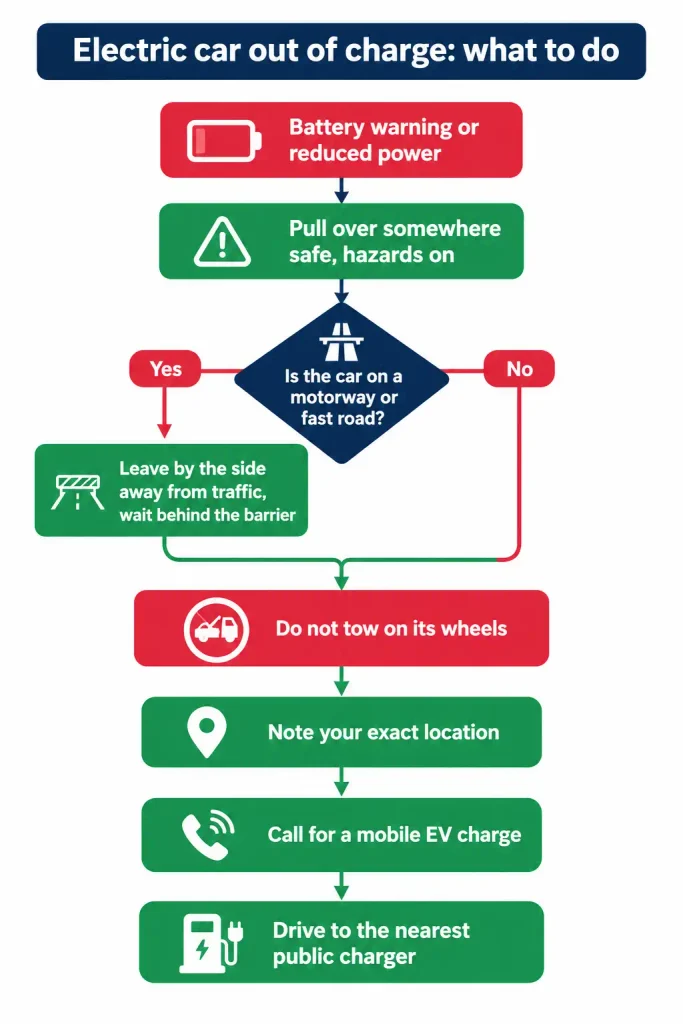
Your electric car has dropped to zero, you are stopped somewhere you never planned to be, and the nearest charge point is too far to walk. You cannot carry electricity in a can the way you would petrol, and on most EVs you cannot simply be towed to a charger either.

This is the gap mobile EV charging fills. We bring a portable power source to wherever the car is sitting and put enough charge in to get you moving again, usually to the nearest charge point or home. Here is what the service actually is, how it works at the roadside, and what to expect if you ever need to call one out.

What mobile EV charging actually is

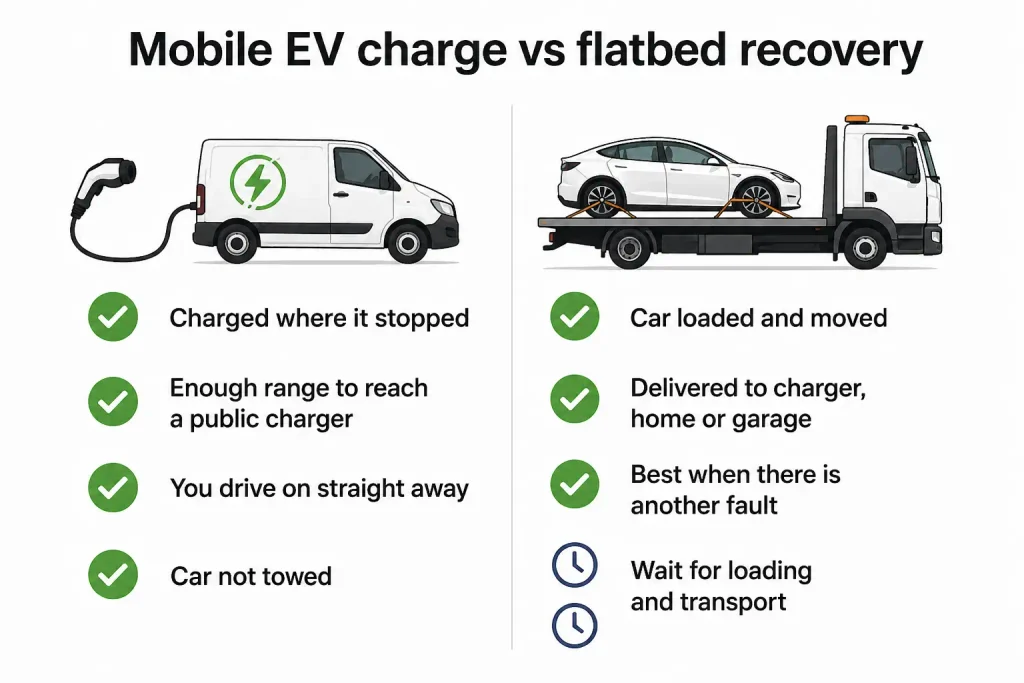
Mobile EV charging is a roadside service that brings the charger to your car instead of taking your car to a charger. A technician arrives with a portable charging unit, connects it to your charge port, and delivers a top-up of power on the spot.

The key word is top-up. This is not a full charge. The aim is to put in enough range to reach the nearest working charge point or get you home, not to fill the battery from empty, which would take far too long at the roadside. Breakdown providers and specialists across the UK now run this kind of service precisely because a flat EV is awkward to move.

So the moment you run flat, you are not automatically facing a recovery truck and a long wait. In a lot of cases, a charge at the roadside is all it takes.

How mobile EV charging works, step by step

The process is simpler than most people expect, and it usually happens in one visit.

  • We come to the car wherever it has stopped, whether that is a driveway, a car park or the side of a road.
  • The technician connects a portable charger to your vehicle’s charge port using the right connector for your car.
  • The unit feeds power into the traction battery for a set period, enough to give you usable range.
  • Once you have enough to move, you drive to the nearest charge point and top up properly there.

Most roadside units run on an AC supply through a standard Type 2 connector, which the vast majority of EVs on UK roads can accept. How much range you get back depends on the unit and how long it stays connected, but the goal is always the same: enough to reach a proper charger safely. Tell us your make and model when you call, and we arrive with the connector your car needs.

Why a flat EV usually can’t just be towed

This is the part that catches people out. With a petrol or diesel car, a flat battery or empty tank can be sorted with a jump or a can of fuel, and the car can be towed on its wheels if needed. An electric car is different.

On most EVs, the wheels are connected directly to the electric motor with no true neutral gear. Tow one with its driven wheels on the ground and those wheels spin the motor, which can generate current and damage the drivetrain. That is why a flat EV is usually recovered on a flatbed or with an all-wheels-up system, rather than dragged behind a truck.

There is also a second battery worth knowing about. Your EV has a small 12 volt battery that runs the lights, screens and electronics, and a large traction battery that drives the car. You can jump the 12 volt battery from another vehicle, but you cannot jump the traction battery. If that is the one that has gone flat, it needs charging or recovery, and this is exactly where a roadside charge earns its place.

Mobile EV Charging vs Fixed Charging Points

FeatureMobile EV ChargingFixed Charging Station
Setup CostLowHigh (infrastructure, permits)
FlexibilityVery HighLow
Charging SpeedMedium to FastFast to Ultra-Fast
DeploymentOn DemandPermanent
Best ForFleets, emergencies, remote areasPublic & residential use

Both systems have their place but Mobile EV Charging adds agility to the UK’s growing network, ensuring drivers are never far from power.

Phoned these guys and arrived before the estimated time and was friendly and efficient all done and dusted saved my camping trip would highly recommend “— Glynn, Google review”.

What to expect when you call us out

When you call, we answer 24/7, and for most jobs we reach you in 30 to 45 minutes. We plug in, give you enough charge to reach the nearest charge point or get home, and you avoid sitting on the hard shoulder waiting for a flatbed.

Being straight with you, a roadside charge is not always the answer. If the traction battery is completely dead, if a fault is stopping the car taking a charge, or if it has stopped somewhere unsafe to work, the right call may be recovery to a charge point instead. We will tell you honestly which one your situation needs when you describe it on the phone.

In our experience, the drivers who call are rarely the dramatic motorway run-outs people picture. More often it is someone who trusted the last fifteen miles of range on a cold day, when an EV’s range drops noticeably, or who got home planning to charge overnight and found the session never started. If you want the full picture of our mobile EV charging callout before you ever need it, it is there to read.

Great company, very helpful and very reasonable price to drain & clean the fuel lines.— ” Mike, Checkatrade”.]

Mobile EV charging: common questions

How much charge does mobile EV charging give you?

Enough to get you moving, not a full battery. The aim is to put in usable range so you can reach the nearest charge point or get home, then charge properly there. How much you get back depends on the unit and how long it stays connected. Treat the roadside top-up as a rescue to the next charger, not a replacement for a full charge.

Can you charge any electric car at the roadside?

Most of them, yes. The majority of EVs on UK roads accept an AC top-up through a standard Type 2 connector, which is what roadside units typically use. Compatibility still comes down to your specific car and the unit, so tell us your make and model when you call. That way we turn up with the right connector and do not waste your time.

What if my EV battery is completely dead?

At a displayed zero, most EVs still hold a small reserve and can usually take a charge. If the traction battery is genuinely flat, or a fault is stopping it charging, a roadside top-up may not be possible and recovery to a charge point is the safer route. We work out which applies from what you tell us before we set off.

Can I just jump-start my electric car instead?

You can jump the small 12 volt battery that runs the electronics, the same way you would any car, and that helps if the 12 volt is the problem. You cannot jump the large traction battery that actually drives the car. If that is the one that has run flat, jump leads will not help, and you need a charge or recovery instead.

Run flat in your EV? Get a charge to you, not a tow

If your electric car has run out of charge and there is no charger you can reach, you do not have to wait on a flatbed. Call Fuel Doctor on 07826 035386. We answer 24/7, reach most call-outs in 30 to 45 minutes, and put enough charge in at the roadside to get you to the nearest charge point or home. Tell us your make and model when you call so we arrive with the right connector. Not sure we cover your area? Check the areas we cover before you set off.

About the author

Raees Ahmad is a mobile EV charging and wrong fuel recovery technician at Fuel-doctor247, helping drivers across Greater Manchester, Lancashire and Yorkshire] with 10+ years of roadside experience. He and the team attend EV charging, roadside and forecourt call-outs 24/7 and have got 1,000+ UK drivers moving again.

Why Misfuelling With AdBlue Is So Costly

Misfuelling With AdBlue

Adding AdBlue® (Diesel Exhaust Fluid / DEF) to a diesel filler neck is one of the most expensive mistakes a modern driver can make. Because AdBlue is 32.5% pharmaceutical-grade urea dissolved in de-ionised water, even a 0.5% by volume addition strips diesel’s lubricity, crystallises in high-pressure pumps, and corrodes aluminium lines. Wrong Fuel Master (2024) reports average UK repair bills of £ 2,750 and downtime of 36 hours per incident. This guide explains the chemistry, symptoms, immediate actions and long-term fixes using data from ISO 22241, Bosch wear studies and major OEM bulletins to help you avoid, limit or repair the damage.

1 | What Is AdBlue (DEF) and Why It Must Stay Separate

AdBlue (AUS 32) feeds the Selective Catalytic Reduction (SCR) system that converts harmful NOₓ gases into nitrogen and water vapour. It is neither a fuel nor an additive: it never touches internal engine components when systems are intact. Diesel is an oil-based hydrocarbon that lubricates injector plungers and pump cam-plates; DEF is water-based and mildly alkaline. ISO 22241 explicitly prohibits any DEF contact with fuel circuits because trace metals or lubricants ruin SCR catalysts, while urea crystals behave like abrasive sand inside precision fuel components. Mixing the two, therefore, risks dual-system failure: fuel delivery and emissions control.

2 | AdBlue vs Diesel Physical & Chemical Mismatches

  • Viscosity: Diesel’s 2–4 cSt at 40 °C vs DEF’s approximate 1 cSt; lubrication instantly collapses.
  • Boiling point: Diesel 180–360 °C; DEF water fraction boils at 100 °C, forming steam pockets.
  • Freezing point: Diesel –10 °C (winter‐grade) vs DEF –11 °C; thawed DEF leaves sticky crystals.
  • Corrosivity: DEF attacks copper, untreated steel and some aluminium alloys.
  • Density: Diesel ≈ 0.82 kg/L¹; DEF ≈ 1.09 kg/L¹, causing rapid phase separation and water pooling at the fuel pick-up.

These contrasts make any mixture inherently unstable and destructive once pumps circulate fluid through rails and injectors.

3 | What Happens When DEF Enters a Diesel Tank

  1. Dilution & Phase Separation – DEF disperses then water sinks, creating corrosion pockets within minutes.
  2. Lubricity Loss – 1 % DEF raises HFRR wear scar from 350 µm to 700 µm (Bosch Test 22-DEF-19).
  3. Crystallisation – Urea precipitates, forming hard granules that score injector needles.
  4. Chemical Attack – Ammonia generated in hot injectors pits the pump plungers.
  5. Catalyst Poisoning – If the engine runs, phosphates and metals overload the SCR brick, voiding warranty (BMW SIB 13-04-21; Ford TSB 18-2190).

Even starting the engine for a few seconds can escalate a £350 roadside drain into a £ 4,000 full-system rebuild.

Read More: AdBlue in My Petrol Car

4 | Recognising Contamination: Ordered Symptom List

Ammonia odour at filler neck or exhaust—STOP immediately.
Milky fuel sample from tank drain point.
Dashboard alerts: “Fuel Rail Pressure Low” / “Injector Fault.”
Rough idle after recent refuel.
Blue-white exhaust smoke with acrid smell.
Crystals around injector unions or pump seams.

Early ammonia smell precedes mechanical damage; catching it here can save thousands.

5 | Damage Thresholds & Testing Data

DEF % in DieselEffect on Lubricity*Typical OutcomeRepair Cost†
0.1 %+15 % wearTank flush recommended£250–£400
0.5 %+48 % wearPump wear measurable£1 200–£1 800
≥1 %+70 % wearInjectors seize, SCR risk£2 500–£5 000

*Bosch Test 22-DEF-19, 2024.
†Average UK workshop quotes, Wrong Fuel Master 2024.

6 | Immediate Do’s & Don’ts After Misfuelling

Do

  • Stop filling and do not start the engine.
  • Call a wrong fuel specialist.
  • Keep all receipts, insurers classify this as accidental damage.

Don’t

  • Attempt dilution with more diesel; water will still separate.
  • Add alcohol-based “dryers”; they cannot dissolve urea.
  • Drive “just to the garage” even idling distributes DEF to rails.

7 | Professional Drain & Flush – Scope and Cost

Vehicle ClassDrain & Flush+Injectors+High-Pressure Pump+SCR/DPFTotal Range
Passenger car£350£600£700£800£1 750–£2 450
Light van£420£720£850£1 000£2 100–£3 000
Heavy truck£650£ 1,500£ 2,500£ 1,000£5 000–£6 500

Labour: tank removal, alkaline rinse, de-ionised water neutralisation, nitrogen blow-through, new filters and seals. Components are bench-flow-tested; failures trigger exchange units.

8 | Can You Drive After Contamination?

Manufacturers unanimously advise against it. A few anecdotal cases of ≤0.1 L DEF in a full 70 L tank showed no immediate symptoms, yet warranty investigations revealed accelerated cam-plate wear within 5,000 km. Starting the engine also coats the Diesel Oxidation Catalyst with urea, clogging the flow and triggering limp-home mode. BMW and Ford bulletins state that driving after DEF misfuelling constitutes misuse and voids fuel-system warranty—regardless of distance travelled.

9 | Preventing AdBlue Misfuelling

  • Magnetic misfuel adaptors (ISO-Lock™) block diesel nozzles from DEF necks.
  • Blue filler caps & “UREA ONLY” decals decrease night-time errors.
  • Separate DEF fuel cards force a conscious double-check at truck stops.
  • Nozzle-diameter sensors issue audible alerts if the wrong spout approaches the neck.
  • Driver training: include a one-page misfuel response laminated in every cab.
  • Storage discipline: keep DEF drums a minimum of 5 m from diesel barrels.

10 | FAQs

Does DEF float on diesel?
No. Water sinks below the fuel pick-up; urea dissolves, so separation does not protect components.

Will insurance pay for repairs?
Many comprehensive policies cover accidental misfuelling, but you may forfeit your no-claims bonus and pay an excess.

How long does a mobile drain take?
Typically 45–60 minutes; full workshop decontamination and injector testing require 24–48 hours.

Is any DEF amount “safe”?
OEMs set a zero-tolerance policy. ISO 22241 warns that even 0.2 % water can trigger diesel pump cavitation.

Where can I read the official DEF purity rules?
See ISO 22241-1:2023 Diesel Exhaust Fluid Specification (iso.org) and the EPA SCR Fundamentals page.

(Add FAQPage structured data to enable rich-result eligibility.)

Conclusion – Keep DEF & Diesel Apart

AdBlue enables Euro 6 and EPA Tier IV engines to meet strict NOₓ limits, but it is catastrophically incompatible with diesel fuel systems. A single trigger squeeze can corrode pumps, poison catalysts and void warranties. Follow the golden rules: never start the engine after misfuelling, call a certified fuel-drain specialist, and fit inexpensive misfuel-prevention hardware. Meticulous labelling, driver education and ISO-compliant DEF handling will safeguard both your engine and the environment.

Further reading

  • ISO 22241 DEF Purity Specification – iso.org
  • Selective Catalytic Reduction Explained – epa.gov
  • Safe Diesel-Tank Draining Procedures – SAE Technical Paper 2024-01-1025

Ready to get started with Fuel Doctor 247?

Get a Free Quote

Fuel Doctor Manchester – 24/7 Assistance for Misfuelling Mistakes

Fuel Doctor Manchester

You have just clocked that the petrol nozzle has been running into your diesel tank. Maybe the pump clicked off a second ago, maybe you are a mile down the road and the engine is starting to hunt and smoke.

Either way, do one thing before anything else: do not start the engine, and if it is already running, switch it off the moment it is safe to stop. That single decision is usually the line between a quick drain and a repair bill in the thousands. We pull the wrong fuel out of cars at the roadside across Greater Manchester every day, and almost every job that ends well started with the driver leaving the key alone.

The mistake most drivers make: petrol in a diesel

On the call-outs we attend, the wrong way round is by far the most common. The petrol nozzle is slim enough to slip straight into a diesel filler neck, so it goes in without a fight. A diesel nozzle is fatter and usually will not fit a petrol car at all, which is why diesel-in-petrol is the rarer call.

Here is the pattern we see again and again. On most petrol-in-diesel jobs, the driver spotted it at the pump and never turned the key. That is exactly what keeps the contamination sitting in the tank instead of being dragged through the engine, and it is what keeps the repair simple. If that is you, you are in the good outcome, even if it does not feel like it standing on the forecourt.

A common question is whether a small splash matters. A tiny amount of petrol topped right up with diesel is sometimes tolerated, but it depends on the exact ratio and your specific engine, and we would not gamble a high-pressure pump on a rough guess at the pump. If in doubt, drain it.

Why petrol does so much damage to a diesel engine

Diesel is not just fuel in these engines. It is also the lubricant for the high-pressure fuel pump, which runs to very fine tolerances at huge pressure. The diesel coats those moving metal parts and keeps them from grinding.

Petrol is a solvent. Put it through that pump and it thins out and strips away the diesel film that was protecting everything. Metal then runs on metal. The pump starts shedding tiny particles of itself, and those particles get carried downstream into the fuel rail and the injectors, which are built to even tighter tolerances than the pump.

This is why starting the engine is the thing that turns a cheap problem into an expensive one. Turn the key and you ask the system to pull the petrol-diesel mix out of the tank, through the filter, into the pump, and out through the injectors. Leave it in the tank and none of that happens. The reason we keep repeating “do not start it” is that everything costly is downstream of that first crank. If you want the full breakdown, our guide on petrol in a diesel car goes deeper.

Diesel in a petrol car, and AdBlue in the fuel tank

Diesel in a petrol engine is the less common and usually less severe mix. Petrol engines fire with spark plugs, and thick diesel fouls the plugs, clogs the filter and injectors, and tends to leave the car misfiring, smoking, and refusing to run properly. It still needs draining and flushing, but the pump is not being destroyed the way it is with petrol in a diesel. Our diesel in a petrol car page covers what to expect.

There is a third one we get called to: AdBlue poured into the diesel fuel tank rather than its own filler. AdBlue is a urea and water solution. Inside a fuel system it does not burn, it crystallises, and those crystals are corrosive to fuel system components. This one needs draining quickly and the system checking, because leaving it to sit is what causes the lasting harm. If that is what happened, head to AdBlue in the fuel tank.

What to do in the next ten minutes

The steps are simple, and the calmer you do them the better the result.

  • Stop filling the second you notice. Do not start the engine. If you have already started it, pull over somewhere safe as soon as you can and switch it off.
  • Tell the forecourt staff. They deal with this regularly and will not be surprised. If they need the car moved, ask them to help push it, and only turn the key far enough to release the steering lock.
  • Do not light up the dashboard or crank it over to “test” anything. There is nothing to test.
  • Check the pump label if you are unsure which fuel went in. UK pumps carry clear labels, and the government’s E10 petrol guidance explains the petrol and diesel markings.
  • Call a mobile fuel drain rather than a tow. We come to the car, drain it where it sits, and you drive away. No recovery truck, no garage appointment.

What happens when we arrive

When you call us, the phone is answered 24/7, and a technician is usually with you in around 30 to 45 minutes anywhere across Greater Manchester. You can find Fuel Doctor 247 in Greater Manchester on the map if you want to see exactly where we cover from.

The drain itself is quick. A typical job runs 20 to 40 minutes: we extract the contaminated fuel from the tank, flush the system through, put in a clean starting amount of the correct fuel, and get the engine running again before we leave. Most drivers are back on the road the same hour, on the same forecourt, without a tow or a booking.

We have been doing roadside fuel recovery for 15+ years and have safely sorted out more than 1,000 UK drivers. That experience is mostly why we are quick. We have seen your exact situation, in your make of car, more times than we can count.

Phoned these guys and arrived before the estimated time and was friendly and efficient all done and dusted saved my camping trip would highly recommend “— Glynn, Google review”.

Great company, very helpful and very reasonable price to drain & clean the fuel lines.— ” Mike, Checkatrade”.]

FAQ

Will my car be ok if I didn’t start the engine?

If you never turned the key after filling, the wrong fuel stayed in the tank and did not reach the pump, injectors, or filter in any quantity. That is the best case. Once it is drained and flushed and the correct fuel is in, most cars drive away with no lasting damage. We cannot guarantee it sight unseen, but a tank-only contamination is a simple fix.

How much does it cost to fix wrong fuel in my car?

The honest answer is that it depends on one thing more than any other: did the engine run. A tank-only drain and flush, caught at the pump, is a single fixed roadside job. If the car was started and driven, contamination has moved into the pump and injectors, and that is where costs climb. The cheapest version of this problem is always the one where the key stayed put.

Can I just top up with more diesel and keep driving?

Sometimes a very small petrol splash diluted heavily with diesel is tolerated, but it hangs on the exact percentage and your engine, and there is no safe way to measure that on the forecourt. A high-pressure diesel pump is an expensive thing to gamble. We would rather drain it and send you off certain than have you guess and risk the pump.

How long does a mobile fuel drain take?

The drain and flush itself is usually 20 to 40 minutes once we are with you. Add roughly 30 to 45 minutes for us to reach you across Greater Manchester. Most drivers are moving again within the hour of calling, from the same spot, with no tow involved.

What if I’ve already driven a few miles?

Pull over safely and switch the engine off straight away. Driving on spreads the contamination further through the system, so stopping sooner limits the damage. We will still come to you, drain and flush the tank, and check whether the fuel has reached the pump and injectors so you know where you stand before you drive again.

Get the wrong fuel out today

If you are standing at the pump or pulled over on the hard shoulder right now, the next step is one phone call. Leave the engine off, keep the car where it is safely sitting, and call Fuel Doctor 247 on 07826 035386. We answer 24/7, reach most of Greater Manchester in around 30 to 45 minutes, and drain and flush your tank at the roadside so you drive away the same hour. No tow, no garage booking, no waiting days for a slot. If you would rather message first, reach us through our contact page.

About the author

Raees Ahmad is a mobile EV charging and wrong fuel recovery technician at Fuel-doctor247, helping drivers across Greater Manchester, Lancashire and Yorkshire with 10+ years of roadside experience. He and the team attend EV charging, roadside and forecourt call-outs 24/7 and have got 1,000+ UK drivers moving again.

How to Find a Fuel Doctor Near You for 24/7 Fuel Drain Services

Fuel Doctor near me

With the increase of immense traffic, misfuelling has become a common mistake. Many drivers unknowingly fill their car tanks with the wrong fuel, leading to severe engine damage. However, searching for a “fuel doctor near me” can help reduce the situation’s intensity.  Fuel doctor’s services are 24/7 available everywhere in Bradford, Leeds, Manchester, and Melbourne. Whether you need the wrong fuel doctor services in Bradford or any other location, professional assistance is available everywhere. This comprehensive guide will explore how to find a fuel fixer near you and how their expert services will help bring your vehicle back on the road.


Fuel Doctor – 24/7 Misfuelling Solution

A fuel doctor is a specialized service that is designed to handle the wrong fuel issues. The expert fuel rescue team offers impeccable services around the globe to keep your vehicle safe from expected damage. The misfuelling services provider quickly examines the situation, drains the contaminated fuel, refills the tank with the right fuel, and lets the vehicle run smoothly. A few more services by the fuel assistance technician are mentioned below:

  •     Thorough Fuel Drainage
  •     Complete System Flushing
  •     Add Right Fuel
  •     On-Site Assistance
  •     Prevention Guideline


Ways to Find a Fuel Doctor Near You:24/7

After realizing the misfuelling, looking for the wrong fuel rescue is essential to prevent further fuel mishaps. Below is a short breakdown of how to find a fuel fixer to resolve the problem immediately. Let’s have a look:

•   Search Online:

The quick and easiest way to get access to the wrong fuel rescue is to research online. If you have caught in misfuelling trouble, just browse for the reliable and professional “fuel doctor near me”. These services with around-the-clock availability, help you to get out from panic. Also, consider the customer’s reviews to reach out the expert assistance.

•   Consider Local Listings:

Consider some other platforms like Yellow Page, Yelp, or Google My Business to get reliable services with the help of client reviews and testimonials. Furthermore, this will also provide comprehensive information such as service locations, contact details, and price information.

•   Community Groups & Social Media:

Another way of finding a fuel doctor and recommendations near you is through social media platforms. Communities often share misfuelling experiences and the services that help them to resolve the issues. So, get information from them particularly according to your locations like “fuel doctor in Leeds” or any other where you belong to.

•   Emergency Roadside Assistance Services

Numerous companies offer emergency roadside misfuelling services 24/7 to help you get your vehicle back on the road. This assistance includes quick contaminated fuel drainage and flushing the fuel system. So, without a delay, contacting them helps to reach out to a professional fuel doctor.

•   Consider Personal Recommendations:

No doubt, many of around you may have experienced misfuelling accidently and knew the reliable fuel fixing services. So, never hesitate to get personal information from the them as it will help you explore authentic assistance.

Wrong Fuel Doctor Services in Bradford

The drivers of Bradford do not need to get worried if they find their self in the fuel-mix-ups. The expert wrong fuel doctor services in Bradford are available at numerous locations. Just brows for fuel fixer near me and look for services that have a strong reputation. These services will quickly reach the location, examine the situation, and resolve the issue expertly.


Fuel Doctor in Leeds

With increasing traffic, many drivers make misfuelling mistakes in Leeds. However, the fuel doctor in Leeds remains in a standby situation to immediately handle the wrong fuel addition. You need to search for an experienced and professional fuel fixer with a proven track record of resolving fuel mix-ups expertly.


Wrong Fuel Rescue in Manchester

For those in Manchester, misfuelling is not new, with a little distraction, drivers fill their tanks with contaminated fuel. Thanks to Wrong Fuel Rescue in Manchester, it is ready to help 24/7 no matter the location. Finding yourself in the wrong fuel panic, just rely on a professional fuel doctor with a strong reputation. The professional assistance will leave no room in handling the fuel mishaps.


Wrong Fuel Drainage Service in Melbourne

The wrong fuel drainage service in Melbourne is designed to solve the frequent fuel mishaps. Numerous companies in Melbourne provide the wrong fuel services, you just need to search for the specialized fuel drainage services near you. Local fuel rescue offers expert fuel drainage services with quick response and ensures that your vehicle will no longer remain down the road.


Conclusion

Certainly, misfuelling never happens deliberately, however, this minor mistake leads to severe engine damage. However, the 24/7 availability of the fuel doctor ensures the stability of your vehicle everywhere in Bradford, Leeds, Manchester, or Melbourne. After putting in the wrong fuel, searching for a fuel doctor near me is just the solution. You can find professional assistance by using online research, social media, and personal recommendations. The thing that you must take into account while getting in the wrong fuel panic is to act quickly to minimize the severity of the situation.

FAQS

Q1- How can I find a fuel doctor for quick wrong fuel fixing?

A- Just browse for the professional fuel fixer near you, and also look for their reputation in successfully handling fuel mix-ups. Consider the customer’s review, quick response time, and testimonials to get reliable solutions.

Q2- Do wrong fuel rescue services in Manchester and Melbourne offer 24/7 assistance?

A- Of course, wrong fuel rescue in Manchester and Melbourne offers around-the-clock services and resolves the wrong fuel problems immediately. Whether you need roadside help or in-traffic jam assistance in Melbourne, a fuel doctor reduces your panic.

Q3- Can personal recommendations help find the reliable wrong fuel rescue services?

A- Personal recommendations are an effective and trustworthy way to reach out to reliable wrong fuel fixing services. Many with personal mis fuel experience and the resolution by the expert hands, can guide you in the effective direction.

Ready to get started with Fuel Doctor 247?

Get a Free Quote

Top 5 Common Fuel Mistakes and How Fuel Doctor Fixes Them Fast

Common Fuel Mistakes

Putting the wrong fuel in your vehicle is a common mistake however, it causes severe engine damage and costly repairs. In critical situations, you have to replace the whole engine to return your car on the road. Thanks to the fuel doctor that can resolve the fuel-related issues immediately to prevent further issues. The trained technicians expertly handle misfuelling mistakes and their professional assistance also saves you from significant financial loss. This guide will help you know the top five common wrong fuel mistakes and their solutions by an expert fuel fixer.

Common Fuel Mistakes Drivers Make

Although filling fuel in your car tank seems a simple process, however, a few drivers, with a little distraction, make mistakes and push their car into extreme danger. Knowing these mistakes can help reduce the ratio of the wrong fuel-filling. Below are the five common misfuelling blunders that you need to know to prevent severe engine damage and costly repairs. Let’s have a look:

•   Putting Petrol in a Diesel Car:

One of the common mistakes that drivers make is putting petrol in diesel cars. Petrol and diesel fuel have different properties and work for different engines. Diesel fuel holds lubricated substances that help the engine run smoothly. Petrol is less cohesive than diesel so, reduces the engine power and causes misfiring. This severe mistake also damages the engine components and leads to significant financial loss.

•   Driving After Putting Wrong Fuel:

Without knowing the severity, some drivers start their vehicles after adding the wrong fuel. This mistake leads to immense engine damage. The wrong fuel circulates all engine parts and damages components like fuel pumps and injectors. So, after realizing the misfuelling mistake, immediately stop the engine and contact the fuel doctor to resolve the panic and prevent costly repairs.

•   Adding Diesel to a Petrol Car:

Besides this, filling the petrol tank with diesel is a frequent mistake that often drivers make and puts their vehicles in big danger. Diesel and petrol have different properties and are used for different engines. So, when diesel is added to petrol engines, causes injector clogging, affects the combustion procedure, and harms spark plugs. This mistake if not addressed promptly, further creates difficulty in starting the engine and damage components.

•   Running the Car on Empty:

Another one of the wrong fuel mistakes most drivers drive cars without noticing the fuel gauge measurement. This ignorance causes the fuel pump damage. The low fuel levels allow sediments and other impurities to enter the fuel system and cause damage to the fuel pump and blockage. Additionally, this act also becomes the cause of engine failure. Thus, to keep your car running smoothly, check the fuel level and never drive until the tank is a quarter full. This knowledge will ensure the stability of the vehicle and maintain its performance.

•   Adding the Wrong Type of Fuel Additives:

Although, the right fuel additives help enhance the performance of the vehicle, however, the wrong addition of these affects the stability of the engine. The understating of the right fuel additives is crucial to keeping the vehicle in a working position. Drivers must know that petrol additives are not for diesel tanks and similarly diesel is not for petrol tanks. Although it seems a minor mistake, the consequences are awful such as reduced power, producing unusual sounds, and other issues. So, comprehensive knowledge is needed before adding additives to any vehicle.

How Fuel Doctor Fixes These Mistakes Quickly

As misfuelling has become a common mistake, the fuel doctor’s assistance is a big incentive in resolving the problem. Their 24/7 availability helps reduce fuel-mix-up mistakes with proficiency.  Below is a short breakdown of how fuel fixers’ assistance works:

1. Quick Response:

The quick arrival of the fuel fixer ensures that your vehicle is in expert hands and soon will be back on the road. Whether you are by the side of the road or are stuck in traffic, wrong fuel recovery services reach the location in no time and resolve the issue expertly.

2. Professional Solutions:

With the help of specialized equipment, the fuel fixer handles the misfuelling problems to save your car’s engine from severe damage. The service offers around-the-clock assistance at any location to minimize the loss and ensure the vehicle’s stability.

3. Further Prevention Guidance:

The fuel fixing services not only resolve the wrong fuel mistakes but also give comprehensive guidelines to stay safe from future misfuelling issues. The fuel support team with quick arrival solves the problems and helps run the vehicle again.

4. Reliable & Comprehensive Service:

 The professional fuel doctor provides comprehensive and reliable assistance no matter where you are. Whether you want to maintain your vehicle regularly or just need to fix the sudden wrong fuel issue, an expert fuel fixer helps keep your car in running condition.

Searching for “Wrong Fuel Recovery Services Near Me” Helps Reduce Panic

After realizing the wrong fuel mistakes, stay calm and quickly, search for the (wrong fuel recovery services near me) to get out of the panic situation. This consideration will help reach out to the fuel fixer team that is available at many locations. The wrong fuel support team immediately solves fuel-related emergencies and saves your investment in terms of costly repairs. Below is why the search for fuel recovery assistance is crucial:

Final Thoughts

Understanding common fuel mistakes helps drivers save their vehicles from potential damage. The wrong fuel mistakes often happen by drivers; however, the availability of a fuel doctor and expert fuel support team quickly resolve the issues by examining the amount of wrong fuel, drainage of contaminated fuel, correct refilling, and driving test. Thus, knowing of the aforementioned mistakes and timely reaching out to the wrong fuel assistant help get back your vehicle on the road. Never ignore any wrong fuel mistakes and stay connected to the expert fuel fixer to prevent expected issues.

FAQS

Q1. How can I get quick access to the fuel doctor?

A. After realizing misfuelling, just search for “fuel doctor near me” to get immediate fuel assistance. Fuel fixing services are available round the clock. They reach the location and they resolve the fuel-mix-ups.

Q2. How do I know if I have the wrong fuel in my car?

A. With the help of a few signs, you can realize misfuelling. These include difficulty in engine starting, unusual sounds, emission of black smoke, and stalling.

Q3. Will using fuel fixing services damage my vehicle?

A. No, the fuel support team is capable enough to handle the wrong fuel mistakes. Their expertise and professionalism ensure that your car is in capable hands and will be soon on the road.

Ready to get started with Fuel Doctor 247?

Get a Free Quote

Top 5 Signs You’ve Put Petrol in Your Diesel Car and How to Fix It

five symptoms of petrol in a diesel car and effective methods to address the problem.

Although using petrol in a diesel car seems like a minor mistake, the consequences reveal the awfulness of the situation. The little mistake causes engine failure, misfiring, and constant damage to the vehicle’s fuel system. Apart from that, costly repairs can affect your finances and lower resale value. This comprehensive guide will explore the five signs that will indicate that you have put the wrong fuel in your car and need to take immediate steps to prevent further damage. This will also provide the solution to misfuelling and help get your car back on the road. Just stay for a while on this page and save investment.

Understanding Misfuelling & Its Consequences

No doubt, misfuelling does not happen deliberately! Only a little distraction becomes the cause of high-cost damage. When you mistakenly put petrol in a diesel car, the contaminated fuel circulates all engine parts and affects its performance. Additionally, starting the engine can lead to further vehicle disaster, and in severe cases you have to replace the whole engine. Here is what happens after putting the wrong fuel in your car:

Top 5 Signs of Petrol in Your Diesel Car

After putting the wrong fuel in your vehicle, only a few signs can help you know that something is wrong with your car. Let’s know the petrol in diesel car symptoms and find the solutions to reduce the expected damage:

1-  Trouble Starting Engine:

When you feel that your car’s engine is having trouble starting, understand that misfuelling has occurred and quickly stop the engine. Starting the engine with the wrong fuel will further create complex issues. Petrol and diesel have different properties and work for different car engines. When you add petrol to a diesel car, it affects the engine’s performance and causes severe damage.  Thus, take into account this sign to prevent further damage.

2-  Misfires & Rough Idling:

Another common sign of misfuelling is rough idling and misfiring. When you put in the wrong fuel, the engine does not run smoothly and vibrates due to improper ignite. These issues lead to power loss and indicate the severity of the wrong fulling and require immediate solutions.

3-  Loss of Power:

When you accelerate, you may notice a significant loss of power. The engine may feel sluggish or hesitant to respond to the throttle. This is because petrol doesn’t provide the same energy density as diesel, resulting in reduced performance.

4-  Emission of Unusual Smoke:

The common misfuelling mistake also includes the unusual emission of smoke from the exhaust which is an indication of misfuelling and causes full combustion. The presence of petrol in a diesel car produces black smoke after starting the engine. So, immediately stop the engine and contact to fuel fixer to remove the mismatched fuel.

5-  Fuel Gauge Problems:

Fuel gauge issues also showcase that something is wrong with your vehicle and you need to take some quick actions. It includes a stuck gauge, inaccurate reading, electrical problems, issues in the activation of warning lights, and so on. After noticing these signs, it becomes crucial to fix the problem with an expert fuel fixer to prevent further panic.

Steps How to Fix Petrol in Your Diesel Car

There is no doubt that misfuelling happens mistakenly, and only quick actions can help reduce the potential damage. After noticing the misfuelling signs, considering the mentioned tips will keep your vehicle safe from severe loss and costly repair:

•  Immediately Stop Engine:

After putting petrol in a diesel car, starting the engine means putting your vehicle in severe damage. So, avoid this serious mistake because it leads to all parts of the engine, including small components.

•  Arrange a Tow Truck:

Contact a tow truck to tow your vehicle to a safe location to avoid traffic jams and other inconveniences. This will help reach qualified technicians to find the expected problems.

•  Quick Fuel Tank Drainage:

This step needs to be addressed immediately, as contaminated fuel can damage the engine’s performance by circulating all parts of the engine. Immediately, fuel drainage and flushing of the fuel line and injectors can ensure the engine’s stability.

•  Refill with Right Fuel:

After flushing the petrol in a diesel car, the fuel fixer examines the engine to determine whether it is fit to run smoothly and refills the tank with the correct fuel.

•  Engine Authenticity Check:

At the end, the mechanic will check the authenticity of the engine with a short driving test to ensure that the vehicle is ready to run smoothly. This engine check allows you to bring your car back on the road without any fear.

Considering these tips will help save your vehicle from severe loss and costly repairs.

Final Thoughts

Misfuelling occurs everywhere so when you accidentally put petrol in a diesel car, knowing of petrol in a diesel car symptom can help you take immediate action. The above-mentioned guide with the top five signs of misfuelling along with how to fix petrol in a diesel car steps can save your car from further damage and help run your car smoothly again. Following these considerations also helps prevent costly repairs and ensure the stability of the car’s engine.

FAQS

Q1- What are the common signs of misfuelling?

A- Some common signs include trouble starting the engine, loss of power, emission of black smoke, and rough idling. Knowing these signs helps take immediate action to fix the problem.

Q2- What should I do after the misfuelling mistake to prevent further damage?

A- Don’t start the engine or if already in starting mode quickly stop it, contact to fuel fixer, ensure the thorough drainage of the wrong fuel, fill the right fuel, and check engine authenticity with a drive test.

Q3- Can driving with the wrong fuel lead to engine failure?

A- It is strictly prohibited to drive with the wrong fuel as contaminated fuel circulates all the engine parts and affects the performance of the car’s engine. Sometimes this can cause engine failure and you have to replace the whole engine.

Ready to get started with Fuel Doctor 247?

Get a Free Quote

What Happens If You Put a Small Amount of Diesel in Your AdBlue Tank

Small Amount of Diesel in Your AdBlue Tank

Diesel and AdBlue work differently for different vehicle engines and their replacement can be awful for both such as diesel in an AdBlue tank or AdBlue in diesel. However, many drivers unconsciously fill their AdBlue tank with the wrong fuel and this mistake leads to severe engine damage and sometimes significant financial loss. This guide will help you know what happens when you put even a small amount of diesel in AdBlue tank and what consequences occur during diesel contamination. This will also highlight what you need to do if you put diesel in your AdBlue tank.

Difference Between AdBlue & Diesel

a.     AdBlue:

AdBlue is a solution based on urea and deionized water and is used in the latest diesel engines to reduce the toxin emission of nitrogen that badly affects the environment. Being a modern technology, selective catalytic reduction (SCR) systems, ensure the reduction of emissions making the vehicles environmentally friendly.

b.     Diesel:

On the other hand, diesel is a crude oil-based fuel used to power diesel engines. The thicker property of diesel fuel offers immense power which is appropriate for heavy vehicles and helps them run smoothly.

Consequences of a Small Amount of Diesel in Your AdBlue Tank?

No doubt, misfuelling happens mistakenly, however, the consequences appear in the form of a big loss.  Putting diesel in AdBlue tank is a common error no matter the small amount, but results in severe engine damage. A few consequences of wrong-fueling are mentioned below that can indicate the intensity of the misfuelling:

I.  AdBlue Contamination:

Even a small amount of diesel in the AdBlue tank can destroy a car’s engine. AdBlue contains 67% deionized water and when there is diesel in the AdBlue tank, it contaminates and reduces the validity of AdBlue by increasing harmful nitrogen emissions.

II.  Fuel System Damage:

Misfuelling becomes the cause of fuel system damage whether the addition of a small amount of AdBlue in diesel tank by mistake or diesel in AdBlue vehicle, both situations lead to considerable loss. The contaminated fuel spreads the engine and creates engine performance issues.

III.  Blocked Filters:

Diesel can cause deposits in the fuel system and block the fuel filter. This reduces the performance of the engine and influences fuel efficiency. A clogged fuel filter also causes the replacement of the whole engine and causes significant financial loss.

IV.  Immediate System Shutdown:

AdBlue and diesel fuel have distinct properties and are designed for specific fuel tanks. When diesel enters the AdBlue tank, the immediate problems come to start especially with Selective Catalytic Reduction preventing its functionality which is crucial for reducing the toxic emissions from the vehicles. Thus, diesel fuel in AdBlue tank can immediately shut down the engine system.

V.  Corrosion of Components:

When diesel meets AdBlue, it causes corrosion and damages the small components. The presence of diesel can not evaporate like water which AdBlue needs and it leaves only oily residues and affects various parts. This contamination causes corrosion of components.

VI. Expensive Repairs:

Misfuelling mistakes not only damage your vehicle but also cause costly repairs. Mixing up diesel with AdBlue causes engine damage and requires a high-cost repair. SCR system has complex components such as AdBlue injectors and the catalytic converter if they are damaged, a costly repair is required to resolve the problem.

What to Do if You Put Diesel in Your AdBlue Tank?

After knowing the misfuelling mistake you need to take a few immediate actions to reduce the intensity of the situation. These considerations also help you get your vehicle back on the road as soon as possible. Let’s read and consider:

Final Thoughts

Adding a small amount of diesel in the AdBlue tank or a small amount of AdBlue in your diesel tank by mistake, both situations are stressful and can put your car’s engine’s stability in danger.  The above-mentioned guide has explored what happens when you add diesel fuel to the AdBlue tank and what actions you need to take to get rid of the panic. To avoid future wrong-fueling mistakes keep an eye on labeling, and fuel pump, and stay focused to prevent the panic.

READ RELATED: Consequences of Adding a Small Amount of Diesel in a Petrol Car

FAQS

Q1- What happens if I put a small amount of diesel in the AdBlue tank?

A- Putting diesel in an AdBlu tank even a small amount can cause immense engine damage. Diesel contaminates the AdBlue tank reduces its emission performance of nitrogen damages the Selective Catalytic Reduction (SCR)system.

Q2- Can driving with diesel in the AdBlue tank cause engine damage?

A- Certainly, driving with diesel in your Adblue tank can put the stability of your car’s engine in danger. As you start the engine, the mismatched fuel circulates the engine and affects the engine badly.

Q3- What steps should in consider to prevent future misfuelling?

A- To avoid future wrong-fueling mistakes you need to keep an eye on labeling, and the fuel pump, and stay focused while filling the fuel, to prevent the expected engine damage.

Ready to get started with Fuel Doctor 247?

Get a Free Quote