
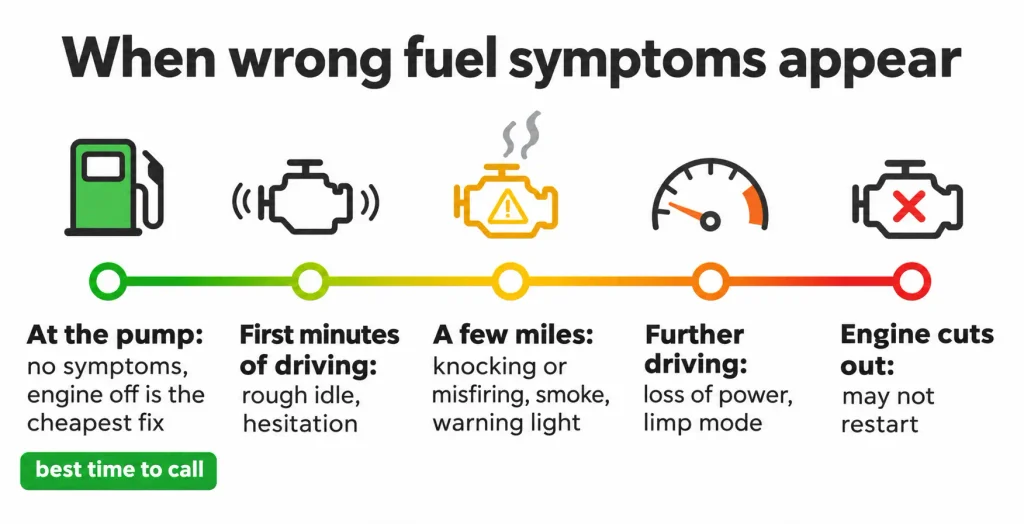
The most common symptoms of wrong fuel in a car are knocking or misfiring, smoke from the exhaust, a loss of power, warning lights and, eventually, the engine cutting out or refusing to restart. They usually appear within a few miles of filling up, once the wrong fuel has reached the engine. If you notice any of them soon after a fill-up, pull over safely, switch off and do not restart the engine.
Which symptoms you get depends on the mistake. Petrol in a diesel car tends to cause knocking, smoke and a loss of power, while diesel in a petrol car tends to cause misfiring, heavy smoke and stalling. This guide covers both, how to confirm it really is a misfuel, and what to do next.
Symptoms showing right now? Call Fuel Doctor 247 on 0333 577 5158 or 0755 456 6460 and we will come to you.
Symptoms of Petrol in a Diesel Car
Petrol in a diesel is the more common and more damaging mistake. Diesel engines rely on the fuel to lubricate the high pressure pump, and petrol strips that lubrication away. Once the mix reaches the engine, you may notice:
- A loud knocking or rattling sound, especially when accelerating, because petrol ignites at the wrong moment under compression
- White or grey smoke from the exhaust
- Slower acceleration and a loss of power, sometimes with the car going into limp mode
- The engine management or glow plug warning light coming on
- Rough idling or juddering when you stop at junctions
- The engine cutting out and then struggling to restart, or not restarting at all
How quickly these appear depends on how much petrol went in and how much diesel was already in the tank. With only a splash of petrol in a full tank, the car may seem fine for a while, but the pump can still be wearing. Our guide to a small amount of petrol in a diesel car explains why even a few litres needs draining, and our closer look at the signs of petrol in a diesel car covers this mix-up in more detail.
Symptoms of Diesel in a Petrol Car
Diesel in a petrol car is less common, because the diesel nozzle is wider than most petrol fillers, but it still happens. Diesel is too heavy and oily to ignite properly from a spark plug, so a petrol engine struggles to burn it. Typical signs are:
- Misfiring and a rough, lumpy engine
- Heavy smoke from the exhaust, often darker than with petrol in a diesel
- Spluttering, hesitation and a loss of power when you accelerate
- The engine management light coming on
- The engine stalling and failing to restart
The damage is usually less severe than petrol in a diesel, but driving on it can foul the spark plugs and harm the catalytic converter. Here is more on what happens with diesel in a petrol car and how we drain it.
Petrol in Diesel vs Diesel in Petrol: Symptoms Side by Side
| Symptom | Petrol in a diesel car | Diesel in a petrol car |
|---|---|---|
| Engine noise | Loud knocking or rattling | Misfiring, rough running |
| Exhaust smoke | White or grey | Heavy, often darker smoke |
| Power | Slow acceleration, possible limp mode | Spluttering and hesitation |
| Warning lights | Engine management or glow plug light | Engine management light |
| Worst case | Engine cuts out, pump and injector damage | Stalls, fouled spark plugs, catalytic converter damage |
| How serious | More serious | Usually less serious, still needs draining |
How to Confirm It Is Wrong Fuel
Several other faults can cause smoke, misfiring or a warning light, so a few quick checks help before you call:
- Check your receipt. It shows the fuel grade and the price per litre. Compare it with the pump you used and your car’s fuel type, which is usually printed inside the filler flap.
- Think about timing. Wrong fuel symptoms almost always start within minutes or a few miles of filling up. A fault that appears days later is less likely to be a misfuel.
- Smell the filler. With the engine off, petrol has a sharper, lighter smell than diesel. A strong petrol smell from a diesel filler is a clue.
Faults that can look like wrong fuel
- Contaminated fuel from the forecourt, such as water in the tank, can cause similar spluttering. If several drivers report problems after using the same station, this is a possibility.
- A blocked fuel filter or failing injector can cause rough running and smoke, but usually builds up gradually.
- A diesel particulate filter (DPF) or EGR fault can trigger limp mode and warning lights on diesels without any misfuel.
If the timing points to your last fill-up and the receipt shows the wrong grade, treat it as a misfuel and keep the engine off.
What to Do When You Notice Wrong Fuel Symptoms
- Pull over as soon as it is safe. Use a lay-by, hard shoulder or side road, and switch on your hazard lights.
- Switch the engine off and leave it off. Every restart pushes more of the mix through the pump and injectors.
- Do not top up with the right fuel to dilute it. The wrong fuel still passes through the system.
- Do not clear the warning lights with a code reader. The fault is real and the wrong fuel is still in the tank.
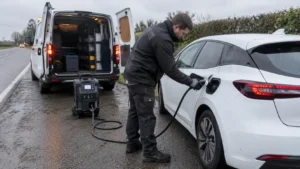
- Call a mobile wrong fuel specialist. The car can be drained, flushed and refilled where it stopped, without a tow.
Once the engine has run on the wrong fuel, a drain still comes first, and then the technician checks whether any parts need attention. Our wrong fuel recovery guide walks through each stage, and our breakdown of wrong fuel repair costs in the UK explains what affects the price. If petrol went into a diesel, here is how our mobile petrol in diesel drain works.
Frequently Asked Questions
The main symptoms are knocking or misfiring, smoke from the exhaust, a loss of power, warning lights on the dashboard and the engine cutting out or failing to restart. They usually appear within a few miles of filling up.
Often within a few minutes or a few miles, once the wrong fuel reaches the engine. With only a small amount of the wrong fuel in a full tank, symptoms may take longer to appear, but damage can still be happening.
Knocking when accelerating, white or grey exhaust smoke, slow acceleration, a warning light, rough idling and, eventually, the engine cutting out.
Misfiring, heavy exhaust smoke, spluttering and hesitation, the engine management light and stalling.
Sometimes for a short while, especially with only a small amount of the wrong fuel. Running normally does not mean no damage is being done, so it is still best to have the tank drained.
Pull over safely, switch the engine off and do not restart it. Then call a mobile wrong fuel specialist to drain and flush the system where the car has stopped.
Wrong Fuel Symptoms? Call Fuel Doctor 247
If your car started knocking, smoking or losing power soon after a fill-up, switch off and call us. We cover Greater Manchester, Lancashire, Merseyside, Cheshire, Derbyshire and Yorkshire, and we drain, flush and refill on site.
Call 0333 577 5158 or 0755 456 6460, or send us your details. Check the towns and cities we cover.
You Mix It. We Fix It.