
If your electric car has run out of charge, get somewhere safe, switch on your hazard lights and do not try to tow it on its wheels. Most EVs should only be moved on a flatbed, so the quickest fix is usually a mobile EV charge at the roadside. That adds enough range to drive yourself to the nearest public charger.
Running flat in an EV is less common than running out of fuel, because the car gives plenty of warning first. But cold weather, a broken charger at a service station or a longer detour than planned can catch anyone out. This guide explains what happens as the battery empties, what to do the moment you stop, and how a roadside charge works.
Stuck now? Call Fuel Doctor 247 on 0333 577 5158 or 0755 456 6460 for mobile EV charging at your location.
What Happens When an Electric Car Runs Out of Charge?
An EV does not just stop without warning. As the battery runs low, most cars go through the same stages:
- Low battery warnings. The dashboard and sat nav start warning you, usually somewhere around 10% to 20%, and many cars suggest nearby chargers.
- Reduced power mode. Close to empty, the car limits speed and acceleration to stretch the last miles. Some makes show a tortoise or turtle symbol. Heating and air conditioning may be cut back too.
- Coming to a stop. When the usable charge is gone, the car slows to a halt and will not drive again until it is charged.
Even at “0%”, the battery is not truly empty. Manufacturers keep a reserve to protect the cells, and the separate 12V battery keeps hazard lights, locks and the dashboard working. That is why a short roadside top-up is usually enough to get the car moving again.
The dashboard figure is also an estimate. Range drops in cold weather, at motorway speeds, when heating is on and when climbing hills, so “20 miles left” can disappear faster than expected.
What to Do If Your Electric Car Runs Out of Charge
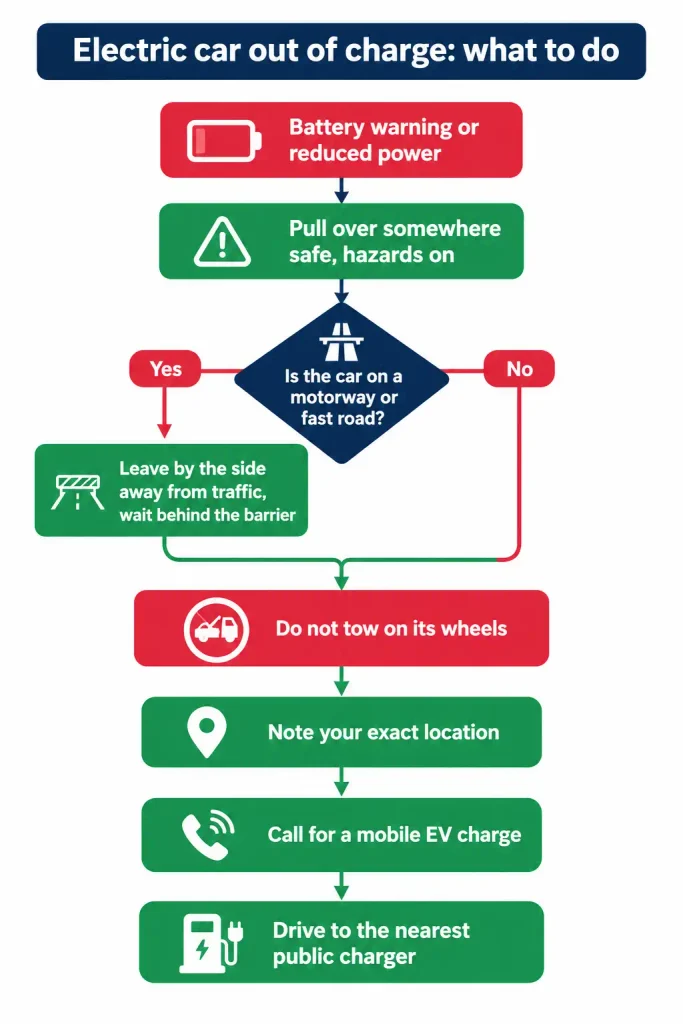
- Pull over as early as you can. Once reduced power mode starts, head for a lay-by, hard shoulder, car park or side road while the car can still move.
- Make yourself safe. Switch on hazard lights. On a motorway or fast road, get out on the side away from traffic and wait behind the barrier. Use an emergency refuge area or the hard shoulder only if you cannot reach a safer spot.
- Do not try to tow it on its wheels. Many EVs can be damaged if the drive wheels turn while being towed. Check the handbook, and if the car must be moved, it should go on a flatbed.
- Turn off what you do not need. Switch off heating, lights and anything plugged into the car to protect the 12V battery. Hazard lights still work with the car switched off.
- Note your location. Use a road sign, junction number, marker post or the what3words app so help can find you quickly.
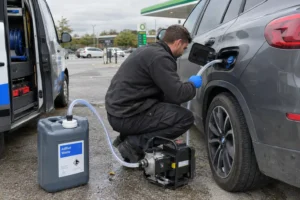
- Call for a mobile charge. A technician can give the car enough charge on the spot to reach the nearest public charger.
[In-body image 1]
Mobile EV Charge vs Flatbed Recovery
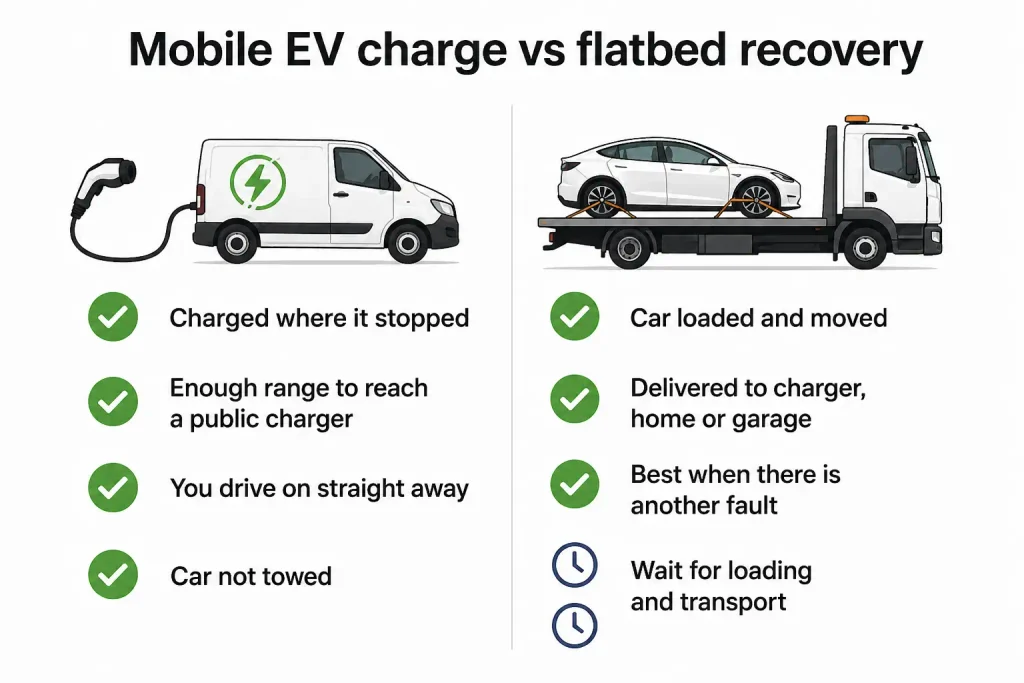
When an EV runs flat, there are really two options: charge it where it is, or put it on a flatbed and take it to a charger. Here is how they usually compare:
| Mobile EV charge | Flatbed recovery | |
|---|---|---|
| Where it happens | Where the car stopped | Car is loaded and moved |
| What you get | Enough range to reach a public charger | Car delivered to a charger, home or garage |
| Who drives on | You, straight away | You, once the car is charged at the destination |
| Risk to the car | None, the car is not towed | Low, if loaded correctly on a flatbed |
| Best for | A flat battery with no other fault | An EV with a fault beyond a flat battery |
A flatbed is the right choice if there is a warning for something other than low charge, or if the car will not respond after charging. For a simple flat battery, a roadside charge is usually faster and avoids the car being moved at all.
How Roadside Mobile EV Charging Works
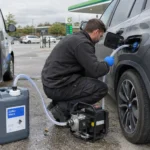
A mobile EV charging service brings a portable charging unit to the car in a van. The technician connects it to your car’s charge port, just as you would at a public charger, and delivers a top-up charge on the spot.
What to expect:
- A top-up, not a full charge. The aim is to give you enough range to reach the nearest public charger or home safely, not to fill the battery.
- Charging time varies. How long it takes depends on the car, the charging unit and how cold the battery is. Your technician will tell you roughly how much range you will have before you set off.
- Your connector matters. Most EVs sold in the UK use Type 2 or CCS connectors, but some older models use different plugs. Give the make, model and year when you call so the right equipment comes out.
- Plan your next stop. Before the technician leaves, pick a working public charger within your new range. Apps like Zap-Map show live availability.
For a fuller explanation of the equipment and process, read our guide on what mobile EV charging is and how it works.
Why Electric Cars Run Out of Charge, and How to Avoid It
Most EV drivers who run flat are caught by one of a few things:
- Cold weather: batteries are less efficient in the cold, and cabin heating uses extra energy, so winter range can be noticeably lower than summer range.
- Motorway speeds: EVs use far more energy at 70mph than around town, so the range shown after city driving can be optimistic on the motorway.
- A charger that is out of order or busy: arriving with a few miles left and finding the only charger broken leaves no margin.
- Trusting the last few miles: the range estimate is a guess based on recent driving, and it can drop quickly on hills or in the rain.
A few habits keep you out of trouble. Plan long trips with at least one backup charger. Aim to arrive at a charger with 10% to 20% left rather than near zero. Precondition the battery and cabin while plugged in during winter. If the range starts falling faster than the miles you are covering, charge at the next opportunity rather than pushing on.
If you also run a petrol or diesel car, the same principle applies to fuel: when something goes wrong, it is cheaper to sort out where you are than to keep driving. See our guide to wrong fuel in a car for that side of things.
Frequently Asked Questions
What happens if an electric car runs out of charge?
The car gives low battery warnings, then limits power to stretch the last miles, and finally slows to a stop. It will not drive again until it is charged, but hazards and locks keep working from the 12V battery.
Can you tow an electric car with a flat battery?
Most EVs should not be towed with their drive wheels on the ground, because it can damage the motor and drivetrain. Check your handbook. If the car needs moving, use a flatbed, or have it charged where it is.
Can you get an emergency charge for an electric car at the roadside?
Yes. A mobile EV charging service brings a portable charger to you and gives the car enough range to reach a public charger or home.
How long does a roadside EV charge take?
It depends on the car, the charging unit and the battery temperature. The goal is a short top-up rather than a full charge, and the technician will tell you how much range you have before you drive off.
Is it bad for the battery to run an EV to 0%?
An occasional flat battery is unlikely to cause lasting harm, as cars keep a hidden reserve to protect the cells. Regularly running it to zero is best avoided, so charge the car as soon as you reach a charger.
Does breakdown cover include running out of charge?
Many breakdown policies cover an EV that has run flat, but what they offer varies, from a tow to a portable charge. Check your policy, or call a mobile EV charging service directly.
Out of Charge? Call Fuel Doctor 247
If your electric car has run flat, get somewhere safe and call us. Fuel Doctor 247 provides roadside EV charging across Greater Manchester, Lancashire, Merseyside, Cheshire, Derbyshire and Yorkshire, giving you enough charge to reach the nearest public charger.
Call 0333 577 5158 or 0755 456 6460, or send us your details. To check whether we cover your town, see our service areas.