
If you have put petrol in the AdBlue tank, do not start the engine and do not switch on the ignition. Petrol does not belong anywhere in the AdBlue system, and the tank, pump, heater, sensors and dosing injector are all built to handle only a urea and water solution. Caught before the engine runs, the fix is usually a drain and flush of the AdBlue tank. Once the system has pumped petrol through it, the repair can involve replacing expensive parts.
The good news is that you have already done the most important thing by stopping to check. This guide explains what petrol actually does inside the AdBlue system, the warning signs if you have already driven, and the exact steps to take right now.
Need help now? Call Fuel Doctor 247 on 0333 577 5158 or 0755 456 6460. We come to you, drain the contaminated AdBlue tank on site and help you avoid a costly SCR repair.
What the AdBlue System Does (and Why Petrol Has No Place in It)
AdBlue is a solution of 32.5% high purity urea and 67.5% deionised water, made to the ISO 22241 standard. It is not a fuel and it never goes near the engine’s combustion chambers. Most modern Euro 6 diesel cars and vans carry it in a separate tank, usually with a blue filler cap next to the diesel filler or under the boot floor.
From that tank, an electric pump pushes AdBlue through heated lines to a dosing injector in the exhaust. The injector sprays a fine mist into the hot exhaust gas ahead of the SCR (selective catalytic reduction) catalyst. There, the urea breaks down into ammonia, which turns harmful nitrogen oxides (NOx) into nitrogen and water vapour.
Every part of that chain is matched to one fluid. The seals, hoses and tank plastics are chosen to resist urea, not hydrocarbons. The level and quality sensors are calibrated to recognise the concentration of a urea solution. Petrol is a solvent and a fuel, so it attacks those materials, confuses those sensors and should never be sprayed into a hot exhaust.
If you are not sure whether your car even uses AdBlue, our guide on whether petrol engines need AdBlue explains which vehicles carry it and why.
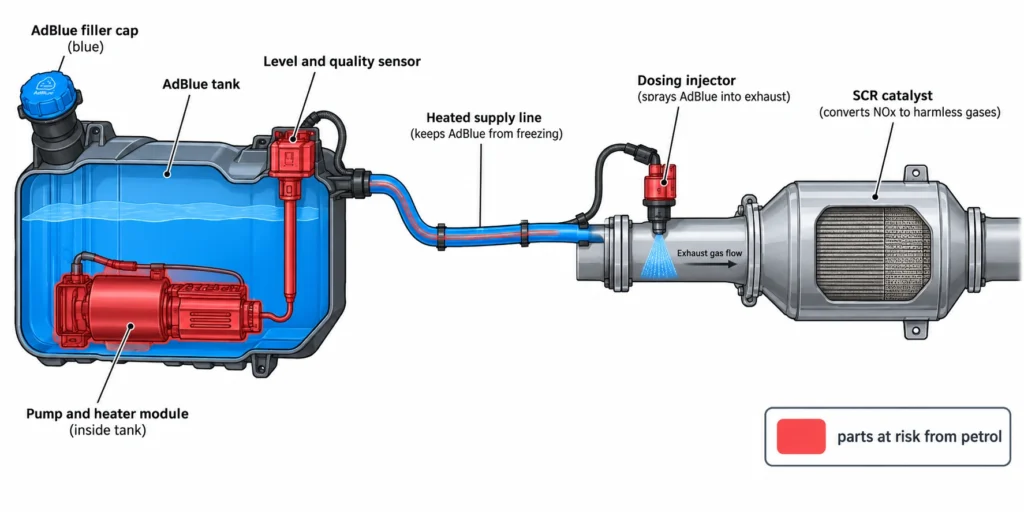
What Happens If You Put Petrol in the AdBlue Tank?
Petrol in the AdBlue tank contaminates the whole SCR system, and how much damage it does depends mainly on one thing: whether the engine has been started since. While the car sits with the ignition off, the petrol stays in the tank. Once the system powers up, it can be drawn through the pump, lines and injector.
Here is what each part of the system faces:
- AdBlue tank and seals: Petrol can soften and swell rubber seals and some plastics that were only ever meant to hold a water-based solution. On many cars the pump, heater and sensors sit inside one tank module, so contamination here affects all of them at once.
- Level and quality sensor: The sensor expects AdBlue’s urea concentration. Petrol gives a completely wrong reading, which triggers an AdBlue or emissions fault on the dashboard.
- AdBlue pump: The pump is not designed to move a thin solvent. Running it on petrol risks wear and seal failure, and a failed pump usually means replacing the tank module.
- Supply lines and heater: Petrol left in heated lines can degrade them and leave residue that blocks the flow of clean AdBlue later.
- Dosing injector: Spraying petrol into a hot exhaust instead of AdBlue is the worst outcome. It can damage the injector nozzle and the area around it.
- SCR catalyst: With no proper AdBlue reaching it, the catalyst cannot do its job, and fuel residue may coat or harm it.
Even a small amount of petrol is a problem. There is no “safe” amount of petrol in an AdBlue system, because the fluid has to stay within a tight specification for the sensors and catalyst to work. Topping up with fresh AdBlue to dilute the petrol does not solve anything and only adds more contaminated fluid to drain.
This is a closely related mistake to diesel going into the AdBlue tank, and the advice is much the same: the earlier the tank is drained, the cheaper the outcome.
Signs You Have Already Driven With Petrol in the AdBlue Tank
If you did not notice the mistake straight away, the car will usually tell you within a short drive. Watch for these signs:
- An AdBlue, SCR or emissions warning light, often with a message such as “AdBlue quality” or “check AdBlue”
- A countdown warning that the engine will not restart after a set number of miles
- The engine management light coming on
- Reduced power or limp mode, as the car protects itself from high emissions
- A strong petrol smell around the AdBlue filler or the rear of the car
- Unusual exhaust smell or smoke after the system starts dosing
If any of these appear, pull over somewhere safe, switch off and leave it off. Every extra mile gives the pump more time to push petrol through the lines and into the dosing injector. Do not try to clear the warning with a code reader, because the fault is real and the contaminated fluid is still in the system.
What to Do Right Now: Step by Step
Follow these steps the moment you realise petrol has gone into the AdBlue tank:
- Stop filling and leave the ignition off. Do not start the engine, and do not press the start button “just to check” the dashboard. On many cars the AdBlue system wakes up with the ignition.
- Put the filler cap back on. This keeps petrol fumes in and stops rain or dirt getting into the tank.
- Move the car safely if you need to. At a forecourt, put it in neutral and push it clear of the pumps with help, keeping the engine off. Ask the staff if you are unsure.
- Do not add AdBlue to dilute it. It will not fix the contamination and only increases the volume that has to be drained.
- Note what happened. Roughly how much petrol went in, whether the engine was started and for how long. This helps the technician judge what needs checking.
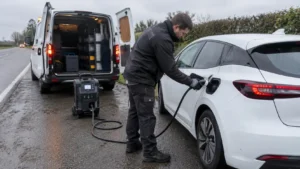
- Call a mobile wrong fuel specialist. A technician can drain and flush the AdBlue tank where the car stands, so it does not need to be towed or driven.
If the engine has already run, still stop, switch off and follow steps 4 to 6. It is never too late to limit further damage.
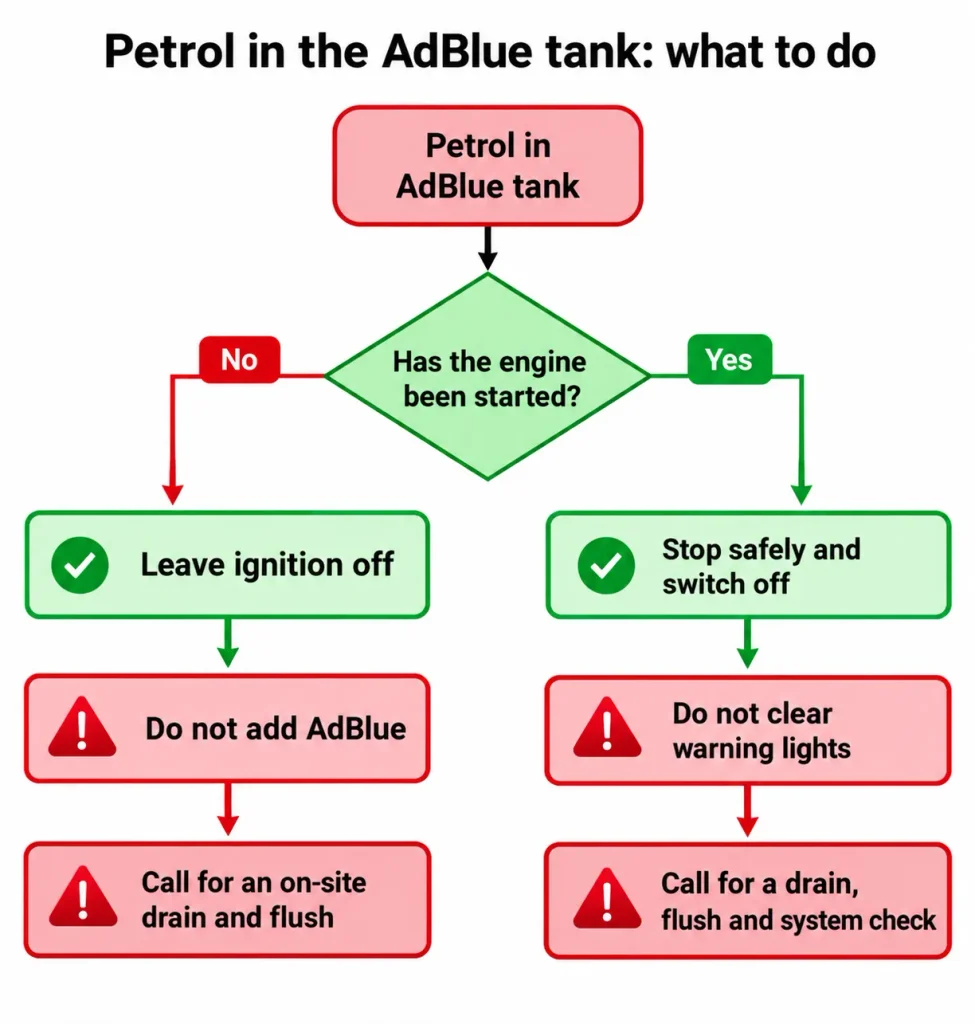
How Petrol in the AdBlue Tank Is Fixed
The fix starts with removing every trace of petrol from the AdBlue tank, and what follows depends on whether the system has run. A typical on-site job looks like this:
- Drain the AdBlue tank. The contaminated mix is pumped out into a sealed container for safe, legal disposal. Petrol is flammable, so this is not something to attempt with a siphon hose on the roadside.
- Flush the tank. The tank is rinsed with clean, fresh AdBlue or deionised water to lift the remaining petrol from the walls and the pump pick-up. Tap water should never be used, as its minerals can damage the system.
- Refill with fresh AdBlue. The tank is filled with new ISO 22241 AdBlue from a sealed container.
- Check for faults. Stored AdBlue and SCR fault codes are read so you know whether the system has flagged a quality or dosing problem.
If the engine was never started, this is often the end of the job. If the car has been driven, the pump, lines and dosing injector may also hold petrol. In that case, some components may need cleaning or replacing, and on many vehicles the pump, heater and sensors are sold as a single tank module. Your technician will tell you honestly if the car needs a garage visit after the drain.
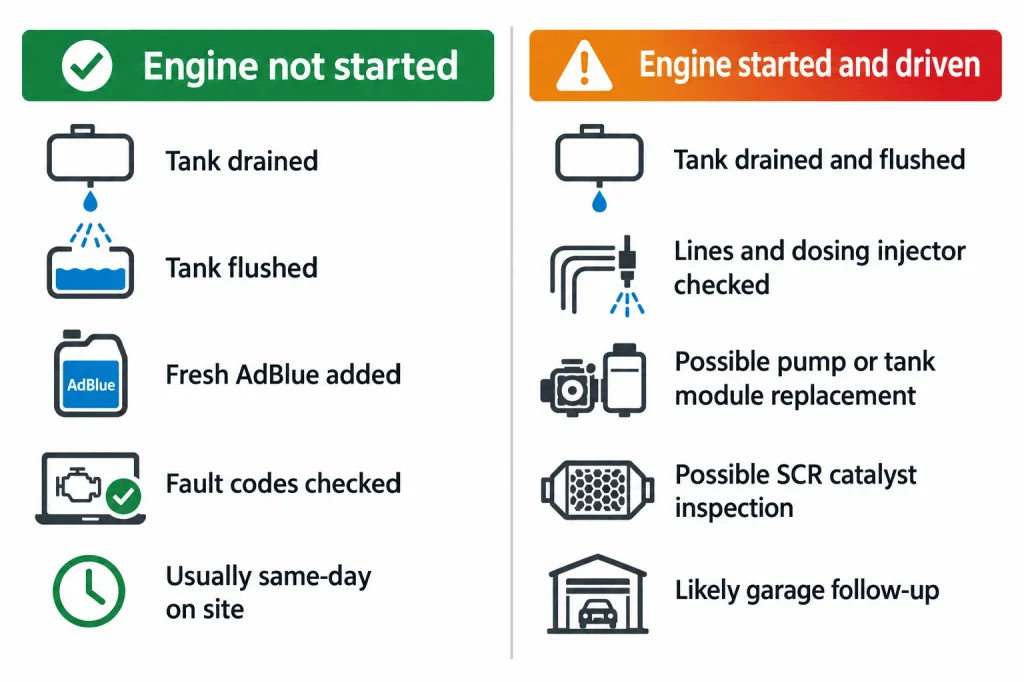
Our AdBlue contamination service covers mix-ups in both directions, so the same technician can deal with it whichever tank the wrong fluid went into.
How Much Does It Cost to Fix Petrol in the AdBlue Tank?
The biggest factor in the cost is whether the engine ran with petrol in the system. A drain, flush and refill done before the car is started costs far less than repairing a contaminated SCR system. Replacing an AdBlue tank module or dosing injector at a main dealer can run into four figures on many models.
Other things that affect the price:
- Time and location: late night, weekend and motorway call-outs can cost more than a daytime job on a driveway.
- Tank size and access: some AdBlue tanks sit under the boot floor or behind trim, which adds labour.
- Vehicle type: vans and larger SUVs often carry bigger AdBlue tanks than small hatchbacks.
- Parts needed: fresh AdBlue is inexpensive, but sensors, pumps and injectors are not.
When you call, give the technician the make, model and year of the vehicle and say whether the engine was started. That lets them quote properly before they set off. For a wider look at what drives the price of a misfuel repair, see our breakdown of wrong fuel repair costs in the UK.
Will my insurance cover it? Some comprehensive policies include misfuelling cover, while many exclude it or pay only for the drain. Check your policy wording or call your insurer before claiming, and remember that a claim may affect your no-claims discount.
How Petrol Ends Up in the AdBlue Tank (and How to Avoid It)
Petrol in the AdBlue tank is rarer than the classic diesel and petrol mix-ups, but it happens more often than people expect. Common causes include:
- Topping up from a jerry can or funnel: a can of petrol for the lawnmower or a second car gets poured into the wrong filler.
- Two fillers side by side: on many cars the blue AdBlue cap sits right next to the fuel cap, and a tired driver opens the wrong one.
- Swapping between cars: someone used to a petrol car borrows a diesel one and does not realise it has a second tank.
- Unmarked containers: AdBlue and fuel kept in similar bottles in the garage or the boot.
A few simple habits prevent almost all of these. Only fill AdBlue from its own sealed bottle or a forecourt AdBlue pump. Keep fuel and AdBlue containers clearly labelled and stored apart. Before you pour anything, check the colour of the cap: blue is AdBlue only.
Other mix-ups we deal with regularly include AdBlue poured into the fuel tank by mistake and the far more common petrol in a diesel car. If you are worried about a petrol car instead, here is what AdBlue does to a petrol engine.
Frequently Asked Questions
Petrol contaminates the AdBlue system. It can damage seals, the pump, the quality sensor and the dosing injector, and it triggers AdBlue or emissions warnings. If the engine is not started, a drain and flush of the AdBlue tank usually puts it right.
No. There is no safe amount of petrol in an AdBlue system. Driving lets the pump push petrol through the lines and injector, which turns a simple drain into a much bigger repair.
No. Adding more AdBlue does not make the contaminated fluid usable. It only increases the amount that has to be drained and disposed of.
AdBlue does not pass through the engine, so the engine itself is not normally at risk. The damage is to the AdBlue and SCR emissions system, but a fault there can put the car into limp mode or stop it restarting.
On site, a drain, flush and refill usually takes around an hour, depending on where the tank sits and how easy it is to reach. Extra checks take longer if the engine was run.
It depends on your policy. Some comprehensive policies cover misfuelling, others exclude it. Check your policy documents or ask your insurer before you make a claim.
Petrol in Your AdBlue Tank? Call Fuel Doctor 247
If petrol has gone into your AdBlue tank, keep the engine off and call us. Fuel Doctor 247 is a mobile wrong fuel service covering Greater Manchester, Lancashire, Merseyside, Cheshire, Derbyshire and Yorkshire. We come to the car, drain and flush the AdBlue tank on site, and explain clearly whether anything else needs attention.
Call 0333 577 5158 or 0755 456 6460, or send us your details online. You can also check whether your town is on our list of areas we cover.
You Mix It. We Fix It.