
You have poured AdBlue into the diesel filler, or you have a horrible feeling you might have, and you want to know how bad it is. The honest answer is that AdBlue in the fuel tank by mistake is the one misfuel where the clock matters most, and the one where not starting the engine makes the biggest difference. Leave the key alone and this is a drain and flush. Start it and drive, and you can be looking at a fuel pump and injectors instead. Here is what we see on these call-outs, what is actually happening in the tank, and what to do in the next few minutes.
AdBlue in the fuel tank: what to do before anything else
Do not start the engine, and do not switch the ignition on to check a warning light. On most modern diesels the first click of the key primes the fuel pump, and AdBlue sitting at the bottom of the tank is exactly what the pickup will draw first. Keyless cars are the same: pressing start without your foot on the brake still wakes the fuel system.
If the car is still at the pump or on the drive, leave it where it is. Put it in neutral and push it clear of the pump if the forecourt staff ask, but do not roll it far, because some tank designs slosh the AdBlue layer up towards the pickup.
If the engine is already running, pull over as soon as it is safe and switch off. Do not restart it “to see if it clears”. AdBlue does not clear. Every second the engine runs, more of it is pulled through the filter into the high-pressure pump.
Then make one call. We come to the car, wherever it is, and you do not need a tow or a garage slot. You can check your area on our areas we cover page.
Why AdBlue is worse in a diesel tank than petrol is
AdBlue is not a fuel and it is not an additive. It is roughly a third urea and two thirds deionised water, made to be sprayed into the exhaust so the SCR catalyst can turn nitrogen oxides into nitrogen and water. Arval’s driver guide puts the mix at 32.5 percent high-purity urea in demineralised water. Every part of it is wrong for a fuel system.
Three things happen the moment it goes into a diesel tank.
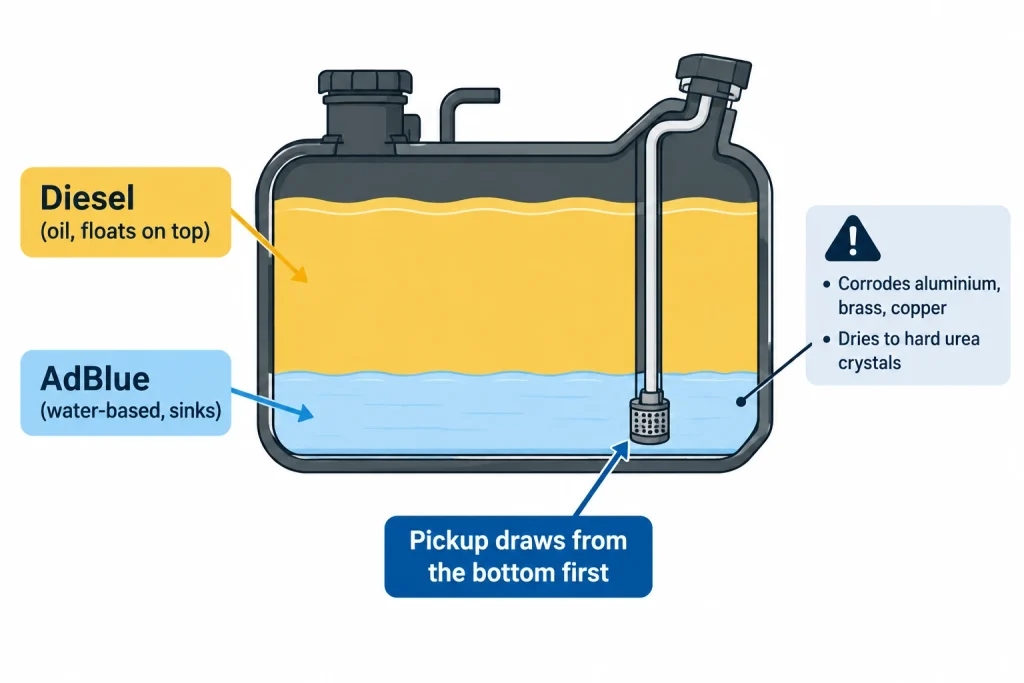
- It does not mix. Diesel is an oil and AdBlue is water, so the AdBlue sinks straight to the bottom of the tank in a clear layer. When we drain these cars the separation is obvious in the container: diesel on top, a clear or slightly milky layer underneath. The problem is that the bottom of the tank is where the fuel pickup sits.
- It corrodes. Urea solution attacks aluminium, brass, copper and zinc, which is most of what a fuel pump, injector body, pressure sensor and tank level sender are made from. Left in the tank overnight it starts to mark the metal.
- It crystallises. As the water evaporates the urea dries into a hard white residue. On cars that have sat for a day or more we sometimes find it around the filler neck. Inside a pump or injector that residue is abrasive, and it does not flush out.
Petrol in a diesel car is a lubrication problem. AdBlue in a diesel car is a water, corrosion and crystal problem all at once, which is why we treat it as the most urgent of the three common misfuels. The costs involved are covered in our post on why misfuelling with AdBlue is so costly.
What happens if the engine was started or driven
On most AdBlue call-outs we attend, the driver was topping up from a bottle or an AdBlue pump and put the nozzle in the black cap instead of the blue one beside it. They usually realise partway through, so the amount is often somewhere between a litre and a full 10 litre bottle. The ones who stop there and ring us are the simple jobs.
The harder jobs are where the car was started. This is roughly what people describe to us on the phone:
- The engine started and ran normally for a short stretch on the diesel already in the lines.
- Within a few hundred metres it began to hesitate, then misfire.
- Loss of power, sometimes an engine management or emissions warning, then a stall with the engine refusing to restart.
If you got as far as the misfire, the AdBlue has reached the high-pressure pump. A common rail pump runs at very high pressure and relies on diesel for lubrication. Water gives it none, so the pump can score or seize, and any pump debris travels straight on to the injectors. On a driven car we drain, flush and then assess the pump and injectors with you. We will not tell you the engine is fine over the phone, because until the system is clean and the car has been run we do not know, and neither does anyone else.
Some drivers get lucky with a very small amount and a quick stop, and the drain is enough. Others need a pump and injectors, which on a modern diesel is a repair bill well into four figures. Which side of that line you fall on depends on the volume of AdBlue, how full the tank was, and how far you drove. That is why the advice is always the same: switch off, leave it, ring.
“Fantastic service, great technician, great price. I definitely would recommend.” – David Pearson, Google review
How we remove AdBlue from a fuel tank
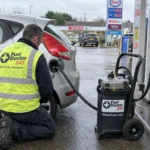
Getting AdBlue out is not the same as draining petrol from a diesel, and it is not a job for a siphon hose on the driveway. The AdBlue layer sits at the bottom and clings to the tank floor, so a partial drain leaves the worst of it behind.
When we arrive we ask two questions: how much went in, and did the engine run. Then the job runs like this:
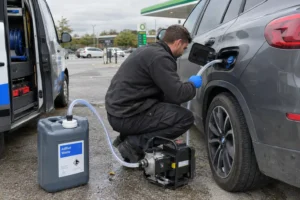
- Drain the whole tank into a sealed container for licensed disposal, taking the bottom layer first so the AdBlue comes out with the diesel rather than staying behind.
- Flush the tank and the fuel lines with clean diesel until what comes through is clean fuel with no cloudy or separated layer.
- On a car that was started, check and usually replace the fuel filter, because it will have taken the first hit, and inspect the lines back to the pump.
- Refuel with enough clean diesel to reach a pump, run the engine, and check it starts, idles and pulls as it should.
Typical arrival is 30 to 45 minutes in our core areas, and on a car that was never started the drain and flush takes 20 to 40 minutes. The full service is described on our AdBlue in fuel tank drain page. If it is the other way round and you have put diesel into the AdBlue tank, that is a different job with its own risks, and we have covered it in our post on a small amount of diesel in the AdBlue tank.
What a service thank you so much was with me within half an hour and fixed my bike, really nice to talk to and reassured me . Thank you so much again for your help ” – Nicola
How to stop it happening again
Nearly every AdBlue misfuel we see has the same cause: two caps under one flap, filled in a hurry. A few habits cut the risk almost to nothing.
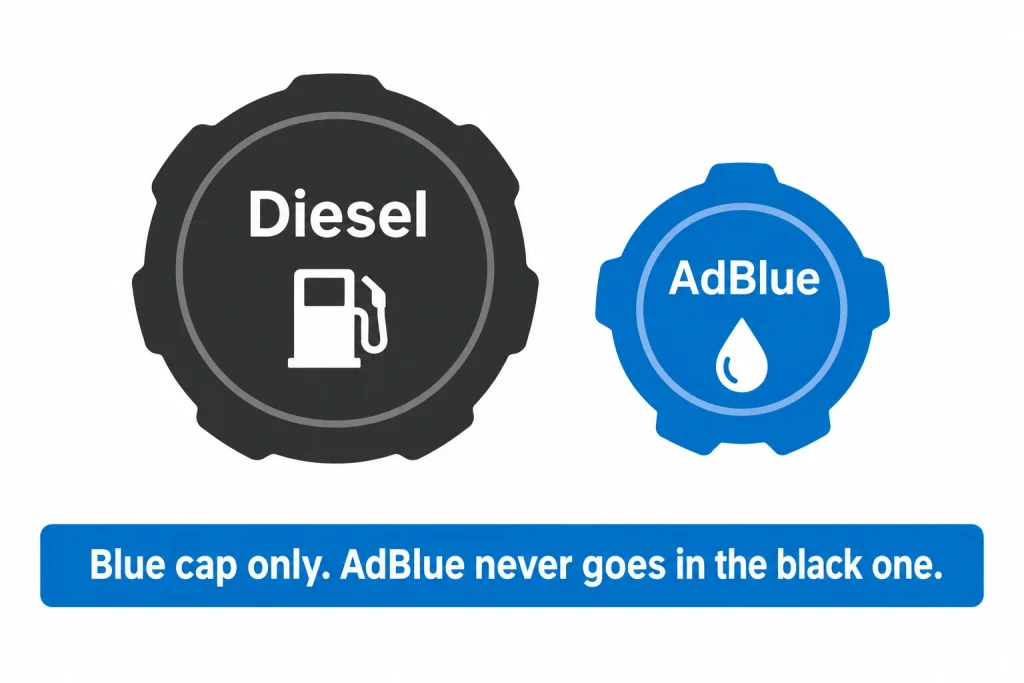
- Check the cap colour before the nozzle goes in. AdBlue caps are blue. Diesel caps are black, and often bigger.
- Read the label on the bottle or the pump twice. AdBlue pumps at HGV bays have a nozzle that fits a car’s diesel filler, which is how a lot of van drivers get caught.
- Fill AdBlue at home or at a service, not on a busy forecourt, if your car has a filler that sits right beside the diesel one.
- If a warning light asks for AdBlue, top up the AdBlue tank only. It is never a fuel tank additive.
FAQ
Even a small amount matters, because it sinks to the bottom where the fuel pickup is. Half a litre in a full tank may burn through with nothing worse than a rough run, but the same half litre in a quarter-full tank can reach the pump within the first mile. We do not put a number on what is “safe” because you rarely know the true mix at the pump. A drain is quick and cheap next to a pump and injectors, so we drain.
The whole tank is drained into a sealed container, bottom layer first so the AdBlue comes out rather than staying behind, then the tank and lines are flushed with clean diesel until the fuel runs clear. On a car that was started, the fuel filter is checked and usually replaced. Siphoning from the filler neck does not work, because it takes the diesel off the top and leaves the AdBlue underneath.
No. AdBlue is water-based and diesel is an oil, so they separate straight away, with the AdBlue sinking to the bottom of the tank. This is why the mistake is dangerous even in small amounts: the AdBlue does not get diluted through the tank, it collects exactly where the pump draws from. When we drain these cars you can see the two layers in the container.
The engine itself is rarely the casualty. The damage is to the fuel system: the high-pressure pump, which has no lubrication from water and can score or seize, then the injectors, which take any debris from the pump, plus corrosion of aluminium and brass parts if the AdBlue sits in the system. If the engine was never started, none of that has begun, and a drain and flush is usually the end of it.
Do not start the engine, and treat it the same way as a diesel: leave the car where it is and call for a drain. Petrol cars do not use AdBlue, so this usually happens when a bottle meant for another vehicle goes in the wrong car. The corrosion and crystallisation risks are the same. We have covered that situation separately in our post on <a href=”https://fuel-doctor247.com/blog/what-happens-if-i-put-adblue-in-my-petrol-car/”>what happens if you put AdBlue in a petrol car</a>.
Speak to us now
If you are reading this next to the car with the engine off, you have already done the most important thing. Call Fuel Doctor 247 on 0333 577 5158 or 0755 456 6460. The line is answered 24 hours a day, we will ask how much went in and whether the engine ran, and a technician will be with you in roughly 30 to 45 minutes across our coverage area. The drain and flush typically takes 20 to 40 minutes and you drive away the same hour. No tow, no garage booking, and we tell you exactly what we found before we leave.