
You have realised what you have done and the first thought is not about the engine. It is about the money. That is the honest reaction and there is no point pretending otherwise.
Here is the part nobody tells you at the pump. The gap between the cheapest possible outcome and the worst one is enormous, and the thing that decides which end you land on is almost entirely within your control right now. Not the make of car. Not how much wrong fuel went in.
Whether the engine gets started.
Wrong fuel in car: how much to fix in the UK depends on one decision
Two rough figures cover most cases.
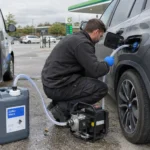
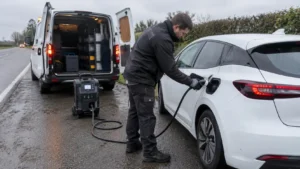
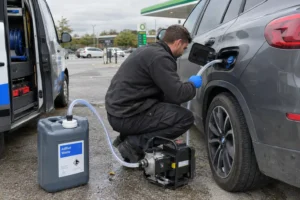
- Engine never started. A mobile drain and flush, typically somewhere between £150 and £400 depending on the vehicle, the tank size and the time of day.
- Engine started and driven. Anything from a few hundred pounds up into four figures, and on some vehicles well beyond that.
Around 150,000 UK drivers misfuel every year, so the market for fixing it is well established and competitive. What varies wildly is who you call.
If you have not turned the key, you are looking at the low number. Stop reading here if you need to and make the call. The rest of this explains where the money actually goes.
What a mobile fuel drain costs
Most straightforward car drains land in the £150 to £400 bracket. Some sit lower for small tanks caught early. A few sit higher.
The things that push a quote up are predictable:
- Out of hours. A 2am call-out on a motorway costs more than a Tuesday afternoon on a forecourt.
- Tank size and vehicle type. A large van or a twin-tank vehicle takes longer and produces more contaminated fuel to dispose of.
- Access. A car boxed into a tight multi-storey bay is harder work than one on an open forecourt.
- Replacement fuel. Some quotes include a few litres of the correct fuel to get you moving. Some do not. Ask.
Compare that with the alternatives. Breakdown providers charging non-members commonly start around £220 plus VAT and climb from there. Main dealers are a different world entirely, because a dealer will often insist on replacing every component the contaminated fuel touched to protect the warranty rather than assess what actually needs replacing. Bills of £1,000 to £5,000 are routine at that end, and there are documented cases well above that.
We should be straight with you here. We give a fixed price on the phone before anyone gets in a van. Not an estimate that grows on arrival. If a company will not quote you a number before they turn up, that tells you something.
Fantastic service, great technician, great price. I definitely would recommend.
David Pearson, Google review
What it costs once the engine has been started
This is where the numbers change shape.
The moment the engine turns over, the fuel pump pulls the mixture out of the tank, through the filter, into the high-pressure pump, out to the injectors, and back to the tank through the return line. Inside about a minute the contamination is no longer sitting in one place. It is everywhere.
That matters because of what petrol does to a diesel system specifically. Diesel is a lubricant as well as a fuel. The high-pressure pump in a common rail diesel runs at pressures most people would not believe and depends on diesel itself to keep its metal surfaces apart. Petrol is a solvent. It strips that film away in seconds.
Once the pump is running dry in that sense, it starts eating itself. Fine metal particles break off, and the pump pushes them straight into the fuel rail and the injectors, which have internal clearances finer than a human hair.
Now you are pricing parts, not labour. A single diesel injector commonly runs £300 to £900 before labour, and a full set on a four cylinder engine regularly passes £2,000 once you add fitting and coding. Put a high-pressure pump, a rail and a full system clean alongside that and you can see how a £250 job becomes a £3,000 one.
One thing we can tell at the roadside: fuel drained from a car that has been driven on petrol often comes out visibly paler and thinner than clean diesel, and sometimes with a faint metallic glitter in the container. That glitter is the pump. It tells us the conversation with the owner is about to get more expensive.
Diesel in a petrol car is cheaper to fix
Worth saying clearly, because the two mistakes get quoted as though they cost the same.
Diesel in a petrol engine does not destroy anything mechanically the way the reverse does. Diesel will not ignite from a spark plug. It coats the plugs, fouls them, the engine misfires and stalls, and if it runs long enough it can clog the catalytic converter.
The fix is usually a drain, a flush and fresh petrol, occasionally with new spark plugs. Same drain price bracket, far lower risk of a follow-on bill. It is also less common, because a diesel nozzle will not fit most petrol filler necks without real effort.
AdBlue in the fuel tank is the expensive one
This one catches people out on price more than any other, and drivers rarely see it coming.
AdBlue is a urea solution. It is not a fuel and it does not behave like one. In a diesel tank it crystallises out of solution and corrodes fuel system components from the inside. A standard drain does not resolve it, because the residue clings to surfaces that petrol or diesel would simply wash off.
Expect this to start around £350 and go up from there, sometimes considerably, depending on how much went in and whether the engine ran. Our guides on AdBlue in a fuel tank and how to fix it and why misfuelling with AdBlue is so costly go into what the job actually involves.
If AdBlue is what went in, say so on the phone. Different equipment comes out.
“What a service thank you so much was with me within half an hour and fixed my bike, really nice to talk to and reassured me . Thank you so much again for your help ” – Nicola
Will insurance or breakdown cover pay for it?
Sometimes, and the answer is worth two minutes of checking before you assume either way.
Misfuelling is driver error rather than an accident, so plenty of comprehensive policies exclude it outright. Some cover it under accidental damage. Others sell it as an add-on you either took or did not.
Two things worth weighing before you claim:
- Your excess may be higher than the drain itself. Claiming £250 against a £350 excess makes no sense.
- A claim can affect your no-claims discount even where cover exists.
Breakdown cover is separate again. Some policies include a misfuel drain up to a set value. Others will recover the vehicle to a garage but leave you paying for the drain anyway, which is the worst of both outcomes because you also lose the car for days.
Ring your insurer while you are waiting. We cannot tell you what your policy says and we would rather you heard it from them.
Why draining it yourself costs more than it saves
We understand the thinking. A siphon pump is twenty pounds and the internet makes it look simple.
Two problems. Petrol vapour is explosive and siphoning without anti-static equipment near a running or recently running vehicle is a genuine fire risk, not a theoretical one. And contaminated fuel is classified as hazardous waste in the UK. You cannot legally pour it down a drain, put it in a bin or burn it, and the penalties for doing so are far larger than the drain would have cost.
There is also the practical issue that a siphon reaches the tank, not the fuel lines, the filter or the rail. Which means it does not actually finish the job.
Frequently asked questions
Most mobile drains fall between £150 and £400 for a standard car, with the exact figure depending on the vehicle, the tank size, the location and whether it is an out-of-hours call. Breakdown providers charging non-members typically start higher, around £220 plus VAT. Main dealers sit in a different bracket entirely and often run into four figures.
It depends entirely on your policy. Many comprehensive policies exclude misfuelling because it is driver error, while others cover it under accidental damage or sell it as an add-on. Check the wording before you commit to claiming, because your excess is often higher than the cost of a mobile drain and a claim can still affect your no-claims discount.
Almost never, once you add everything up. A garage route usually means recovery costs on top of the work, plus days without the vehicle. Main dealers in particular tend to replace every component the wrong fuel touched rather than assess what genuinely needs it, which is why those bills climb so fast. A roadside drain avoids both.
Considerably more than a standard fuel drain, generally starting around £350. AdBlue is a urea solution that crystallises and corrodes fuel system components, so it cannot simply be pumped out and flushed like petrol or diesel. The tank and lines need thorough cleaning, and in some cases components need replacing.
The cheapest version of this problem is the one you deal with now
Every hour a contaminated system sits, and every mile driven on it, moves the bill in one direction. The car sitting still with the key out costs you nothing extra at all.
One call settles it. A fixed price agreed before we set off, a technician with you in roughly 30 to 45 minutes, a 20 to 40 minute drain and flush, and you drive away the same hour. No recovery truck, no garage booking, no vehicle stuck somewhere for a week.
Call Fuel Doctor 247 on 0333 577 5158. We answer 24/7.