
You have just realised the nozzle in your hand is the wrong colour, or the car is juddering half a mile down the road and something smells off. Either way, the next few minutes matter more than anything else that happens today.
We drain misfuelled vehicles every week of the year. The single biggest factor in whether this costs you an hour or costs you a fuel system is not how much wrong fuel went in. It is whether the engine was started, and how far the car was driven afterwards.
So before you read another line: if the car is still on the forecourt and the key has not been turned, you are in the best possible position.
What to do if wrong fuel in car goes in by mistake
There are four steps, and the order matters.
- Do not start the engine. Not to move off the pump, not to reposition the car, not for ten seconds to check something.
- If the engine is already running, switch it off. Every additional second pulls contaminated fuel further through the system.
- Get the car somewhere safe and put the handbrake on. Forecourt staff will usually help push it clear of the pump. On a motorway, follow the Highway Code guidance on breakdowns and get yourself behind the barrier before you make any calls.
- Call a mobile fuel drain service and wait. Do not accept a tow to a garage unless a technician has told you the car needs one.
That fourth point saves people the most money. A tow plus a garage booking plus three days off the road is a far worse outcome than a technician turning up with a drain rig and sorting it where you stand.
On most petrol-in-diesel call-outs we attend, the driver spotted the mistake at the pump and never turned the key. That is exactly what keeps the wrong fuel sitting in the tank instead of circulating through the pump and injectors, and it is why those jobs are usually a straightforward drain and flush.
What happens if you put wrong fuel in car
The damage depends entirely on which way round the mistake went. These are two very different problems and they get talked about as though they are one.
Petrol in a diesel car
This is the serious one, and it is by far the most common. The filler neck on a diesel car is wider, so a petrol nozzle slides straight in without resistance.
Diesel is not only a fuel. It is a lubricant. The high-pressure fuel pump in a modern common rail diesel runs to enormous pressures and relies on diesel itself to keep its internal metal surfaces from touching. Petrol is a solvent. It strips that lubricating film away.
Once the engine runs, the pump starts wearing metal against metal. Fine metal particles break loose, travel into the fuel rail and reach the injectors, which have clearances measured in microns. At that point you are no longer looking at a fuel drain. You are looking at a pump, a rail, injectors and a full system clean, and the bill runs into thousands.
Left alone in the tank with the engine off, petrol does none of that. It just sits there.
Diesel in a petrol car
Less common, because a diesel nozzle is too wide to fit most petrol filler necks properly, though people do manage it with a jerry can or an older vehicle.
Diesel will not ignite from a spark plug the way petrol does. It does not vaporise readily at the temperatures a petrol engine works at. Instead it coats the spark plugs, fouls them, and the engine misfires, smokes heavily and cuts out. Prolonged running can clog the catalytic converter.
Mechanically it is far kinder than the reverse. In most cases a drain, a flush and fresh petrol has the car running normally again. Occasionally the plugs need cleaning or replacing.
AdBlue in the diesel tank
Worth mentioning because we get called to it regularly and drivers rarely realise how serious it is. AdBlue is a urea solution, not a fuel. In a diesel tank it crystallises and corrodes fuel system components from the inside. This is never a simple drain. The tank has to come out or be thoroughly cleaned, and lines often need replacing. If you have done this, say so on the phone so the right kit comes out, and read our guide on how to fix AdBlue in a fuel tank while you wait.
Wrong fuel in car symptoms drivers notice first
Some people know instantly. Others only work it out once the car starts behaving strangely, sometimes a mile or two later.
If you have a diesel car with petrol in it and you have driven off, the usual sequence is:
- The engine starts fine, then begins to run rough within the first minute
- Noticeable loss of power, particularly under acceleration
- Knocking or a harsher, rattlier note than normal
- Clouds of white or grey smoke from the exhaust
- Engine management light on the dash
- The engine cuts out and will not restart
Petrol cars fed diesel behave differently. They tend to misfire straight away, produce thick black smoke, and stall quickly. You rarely get far.
There is also a smell. Petrol in a diesel car gives off a sharper, more chemical smell than diesel does on its own, and it carries. If you have caught yourself thinking the car smells like a lawnmower, trust that instinct.
If you want more detail on how these present, we have covered petrol in diesel car symptoms and the broader picture of wrong fuel in car symptoms in separate guides.
Fantastic service, great technician, great price. I definitely would recommend. – David Pearson, Google review
Can you put wrong fuel in car without realising?
Yes, easily, and it happens to careful drivers constantly.
The pattern we see most often is a change of routine. A new company car after years in a diesel. A hire vehicle. Someone else’s car for the school run. Filling up at an unfamiliar station where the pump layout is reversed. Distraction on a phone call. It is almost never carelessness. It is muscle memory doing what it always did.
Colour coding does not help as much as people assume, because it is not consistent across every forecourt in the UK. Diesel is often black in one place and green in another.
If you are reading this because you are unsure whether you actually made a mistake, check your receipt. It lists the fuel grade. That takes ten seconds and removes all doubt before you decide whether to call anyone.
Does insurance cover putting wrong fuel in car?
This is the question we get asked most while we are draining a tank, and the honest answer is that it depends on your policy wording.
Misfuelling is driver error rather than an accident, so many comprehensive policies exclude it by default. Some insurers cover it under accidental damage. Others offer it as a paid add-on that you either took or did not take when you bought the policy.
Two things worth knowing before you decide to claim:
- Your excess may well be more than the cost of a mobile drain. Claiming can leave you worse off.
- A claim can affect your no-claims discount even where the cover exists.
Breakdown cover is a separate matter again. Many breakdown policies will recover the vehicle to a garage but will not pay for the fuel drain itself, which means you end up paying for the work anyway plus losing the car for days.
Check your certificate or ring your insurer while you are waiting for us. We cannot tell you what your policy says, and we would rather you found out from the people who wrote it than took a guess from us.
What a mobile fuel drain actually involves
There is no mystery to it, and knowing what happens tends to take the anxiety out of the wait.
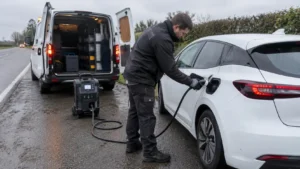
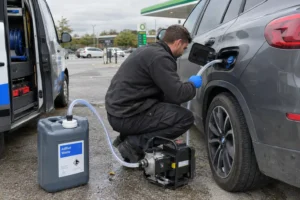
A technician arrives with a drain unit, usually within 30 to 45 minutes depending on where you are and what the traffic is doing. The contaminated fuel is pumped out of the tank into a sealed container and taken away for proper disposal. The system is flushed, the correct fuel is put in, and the engine is started and checked to make sure it runs cleanly before we leave.
The drain itself typically takes 20 to 40 minutes. Most drivers are back on the road within the hour of us arriving. Our step by step guide to wrong fuel recovery walks through the whole process in more detail.
One honest caveat. If the car was driven a significant distance on the wrong fuel, a drain may get it running again but we cannot promise there is no underlying wear to the pump or injectors. We will tell you plainly what we find at the roadside rather than send you off assuming everything is perfect. Fuel that has been through a struggling pump often comes out visibly paler and thinner than clean diesel, and that tells us something about what the car has been through.
Fantastic service much cheaper than others on google came within 25 minutes of call absolutely 100 percent would reccomend > — Jaye Evans, Google review
Searching for wrong fuel in car near me instead of waiting for a tow
A mobile unit reaching you is almost always faster than a recovery truck taking you to a garage that then has to fit you into its schedule.
We work at forecourts, motorway services, driveways, car parks, supermarket filling stations and the roadside. The car does not need to move and you do not need to book anything in advance. If you are not certain we reach your area, our areas we cover page and our guide on how to find a fuel doctor near you will tell you quickly.
Our Google Business Profile has directions, hours and reviews from drivers we have already helped.
Frequently asked questions
Longer than most drivers expect, which is the dangerous part. A diesel car with petrol in it will often start normally and run for anything from a few hundred yards to twenty or thirty miles before the rough running gets bad enough to stop it. A petrol car fed diesel usually misfires within seconds. The engine continuing to run is not evidence that nothing is wrong.
A mobile drain is quoted as a fixed price on the phone before anyone comes out, so you know the figure before you commit. What it saves you is the alternative. Once petrol has damaged a diesel high-pressure pump, the repair involves the pump, the rail, the injectors and a full system clean, and that regularly runs into four figures. On some vehicles it is several thousand.
Turning the key is what turns a contained problem into a spreading one. The pump draws the mixture through the filter, the high-pressure pump and the injectors, then sends the excess back to the tank through the return line. Within a minute the contamination is everywhere in the system rather than sitting in the tank. How much harm that does depends on the distance driven and how hard the engine was worked.
If the engine was never started and the tank is drained, almost certainly not. If it was started, there is no safe threshold anyone can give you honestly. In a nearly full tank one litre is a small percentage and older diesels often shrug it off, but modern common rail systems are far less tolerant. Topping up with more diesel to dilute it does not fix anything. It just circulates a weaker mix.
Q 5. Get the wrong fuel out before it costs you more
Every minute the wrong fuel sits in a system it has been pumped into makes the job bigger. Every minute it sits in a tank with the engine off changes nothing at all. That gap is the whole reason to call now rather than wait and see.
One phone call is all this takes. No tow truck, no garage booking, no leaving the car overnight. A technician comes to you, drains and flushes the system, and you drive away the same hour.
Call Fuel Doctor 247 on 0333 577 5158. We answer 24/7.
About the author
Raees Ahmad is a mobile EV charging and wrong fuel recovery technician at Fuel-doctor247, helping drivers across Greater Manchester, Lancashire and Yorkshire with 10+ years of roadside experience. He and the team attend EV charging, roadside and forecourt call-outs 24/7 and have helped 1,000+ UK drivers get moving again.