
You have just realised the nozzle in your hand was the wrong one. Maybe you are still on the forecourt with the pump running, maybe you are half a mile down the A580 and the car has started to hesitate. Either way, the single most useful thing you can do in the next sixty seconds is leave the key out of the ignition. Wrong fuel incidents in Merseyside are one of the most common call-outs we attend, and the difference between a straightforward drain and a four figure repair bill almost always comes down to what the driver did in the first few minutes.
Why turning the key makes it worse
While the wrong fuel is sitting in the tank and nowhere else, the job is a drain and a flush. The moment the ignition goes on, that changes.
On most modern diesels the ignition alone primes the low pressure lift pump, which starts pulling fuel from the tank towards the filter before the engine has even turned over. Crank it and the contaminated mix reaches the high pressure pump. That pump runs at very fine tolerances and relies on diesel itself for lubrication, because diesel is oily and petrol is not. Petrol acts as a solvent. It thins the lubricating film, metal starts contacting metal, and the pump begins shedding fine debris into the fuel.
That debris is the real problem. Once it is circulating, it travels downstream into the rail, the lines and the injectors, and it cannot be flushed out. Cases that end with a full fuel system replacement usually started as a tank of petrol in a diesel that someone drove home on.
Diesel in a petrol car is less severe but still needs draining. Diesel does not ignite properly against a spark, it fouls the plugs, and running the engine on it can overheat and wreck the catalytic converter.
What we see on Merseyside call-outs
Roughly nine in ten of the misfuel jobs we attend are petrol in a diesel, which matches the picture nationally. The reason is mechanical rather than careless. An unleaded nozzle slips easily into a diesel filler neck, while a diesel nozzle is too wide to fit most modern petrol cars, so the mistake only really goes one way. The RAC has estimated around 150,000 UK drivers misfuel every year, which works out at hundreds a day.
Two patterns come up again and again on our jobs across Liverpool, the Wirral and St Helens:
- Most drivers spot it at the pump and never start the engine. That is exactly the situation we want, and it is why those cars are back on the road within the hour.
- The ones that go wrong are usually small top-ups. Ten or fifteen pounds of the wrong fuel does not stall the car immediately, so the driver sets off, gets a few miles up the M57 or M62, and only stops once the power drops away.
Location matters here more than people expect. If your car dies in the Kingsway or Queensway tunnel, no one is draining anything where you are standing. Tunnel patrols will move the vehicle out to the far side first, and we work on it there. The same goes for a live lane on the motorway. National Highways advice is to get off the carriageway if the car will still move and to stay in the vehicle with your seatbelt on and call 999 if you cannot exit safely.
Fantastic service much cheaper than others on google came within 25 minutes of call absolutely 100 percent would reccomend > — Jaye Evans, Google review]
If you have already started the engine or driven off
Stop as soon as you can do it safely, and do not restart the engine to move a bit further along. Every additional minute of running pushes contamination deeper into the system.
The signs that the wrong fuel has reached the engine are fairly consistent:
- Loss of power under acceleration, often coming and going at first
- A harsh knocking or rattling from the engine, louder than normal diesel clatter
- Heavy smoke from the exhaust, usually white or grey
- Misfiring, hesitation, or the engine cutting out and refusing to restart
- Engine management light coming on, sometimes with limp mode
Once you have stopped, hazards on, keep everyone out of the vehicle and behind a barrier if you are on a fast road. Then call. Our advice on what to do when there is petrol in a diesel car covers the sequence in more detail, and the wrong fuel in Liverpool guide is worth a read if you are inside the city.
AdBlue in the fuel tank is a separate problem
This one catches out drivers of newer diesels, particularly vans, and it does not behave like petrol at all. AdBlue is a urea and water solution meant for its own separate filler, and it is not a fuel.
Put it in the diesel tank and it does not simply mix and burn off. Urea crystallises as it dries and it is corrosive to the metals and seals in a fuel system. Adding more diesel on top does not dilute the problem away, it just spreads it further through the tank and lines. Anyone who tells you to drive it off is giving you expensive advice.
The tank needs draining and thoroughly cleaning, not just emptying, and the sooner it happens the less chance the crystals have to form. We cover the specifics on our AdBlue in the fuel tank page.
What happens when you call for a mobile fuel drain
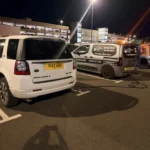
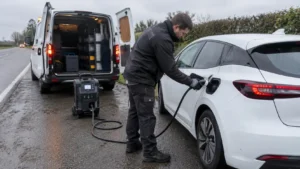
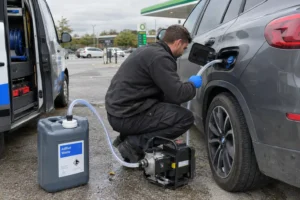
Nobody needs a tow truck or a garage booking for this. The work is done where the car is standing, whether that is a forecourt, a driveway, a car park or the side of the road.
Here is the realistic sequence. The phone is answered 24 hours a day. A technician is usually with you in 30 to 45 minutes anywhere in Merseyside, depending on traffic and where you are. The drain itself takes 20 to 40 minutes: the tank is emptied, the system is flushed through, the contaminated fuel goes into sealed containers for proper disposal, and fresh correct fuel goes in. We start the engine, check it runs cleanly, and you drive away the same hour in most cases.
The contaminated fuel leaves with us. It is a hazardous waste and it is not something to be tipped down a drain or left on the forecourt.
What we cannot tell you over the phone
We are not going to promise your engine is fine, because that depends on things we can only assess when we get to you.
If the engine was never started, the outcome is almost always good and the drain is the end of it. If you drove several miles on a heavy petrol mix in a common rail diesel, there is a real chance the high pressure pump has already suffered, and a drain will not undo that. We will tell you straight if we think that is what has happened rather than take your money and leave you to find out later.
One more thing worth knowing. Misfuel damage is usually excluded from manufacturer warranties, and some makers advise renewing filters and seals even when the engine was never run. If your car is still under warranty, a call to the dealer before you drive it anywhere is time well spent.
FAQ
No, and this is the most expensive myth we deal with. Topping up dilutes the mix but the wrong fuel is still in there, and driving is what does the damage rather than the concentration. The one grey area is a very small splash of petrol in a large diesel tank on an older, non common rail engine. Even then, ask before you turn the key.
It varies with the vehicle, how much wrong fuel went in and where you are, so we quote on the call rather than publish a flat figure. What we can say plainly is that a drain costs a fraction of a high pressure fuel pump and injector replacement, which is what you are risking by driving on. Ask for the price when you ring and you will have it before we set off.
Some breakdown policies include misfuelling assistance and some charge for it as an add-on, so check your documents. Standard car insurance generally treats misfuelling as driver error and will not cover the resulting engine damage. Most people find it quicker to call a mobile drain directly than to wait in a general recovery queue.
Driving is the exact thing that turns a cheap job into an expensive one. A garage a mile away is still a mile of contaminated fuel being pumped through your injectors. Since the drain happens at the roadside anyway, there is no reason to move the car at all.
Straight away in the great majority of cases. Once the system is flushed, fresh fuel is in and the engine has been run and checked, the car goes back to normal service. If the engine was run hard on the wrong fuel beforehand, we may recommend a garage inspection before you take it on a long run.
One call and we come to you
If you are standing next to the car right now, call Fuel Doctor 247 on 07826 035386. The line is answered 24 hours a day, a technician is usually with you inside 30 to 45 minutes anywhere across Liverpool, the Wirral, Sefton, Knowsley and St Helens, and the drain takes 20 to 40 minutes at the roadside. No tow, no garage booking, no waiting days for a slot. You will get the price before we leave. Check where we work in the areas we cover, or find our wrong fuel recovery service on Google Maps.
About the author
Raees Ahmad is a mobile EV charging and wrong fuel recovery technician at Fuel-doctor247, helping drivers across Greater Manchester, Lancashire and Yorkshire with 10+ years of roadside experience. He and the team attend EV charging, roadside and forecourt call-outs 24/7 and have helped 1,000+ UK drivers get moving again.