
If you have put a small amount of petrol in a diesel car, do not start the engine. In a modern diesel there is no amount of petrol that is guaranteed to be safe, because the high pressure fuel pump relies on diesel to lubricate itself. Whether it was 5 litres or 20, the cheapest fix is to have the tank drained before the engine runs.
The amount still matters, though, because it changes how much damage is likely if the engine has already been started. This guide explains what 5, 10 and 20 litres of petrol do in a diesel tank, why the old “top it up with diesel” advice is risky, and exactly what to do now.
Stuck at the pump right now? Call Fuel Doctor 247 on 0333 577 5158 or 0755 456 6460 and we will come to you.
Why Even a Little Petrol Is a Problem in a Modern Diesel
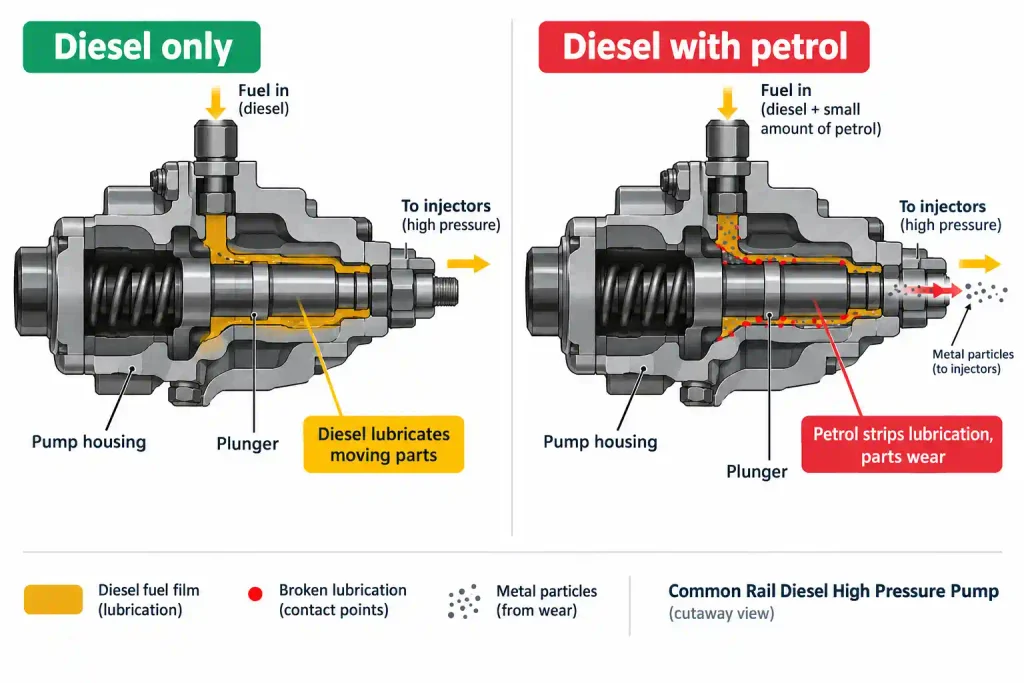
Diesel is an oily fuel, and modern diesel engines depend on that oiliness. Most diesels built in the last 20 years use common rail injection, where a high pressure pump squeezes fuel to well over 1,000 bar before it reaches the injectors. The moving parts inside that pump are lubricated by the diesel flowing through it.
Petrol is a solvent. Mixed into diesel, it thins the fuel and strips away that lubricating film, so metal parts in the pump start to rub against each other. In the worst cases the pump wears and sheds tiny metal particles, which then travel to the injectors and the rest of the fuel system. That is when a cheap drain turns into a pump, injector and fuel line replacement.
Petrol also burns differently. Diesel engines ignite fuel through compression, and petrol does not ignite well that way, so a petrol-heavy mix can cause knocking, misfiring and smoke. Older indirect injection diesels were more forgiving of a splash of petrol, which is where much of the folk advice comes from, but that tolerance does not carry over to modern engines.
5, 10 and 20 Litres of Petrol in a Diesel: What Each Means
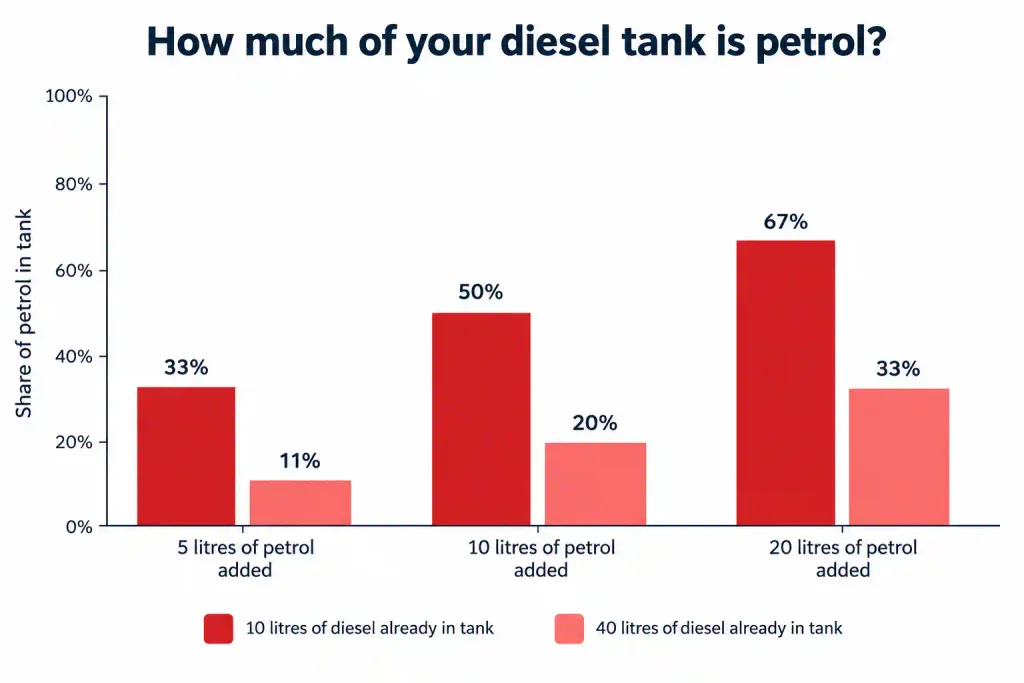
What really matters is the share of petrol in the tank, not the number of litres on the pump display. The same 5 litres is a much bigger problem in a near-empty tank than in a full one:
| Petrol added | Tank already had 10 litres of diesel | Tank already had 40 litres of diesel |
|---|---|---|
| 5 litres | about 33% petrol | about 11% petrol |
| 10 litres | 50% petrol | 20% petrol |
| 20 litres | about 67% petrol | about 33% petrol |
5 litres of petrol in a diesel car
This is the classic “I noticed straight away” situation. If the tank was fairly full, the mix may be around a tenth petrol, and some older diesels might cope. A modern common rail engine is still at risk of pump wear, so the safe answer is a drain, especially as it is usually the quickest and cheapest job of all.
10 litres of petrol in a diesel car
Ten litres is enough to make a serious dent in lubrication, whatever was in the tank. In a low tank it can be half petrol. The engine may start and run for a short while before it begins to knock, smoke or lose power, which is exactly the window in which pump damage happens.
20 litres of petrol in a diesel car
Twenty litres usually means the tank is at least a quarter petrol, and often much more. Running the engine on that mix is very likely to cause damage. We cover this case in detail in our guide to 20 litres of petrol in a diesel car.
Is There a Safe Amount of Petrol in a Diesel?
For a modern diesel, no. You will often hear that anything under 5% petrol is fine. That figure comes from older diesel engines with lower pressure pumps, which tolerated a little petrol better. Today’s common rail systems run at far higher pressures and tighter tolerances, and the fuel pump has no other source of lubrication.
Vehicle makers do not publish a “safe” petrol percentage for their diesels, and some pump damage does not show up straight away. A car can seem to drive normally on a weak mix, then develop a pump or injector fault weeks later. Paying for a drain now is far cheaper than gambling on that.
Can you just top up with diesel?
Topping up with diesel lowers the percentage of petrol, but it does not remove it. Every drop of the mix still passes through the high pressure pump. It also means there is now more contaminated fuel to drain if problems appear. Unless your vehicle handbook specifically allows it for your engine, do not rely on dilution as a fix.
What to Do If You Have Put a Small Amount of Petrol in Your Diesel
- Stop filling straight away. Every extra litre makes the mix stronger.
- Do not start the engine or switch on the ignition. On many diesels the ignition primes the fuel pump, which starts moving the mix through the system.
- Push the car clear of the pump with the engine off. Ask forecourt staff to help, and put it in neutral.
- Note how much petrol went in and how much diesel was already there. It helps the technician judge the job.
- Call a mobile fuel drain service. The tank can be drained and flushed where the car stands, with no tow and no risk of driving on the mix. This is exactly what our mobile petrol in diesel drain is for.
If you have already driven
Pull over as soon as it is safe, switch off and leave it off. Signs the petrol has reached the engine include knocking, misfiring, white or grey exhaust smoke, a loss of power, the engine management light and, eventually, the engine cutting out. Here is a closer look at the signs of petrol in a diesel car. Do not restart it to see if it clears, because each restart pushes more of the mix through the pump.
How a Small Amount of Petrol Is Removed, and What It Costs
A small misfuel is handled the same way as a full tank. The technician drains the tank into a sealed recovery container, flushes the fuel lines, checks or changes the diesel fuel filter, refills with clean diesel and starts the engine to test it. Our guide to how a mobile fuel drain works walks through each step.
The amount of petrol has little effect on the price of a drain done before the engine runs. What pushes the cost up is running the engine on the mix, because that can mean a new high pressure pump, injectors or fuel lines on top of the drain. Time of day, location and the size of the tank also play a part. For a fuller breakdown, see how much it costs to fix wrong fuel in the UK.
If the opposite happened and diesel went into a petrol car, read our guide to a small amount of diesel in a petrol car instead.
Frequently Asked Questions
In a modern common rail diesel, there is no amount that is guaranteed to be safe. Even a small share of petrol reduces the lubrication the high pressure pump needs, so the safest option is always to drain the tank before starting the engine.
It can be. In a full tank it makes a weak mix, but a modern diesel pump can still wear. In a low tank, 5 litres can be a third of the fuel. A drain before starting the engine removes the risk.
Ten litres can make anything from around a fifth to half of the tank petrol, depending on how much diesel was already in it. The car may start and run briefly, then knock, smoke or lose power. Do not start it; have it drained.
Dilution lowers the percentage but does not remove the petrol, and it all still passes through the fuel pump. Unless your handbook says it is acceptable for your engine, have the tank drained instead.
Not always. Some cars run normally for a while, but pump wear can develop and show up later as a fuel pump or injector fault. That delayed risk is why a drain is recommended even for small amounts.
Usually 30 to 60 minutes on site if the engine has not been started. It takes longer if the car has been driven and the system needs extra flushing.
Put Petrol in Your Diesel? Call Fuel Doctor 247
Whether it was a splash or a full fill, keep the engine off and call us. We cover Greater Manchester, Lancashire, Merseyside, Cheshire, Derbyshire and Yorkshire, come to the car and drain, flush and refill it on site.
Call 0333 577 5158 or 0755 456 6460, or contact us online. Not sure if we reach you? Check the towns and cities we cover.
You Mix It. We Fix It.