
You have either just met this question in theory test revision, or you have felt your car slow by itself when you lifted off the accelerator and wondered what was doing it. The short answer covers both. You feel the effects of engine braking whenever you release the accelerator with the car in gear, and you feel them most strongly when you change to a lower gear, which is the answer the theory test is looking for. We work on engines at the roadside every day, so here is what is actually happening under the bonnet and how to use it properly.
The theory test answer and what it means on the road
The official question asks when you will feel the effects of engine braking, and the correct answer is when you change to a lower gear. The reasoning is simple once you see it. Engine braking exists any time your foot is off the accelerator in gear, but its strength depends on engine speed. Drop a gear and the engine spins faster for the same road speed, so the slowing effect multiplies.
Try it on a quiet road. Lift off in fifth at 40mph and the car eases off gently. Change down to third at the same speed and you feel a firm, immediate check, as if the car has leaned back against a hand. That difference is the whole exam point.
The reverse matters just as much for the test and for real driving. Press the clutch or knock the car into neutral and engine braking disappears entirely. That is coasting, and Rule 122 of the Highway Code warns against it precisely because it takes away this layer of control.
What actually slows the car when you lift off
Engine braking is the engine resisting being turned by the wheels instead of driving them. Lift off the accelerator and the throttle closes, so a petrol engine is trying to suck air past a shut plate on every intake stroke. That pumping effort, plus the work of compressing air in the cylinders, drags engine speed down, and because the car is still in gear, it drags road speed down with it.
Modern engines add a bonus most drivers never notice. On overrun, the engine management cuts fuel to the injectors completely, since the wheels are keeping the engine turning for free. Engine braking down a long hill uses no fuel at all, which is one reason instructors push it.
Diesels behave differently, and drivers switching between the two feel it straight away. A diesel has no throttle plate strangling its intake, so its natural engine braking is weaker than a petrol’s. That is exactly why lorries carry separate exhaust brakes, and why a diesel driver descending a steep hill should pick a lower gear a little earlier than they would in a petrol car.
Using engine braking on hills, and why your brakes will thank you
Around Greater Manchester you do not have to drive far to find descents that punish brake-only driving. The drops off Snake Pass and the Woodhead route into the valleys are long enough to overheat brakes that are used continuously, and we have smelt the results in laybys at the bottom often enough to know plenty of drivers still ride the pedal the whole way down.
The problem is brake fade. Friction brakes turn speed into heat, and on a long descent the discs and pads can climb past the temperature where they grip properly, right when you need them most. Engine braking produces no such heat build-up, so the safe pattern is to select a lower gear at the top of the hill and let the engine hold your speed, saving the brake pedal for adjustments.
The old rule of thumb still works: whatever gear got you up the hill will hold you going down it. On snow and ice the same technique earns its keep twice over, because slowing through the engine is gentler and less likely to lock a wheel than braking.
Great service and reasonable price,told me technician will come between 45 – 60 minutes,technician came before 45 minutes.Will definitely recommend. ” Judith Munthali “
When engine braking suddenly feels wrong
Engine braking is also a free diagnostic, because you feel it every single journey without thinking about it. When lifting off suddenly produces surging, jerking, or barely any slowing at all in a car that used to check firmly, something in the engine or fuel system has changed.
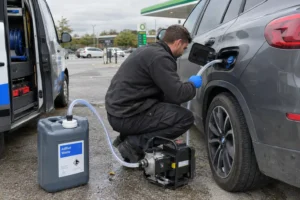
One cause we deal with constantly: the wrong fuel. On our call-outs across Greater Manchester, drivers who filled up with the wrong pump and kept going often describe the car feeling strange on lift-off before the more famous symptoms arrive, the hesitation and rough running showing up as the contaminated mix works through the system. If your engine started behaving oddly within minutes of a fuel stop, stop driving and check your receipt, because a petrol and diesel mix damages the fuel pump more with every mile. Our petrol in diesel fuel drain page explains what happens next, and we attend forecourts and roadsides throughout our Greater Manchester coverage area.
So pleased we could help quickly! Misfuelling can feel like a nightmare, but that’s why our mobile fuel drain team in Greater Manchester is on call around the clock. Getting it sorted within an hour of your enquiry is exactly the standard we hold ourselves to. Thanks for trusting Fuel Doctor 247 — we really appreciate it! ” John Fitton “
FAQ
No. Engine braking is a normal, designed-for way of slowing, and on overrun most modern engines cut fuel entirely, so it costs nothing to use. The one thing to avoid is forcing a gear change so aggressive that the engine screams toward the red line, which strains the clutch and drivetrain. Change down one gear at a time, let the revs settle, and the technique only ever saves wear on your brakes.
It uses less, and usually none. When you lift off the accelerator in gear, the engine management on modern cars stops injecting fuel because the wheels are keeping the engine turning. Coasting in neutral actually burns more, since the engine must idle on injected fuel to keep itself running. Engine braking down a hill in gear is the most economical way down as well as the safest.
Petrol engines create strong engine braking because a closed throttle forces them to work hard just pulling air in. Diesels have no throttle plate, so that pumping resistance mostly is not there, leaving only compression and friction to slow things. The difference is normal, not a fault. Compensate by selecting a lower gear slightly earlier on descents than you would in a petrol car.
Use both for what each does best. Brakes are for accurate, deliberate slowing and stopping, and brake lights warn drivers behind you, which engine braking does not. Engine braking earns its place on long descents, in slippery conditions, and for gentle speed control in traffic. The combination that examiners want to see is early lift-off and sensible gears, with the footbrake doing the precise work.
Engine trouble that started at the pump? Call us
If your car began running rough, surging, or losing power right after refuelling anywhere in Greater Manchester, ring Misfuel Doctor on 07826 035386 before driving further. The line is answered 24/7, we will tell you on the phone whether it sounds like a misfuel, and if it does, a technician typically reaches you in 30 to 45 minutes. The drain and flush takes 20 to 40 minutes, and most drivers are moving again within the hour. Recent jobs are reviewed on our Google reviews for roadside fuel recovery.
About the author
Raees Ahmad is a mobile EV charging and wrong fuel recovery technician at Fuel-doctor247, helping drivers across Greater Manchester, Lancashire and Yorkshire] with 10+ years of roadside experience. He and the team attend EV charging, roadside and forecourt call-outs 24/7 and have got 1,000+ UK drivers moving again.