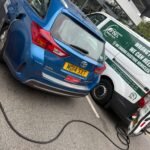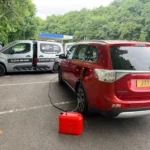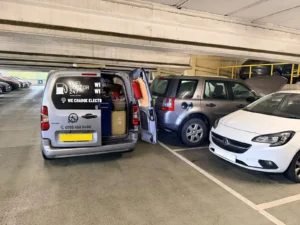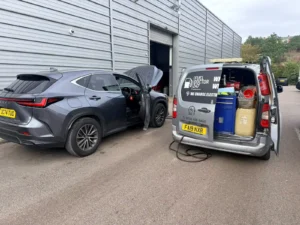

Mobile EV charging is a service that brings a portable charger to your electric car, wherever it has stopped, and gives it enough charge to get you moving again. It is designed for the moment an EV has run flat or is too low to reach a charger, not as a replacement for charging at home or at public chargers.
This guide explains how a mobile charge works from the call to driving away, how much range to expect, which cars and connectors it suits, and when it is the right option compared with waiting for a flatbed.
If your car is low or has run out of charge right now, see our mobile EV charging service or call 0333 577 5158.
What Mobile EV Charging Is (and What It Is Not)
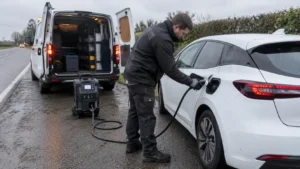
Mobile EV charging, sometimes called roadside or emergency EV charging, is the electric car equivalent of a technician bringing fuel to a car that has run out. A van carries a portable charging unit, the technician connects it to your car’s charge port, and the car takes on enough energy to drive to a proper charger.
It helps to be clear about what it is for:
- It is a top-up, not a full charge. The aim is to give you enough range to reach the nearest working public charger or get home safely.
- It comes to you. The car is charged where it stopped, in a lay-by, car park, workplace or on a driveway, so it does not need to be loaded onto a flatbed.
- It is not a fix for a fault. If the car has a problem other than a flat battery, such as a 12V battery failure or a drivetrain warning, it may still need recovery to a garage.
As EVs become more common on UK roads, more drivers are getting caught out by cold weather, broken chargers or a longer journey than planned. A mobile charge is the quickest way out of that situation for many of them.
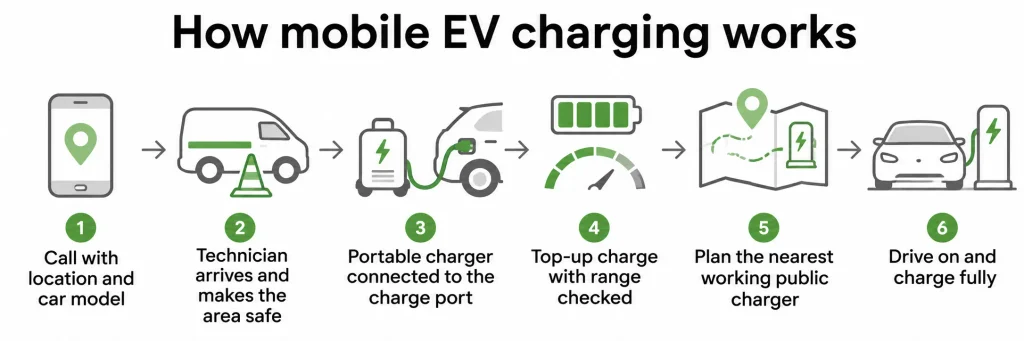
How Mobile EV Charging Works, Step by Step
- You call with your details. Give your location, the make, model and year of the car, and roughly how much charge is left. This tells the technician which connector to bring.
- The technician arrives and makes the area safe. On a roadside or in a car park, the van is positioned to protect the car and the cable run.
- The charger is connected. The portable unit plugs into your car’s charge port, just like a public charger. The car’s own systems manage the charge, as they do at any charge point.
- The car takes on a top-up. The technician watches the charge and the car’s range estimate until there is enough to reach a charger safely.
- You plan the next stop together. Before the technician leaves, pick a working public charger within your new range. Apps such as Zap-Map show live availability.
- You drive to a full charge. Charge properly at the next stop rather than relying on the top-up.
How Much Range Does a Mobile Charge Give?
A mobile charge is sized to get you to the next charger, so the range you leave with depends on how far that charger is and on a few things about your car and the conditions:
- The charging unit: we use an AC charger, which adds range more gently than a rapid charger at a motorway services. That is why a mobile charge focuses on getting you to the next charger rather than filling the battery.
- Your car’s efficiency: a small hatchback covers more miles per unit of energy than a large SUV.
- Battery temperature: a cold battery accepts charge more slowly, so winter top-ups can take longer.
- How flat the battery was: a car that has stopped completely may need a little longer before it is ready to drive.
- How you drive afterwards: motorway speeds, heating and hills all use range faster than steady town driving.
Your technician will tell you how much range the car is showing before they leave, so you know exactly what you have to work with. If the nearest charger is further than a top-up can comfortably cover, they will tell you that too, rather than leave you short again.
Which Cars Can Be Charged? Connectors Explained
Our mobile charger is an AC unit, so it connects to your car’s AC charging socket, the same one you would use with a home wallbox or a standard public post. That covers almost every electric car on UK roads:
| Car’s charging socket | What it is | Works with our AC mobile charger? |
|---|---|---|
| Type 2 | The standard AC socket on almost every EV and plug-in hybrid sold in the UK | Yes |
| CCS | Type 2 socket with two extra DC pins below, on most modern EVs | Yes, through the Type 2 part of the socket |
| Type 1 | Older AC socket on some early models, such as early Nissan Leaf versions | Confirm when you call |
| CHAdeMO | DC rapid socket on some older models | Not used: these cars also have a separate AC socket for charging |
You can usually tell which socket you have by looking at the charge port or checking the handbook. When you call, give the make, model and year, and the technician will confirm they have the right lead before setting off.
Plug-in hybrids: these can also run out of battery charge, but they still have a petrol engine to fall back on, so a mobile charge is rarely needed. If a hybrid has run out of fuel instead, that is a fuel problem, not a charging one.
When Is a Mobile Charge the Right Call?
A mobile charge makes the most sense when:
- The car has run flat or is too low to reach a charger, and there is no other fault showing.
- It should not be towed on its wheels. Many EVs can be damaged if the drive wheels turn while being towed, so a charge where the car stands avoids loading it onto a flatbed.
- The nearest charger is broken or busy, and you need just enough to reach the next one.
- You are at home or work without a charger, and need enough range for an urgent journey.
A flatbed or garage visit is the better choice when the car shows a warning for something other than low charge, when it will not respond after charging, or when the 12V battery has failed and the car cannot be unlocked or switched on.
If you are reading this at the roadside, our guide on what to do when an electric car runs out of charge covers staying safe while you wait.
Frequently Asked Questions
Mobile EV charging is a service that brings a portable charger to an electric car wherever it has stopped and gives it enough charge to reach a public charger or get home.
A technician arrives in a van with a portable charging unit, connects it to your car’s charge port and delivers a top-up charge. The car manages the charge as it would at any charge point.
No. It is a top-up designed to get you to the next charger. Charge fully at a public charger or at home afterwards.
Very likely. Our mobile charger is an AC unit that plugs into the Type 2 socket found on almost every EV sold in the UK, including cars with CCS. A few older models use a Type 1 socket, so give your make, model and year when you call.
Many EVs should not be towed with their drive wheels on the ground. If the car must be moved, it should go on a flatbed. For a simple flat battery, a mobile charge avoids moving the car at all.
It depends on the car, the charging unit, the battery temperature and how much range you need to reach the next charger. The technician will tell you how much range you have before you drive off.
Need a Mobile EV Charge? Call Fuel Doctor 247
If your electric car is low or has run flat, get somewhere safe and call us. We provide mobile EV charging across the North of England, giving you enough range to reach the nearest public charger.
Call 0333 577 5158 or 0755 456 6460, or send us your details. Check whether we cover your town on our areas we cover page.