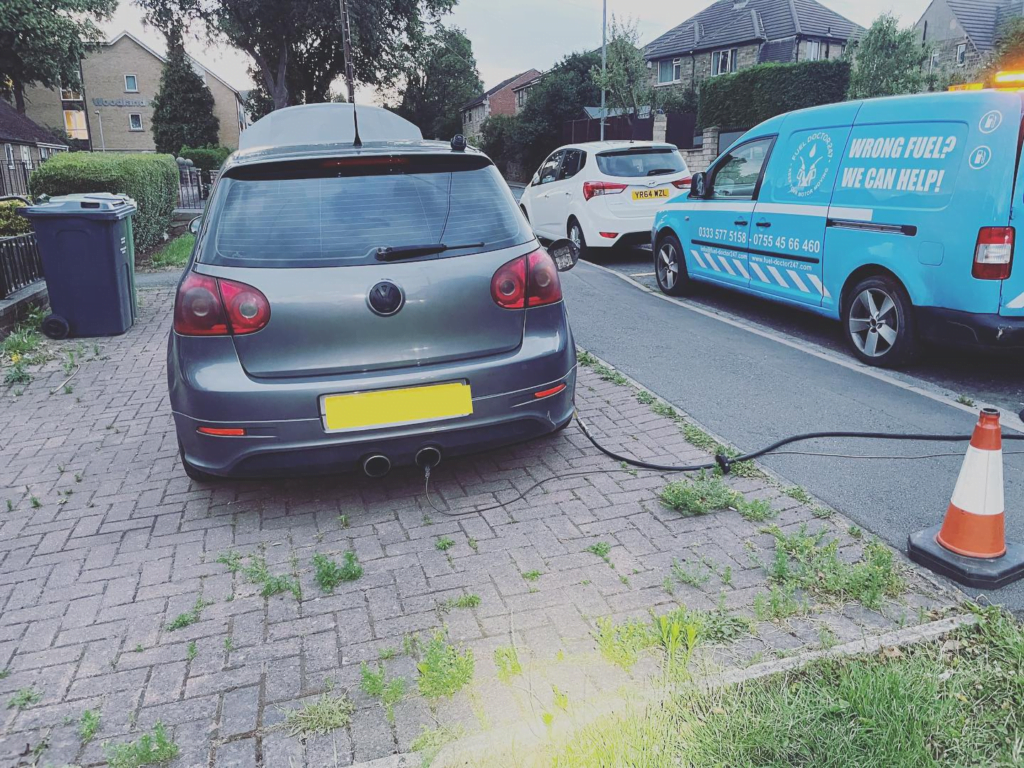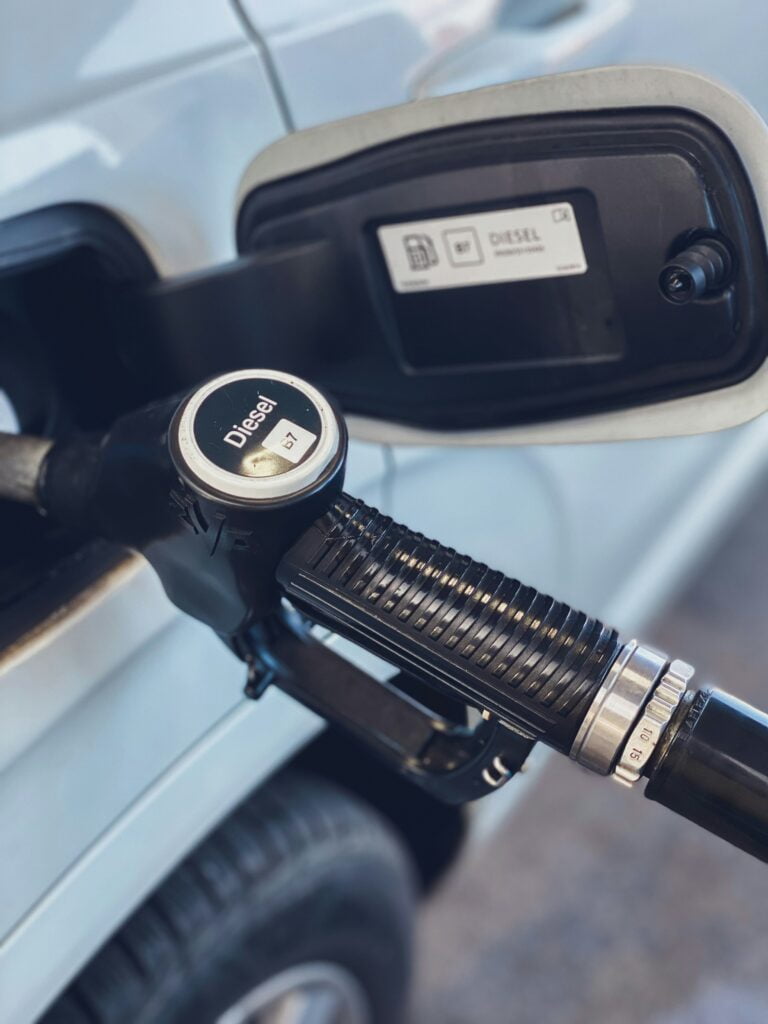
It is quite stressful when you put petrol in diesel car as it leads to extreme damage. Of course, your vehicle is your asset and you don’t want to waste this investment. Certainly, it happens accidentally however, the considerable thing is to feel the mistake and take quick action. Petrol in diesel car symptoms can help you recognize the severity of the situation. A little distraction can turn the game so one needs to know how to fix petrol in a diesel car to overcome the mishap. Filling petrol in diesel car is not the end, driving the vehicle can cause destruction. This guide will help you know the after-effects of miss fuelling. It will also provide sufficient fixing solutions.
After Effects When Petrol in Diesel Car
Petrol and diesel have distinctive properties for different car engines. When you put even a small amount of petrol in diesel car, it turns the situation entirely putting your vehicle in a big risk. Let’s look at what happens to your car after wrong fuelling:
1- Mismatched with Engine:
Petrol in diesel car stops the performance of the engine as petrol burns faster than diesel and results in slower acceleration. This also causes damage to filter media along with other internal components.
2- Incomplete Burning of Petrol:
Petrol doesn’t completely burn in diesel engines so the exhaust produces black smoke this unburnt fuel can cause severe damage. However, you can get an idea from these symptoms that something is wrong with your vehicle.
3- Reduce Engine Power:
Diesel requires more energy and when putting petrol in a diesel car, the engine doesn’t produce the required energy. This shows a considerable reduction in power, which results in the inactiveness of the engine.
4- Lubrication Difficulty:
Petrol in diesel car symptoms also include lubrication concerns. Petrol is not suitable for lubricating the fuel pump and injector because it is diesel‘s specialty. Thus, this situation leads to severe damage to the engine.
How to Bring Your Vehicle Back on the Road
If you realize your mistake as soon as you put a small amount of petrol in a diesel can help you save your vehicle from severe damage. With the help of a few considerations you can overcome this panic situation let’s read and follow:
1- Don’t Start the Engine:
Starting an engine after putting the petrol in diesel car can reduce the power of the engine so stop it immediately if it is running if you want your car again on the road.
2- Professional Help is Crucial:
Never try to fix miss fuelling let it do the experts. Only a professional wrong fuel doctor can help you. To come out of this panic. He can drain the petrol from the diesel engine expertly giving a new life to your vehicle.
3- Help Diagnose the issue with crucial detail:
Explain the details to the mechanic such as the type of engine, amount of wrong fuelling, whether you start the engine or not, and so on. This information may help the wrong fuel fixer how to fix petrol in a diesel car giving you a chance to drive again the car.
Steps involve in Fixing Car Engine
After asking the professional help the mechanic may take some effective steps that can help fix the car engine along with internal components:
Drainage of contaminated fuel
Flush the fuel and remaining traces
Replacement of injector and fuel filter
Remember, only quick action will reduce the loss and prevent the vehicle from severe panic.
Final Thoughts
Petrol in diesel car is not a big deal many do this; however, how to fix petrol in a diesel car is a crucial consideration. Wrong fuelling affects your car engine’s performance reducing its speed and power. After filling Petrol in a car you need to take immediate action to prevent the car from severe damage. With a few considerations such as, don’t start the engine, call for skilled help, and proper drainage you can get your vehicle back to hit the road.
FAQS
How can I know the wrong fuelling in my car?
With a few symptoms you can recognize the miss fuelling such as unusual knocking, emission of black smoke, and engine reluctance are the common signs of wrong fuelling.
What should I do if I put in the wrong fuel by mistake?
Immediately stop the engine, contact to skilled wrong fuel doctor, ensure the complete drainage of the wrong fuel, and check the authenticity of the internal components.
Is professional help crucial to fixing the wrong fuelling?
Of course, fixing miss fuelling by a professional fuel fixer can ensure the stability of your vehicle. So, avoid the self-fixing and let it be done by the expert hands. Only a pro can handle the problem.
Worried about the disaster of 20 liters of petrol in a diesel car? Stay calm, you are not the first, many make this mistake. However, knowing the solutions you can handle the situation preventing your investment from a severe loss. Once you have committed the wrong fuelling mistake, only timely and wise decisions and the right steps can help you come out of this disgusting situation. This guide is for those who have filled petrol in diesel cars and looking for ways to resolve the issue. Let’s read and try to bring your car back on the road.
What Happens When Petrol in Diesel Car? A Big Mishap
Petrol is not designed for diesel cars, similarly same is the case with diesel. When put petrol in a diesel car (mistakenly), the disaster starts putting your vehicle at big risk. Here is a breakdown of what happens after 20 liters of petrol in a diesel car.
· Lubrication Problems:
In a diesel engine, the fuel pump and injectors get their lubricant from diesel while petrol is not a good lubricating agent. When you fill petrol in a diesel car, it reduces the efficiency of the oil and causes of damage to the internal components.
· Clogging—Affects Engine Efficiency:
When you put petrol in a diesel car, it breaks down the filter media due to its high detergent content and damages the engine by supplying unfiltered fuel to all engine components. There is no doubt that 20 liters of petrol in a diesel car is a lot that can be wasted due to stoppage and makes a deep dent in your wallet.
· Cause Combustion Concerns:
Incomplete combustion lowers the performance of the engine and it happens when you put petrol in a diesel car. Infect petrol needs a spark plug to quickly ignite whereas diesel needs a high ratio of compression. Thus, the wrong fueling is the key concern for insufficient combustion and resulting in knocking and reducing the engine power. Unusual smells and black smoking are also considerable concerns.
Consider Expert’s Recommendations & Minimize 20 Liters of Trouble
1. Do Not Start the Engine:
If you want to minimize the trouble of 20 liters of petrol in a diesel car, stop the engine at once after putting the wrong fuel otherwise the contaminated fuel will reach all engine components. This circulation reduces the engine capacity causing severe damage. So, don’t overlook this crucial concern.
2. Strive for Recovery:
To save your vehicle from further damage quickly contact a specialized mechanic who can handle the situation expertly. Inform him about the whole situation along with the amount of 20 liters of petrol in a diesel car so that he can understand the situation clearly and may help you out of this hard problem.
3. Avoid Self Help & Leave it to the Experts:
Making one mistake after another is absurd! So, avoid self-help in this disgusting situation and immediately call for expert help. If you try to fix the problem by yourself, it will create a new concern putting you in serious trouble. Let the professional tackle the situation.
4. Be Open to Detail:
After putting petrol in a diesel car, you have to face a range of problems so, ask for professional help explain the whole situation to get the best solution. Tell the mechanic about your vehicle type, quantity of petrol such as 20 liters, and whether your car engine was stopped or not. This information will assist in comprehensively fixing the problem.
5. Avoid Online Suggestions:
Be calm after filling 20 liters of petrol in a diesel car. No doubt, it’s a big concern however; following the online suggestions may lead to further issues. Only look for professional assistance that can save you investment by providing effective solutions.
Additional Recommendations – You Need to Know
Miss fueling may lead to a severe loss however timely actions can handle the situation. The professional mechanic may address the concern by following actions:
Draining of contaminated fuel
Thorough flushing of remaining petrol residue
Checking engine components like injectors, and fuel pump and repairing damaged ones
Ensure the proper cleaning flushing and repairing
Final Thoughts
Petrol in diesel car or vice versa is a common mistake by the drivers. However, with proper guidelines and recommendations, you can overcome the situation. Of course, the dent of 20 liters of petrol in a diesel car may prevent you put the wrong fuel in your vehiclenext time. With above mentioned guidelines you can save your car and let it back on the road again.
FAQS
What recommendations should I consider to prevent mistakenly filling petrol in a diesel car?
No doubt, many people do this accidentally however; once you commit a wrong fuelling mistake, avoid it next by considering these pieces of advice:
Consider nozzle size; Before filling, check the pump for the required fuel
What are the potential risks of driving the car with petrol in diesel the vehicle?
A. Driving with petrol in a diesel car reduces the engine power due to lubrication issues, affecting fuel pump, smoke, and injector damage.
Can expert advice help me save my vehicle from further damage?
Certainly, professional’s recommendations will help you to come out of the difficult situation and minimize the car damage so don’t overlook these guidelines if you want to run your vehicle again.
You have just filled a petrol car with diesel, or you think you have, and you are standing at the pump wondering how bad this is. Here is the short version from people who drain this mistake for a living: if the engine has not been started, this is one of the easier misfuels to put right. If you have already driven off, it is still fixable, but the job gets bigger with every mile. What happens if you put diesel in a petrol car comes down almost entirely to that one question, so let us deal with the next two minutes first, then explain what is going on inside the engine.
Diesel in a petrol car: what to do in the next two minutes
Do not start the engine. That includes turning the key to the position where the dashboard lights come on, and on keyless cars it includes pressing the start button without your foot on the brake. On most modern cars that first click primes the fuel pump, and the pump does not care what is in the tank. It will push diesel up the fuel line towards the injectors before the engine has turned a single time.
If you are still at the pump, put the car in neutral, ask the forecourt staff to help you push it to a bay, and tell them what has happened. Staff see this every week and they will not be surprised. Leave the fuel cap open and the filler flap up so nobody else tries to be helpful and start it for you.
If you are on the road and the engine is already running, the advice changes slightly. Pull over as soon as it is safe, switch off, and do not attempt to restart it to “see if it clears”. It will not clear. Every restart pulls more diesel through the system and the drain and flush take longer as a result.
Then make one phone call. A mobile fuel drain means no tow, no garage booking and no waiting for a recovery truck to move the car twice. Our team covers the North West, Yorkshire and the wider North of England, and you can check your area on our areas we cover page.
Why a petrol engine cannot run on diesel
Petrol and diesel engines ignite fuel in completely different ways, and that difference is the whole story here.
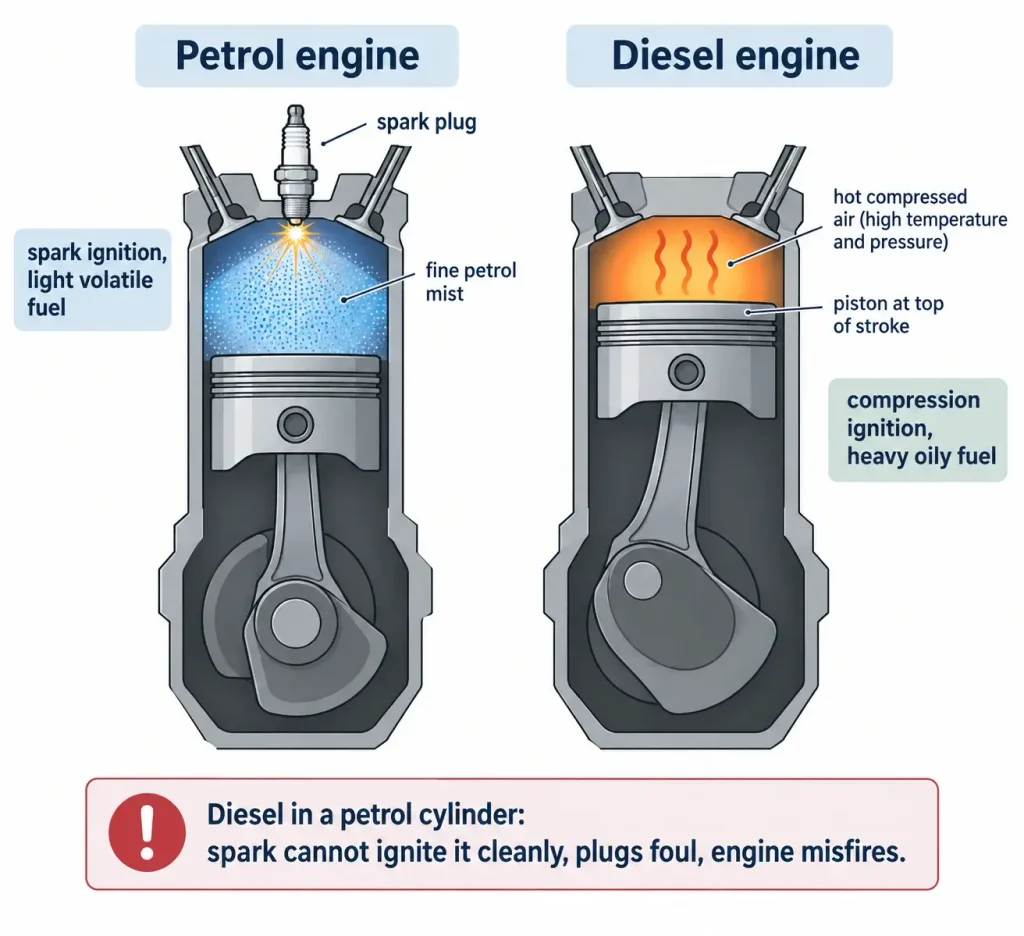
A petrol engine sprays a fine, easily vaporised mist of petrol into the cylinder and lights it with a spark plug. Diesel does not vaporise like that. It is heavier, oilier and far less volatile, which is exactly why a diesel engine ignites it with compression and heat instead of a spark. Put diesel in front of a spark plug and, for the most part, nothing happens. The plug fires into a wet, oily mist that will not catch cleanly.
What you get instead is a partial burn. Some of the diesel ignites late and badly, the rest coats the spark plugs and the inside of the cylinder in a black, sooty film. The plugs foul, the engine misfires, and the unburnt diesel ends up in the exhaust as thick white or grey smoke. Keep running it and that unburnt fuel reaches the catalytic converter, which is where the expensive damage can start.
The one piece of good news is that diesel is a lubricant. Unlike petrol in a diesel car, where the petrol strips the oil film from the high-pressure pump, diesel in a petrol system does not dry anything out. The fuel pump and lines are not being ground down while you decide what to do. The RAC’s wrong fuel advice says the same: diesel in a petrol car is the less serious of the two mistakes. That only holds if the wrong fuel comes out before it has been pushed through the whole system.
What happens if you started the engine or drove off
On most diesel-in-petrol call-outs we attend, the driver noticed at the pump. The black diesel nozzle is physically larger than the green petrol one and it does not sit cleanly in a petrol filler neck, so people often get a few litres in, feel that something is wrong, and stop. Those are the simple jobs. The diesel is still in the tank, nothing has been circulated, and it is a straightforward drain, flush and refuel.
The harder jobs are the ones where the driver did not notice until the car started to play up a mile or two down the road. If that is you, this is roughly what you will have felt, in order:
The engine started on whatever petrol was still in the lines and ran normally for a short while.
As diesel reached the injectors, the idle turned lumpy and the car began to hesitate or judder under acceleration.
Smoke from the exhaust, usually white or grey, sometimes with a strong diesel smell.
Loss of power, then the engine cutting out and refusing to restart, or starting and dying again.
If you got as far as the engine stalling, expect the spark plugs to need cleaning or replacing. When we pull plugs on a petrol car that has been run on diesel they come out wet and black, and no amount of flushing fixes a fouled plug from the outside. If the car was driven for a longer period, the catalytic converter may have taken damage from unburnt fuel, and that is something a garage needs to check once the fuel system is clean. Whether either of those applies to your car depends on how much diesel went in and how far you drove, and we will tell you plainly on site rather than guess over the phone.
How much diesel is too much in a petrol car
This is the question we get asked most on the phone, usually in the form of “it was only a couple of litres, will it be alright”. The honest answer has two parts.
A very small amount of diesel, mixed into a nearly full tank of petrol, will often burn through with nothing worse than a slightly rough idle and some smoke. There is no fixed safe percentage we would put our name to, because it depends on the engine, how full the tank was and how the car is driven. Some engines tolerate a litre in forty. Others will foul the plugs on much less.
The second part is the one that matters at the pump: you very rarely know the exact mix. Fuel gauges are not precise, people misremember how much was in the tank, and the diesel sits at the bottom where the pickup is. Because the drain is quick and the plugs are not, we drain rather than gamble, and we say so on every call. If you want the longer version of this, we have covered it in our post on a small amount of diesel in a petrol car.
“What a service thank you so much was with me within half an hour and fixed my bike, really nice to talk to and reassured me . Thank you so much again for your help ” – Nicola
What a mobile diesel-in-petrol drain involves
When you call, the first thing we ask is whether the engine has been started and roughly how much went in. That tells us what kit to bring and how long you will be waiting. Typical arrival is 30 to 45 minutes in our core areas, and we come to wherever the car is: forecourt, roadside, your driveway or a work car park.
The drain itself is not complicated, which is why it does not need a garage. We connect to the tank, pump the contaminated fuel out into a sealed container for licensed disposal, then flush the lines with clean petrol so that what reaches the injectors afterwards is fuel, not a diesel-petrol mix. If the engine was run, we will look at the plugs and tell you whether they need attention. Then we put enough clean petrol in to get you to a pump and run the engine to check it starts and idles as it should. On a car that was never started, the whole thing usually takes 20 to 40 minutes.
There is no safe number we would stand behind. A litre or two in a near-full tank of petrol will often burn through with some smoke and a rough idle, but the same amount in a quarter-full tank can foul the spark plugs. Because you rarely know the true mix at the pump, and because a drain is quicker and cheaper than a set of plugs and a catalytic converter check, we recommend draining rather than driving on.
What happens if I put diesel in my petrol car by mistake and have not started it?
Very little, and that is the point. The diesel is sitting in the tank and has not reached the pump, lines or injectors. A mobile drain removes it, flushes the lines and refuels the car, and in most cases the engine is none the wiser. This is by far the most common version of the job we attend, and it is the easiest to put right.
How long can you drive with diesel in a petrol car?
Not far, and you should not try. The car will run on the petrol left in the lines, then begin to misfire and smoke as the diesel reaches the injectors, and eventually stall. Every restart pushes more diesel through the system, adds to the clean-up and raises the chance of fouled plugs. If it has started to judder, pull over, switch off and leave it.
How long does it take for diesel to damage a petrol engine?
The spark plugs are the first casualty and they can foul within minutes of running on a heavy diesel mix. Damage to the catalytic converter from unburnt fuel is a slower process and depends on how far the car was driven. The internal parts of the engine itself are usually unaffected by a short run, because diesel lubricates rather than strips. How much of this applies to your car depends on the mix and the distance, which is why we look at the plugs on any car that was driven.
What are the symptoms of putting diesel in a petrol car?
A lumpy idle, hesitation or juddering when you accelerate, white or grey exhaust smoke with a diesel smell, a noticeable loss of power, and finally the engine cutting out and refusing to restart. If the car has not been started yet you will see none of these, and that is the situation to aim for.
Speak to us now
If you are reading this at the pump or on the hard shoulder, you have already done the hard part by not driving on. Call Fuel Doctor 247 on 0333 577 5158 or 0755 456 6460. The line is answered 24 hours a day, we will ask two quick questions about what went in and whether the engine ran, and a technician will be with you in roughly 30 to 45 minutes across our coverage area. The drain and flush typically take 20 to 40 minutes and you drive away the same hour. No tow, no garage booking, and we tell you exactly what we found before we leave.
You have poured AdBlue into the diesel filler, or you have a horrible feeling you might have, and you want to know how bad it is. The honest answer is that AdBlue in the fuel tank by mistake is the one misfuel where the clock matters most, and the one where not starting the engine makes the biggest difference. Leave the key alone and this is a drain and flush. Start it and drive, and you can be looking at a fuel pump and injectors instead. Here is what we see on these call-outs, what is actually happening in the tank, and what to do in the next few minutes.
AdBlue in the fuel tank: what to do before anything else
Do not start the engine, and do not switch the ignition on to check a warning light. On most modern diesels the first click of the key primes the fuel pump, and AdBlue sitting at the bottom of the tank is exactly what the pickup will draw first. Keyless cars are the same: pressing start without your foot on the brake still wakes the fuel system.
If the car is still at the pump or on the drive, leave it where it is. Put it in neutral and push it clear of the pump if the forecourt staff ask, but do not roll it far, because some tank designs slosh the AdBlue layer up towards the pickup.
If the engine is already running, pull over as soon as it is safe and switch off. Do not restart it “to see if it clears”. AdBlue does not clear. Every second the engine runs, more of it is pulled through the filter into the high-pressure pump.
Then make one call. We come to the car, wherever it is, and you do not need a tow or a garage slot. You can check your area on our areas we cover page.
Why AdBlue is worse in a diesel tank than petrol is
AdBlue is not a fuel and it is not an additive. It is roughly a third urea and two thirds deionised water, made to be sprayed into the exhaust so the SCR catalyst can turn nitrogen oxides into nitrogen and water. Arval’s driver guide puts the mix at 32.5 percent high-purity urea in demineralised water. Every part of it is wrong for a fuel system.
Three things happen the moment it goes into a diesel tank.
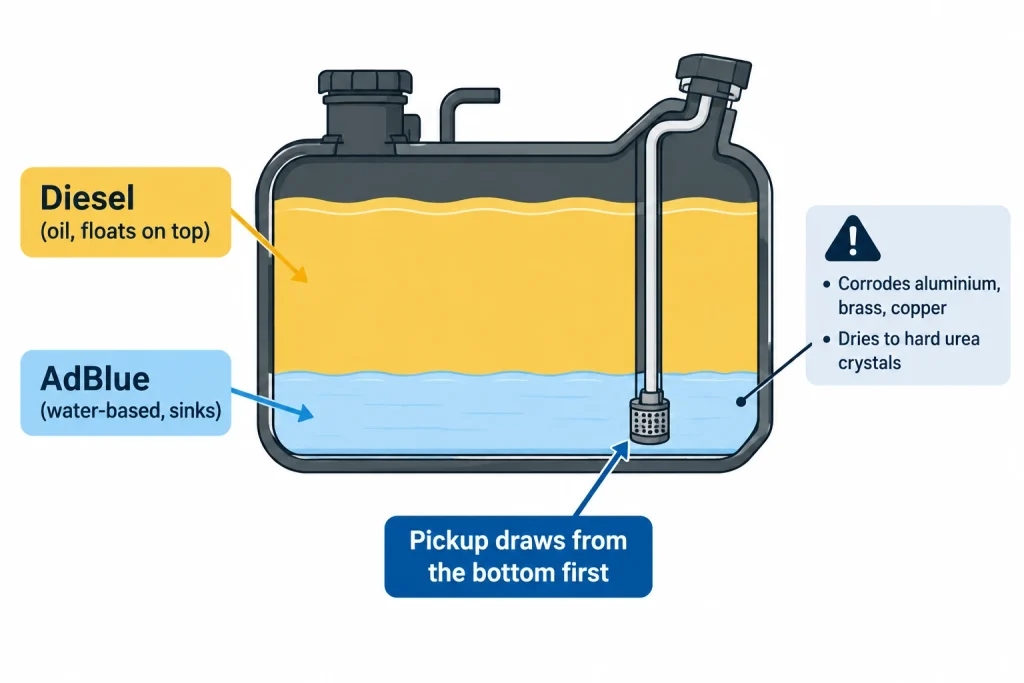
It does not mix. Diesel is an oil and AdBlue is water, so the AdBlue sinks straight to the bottom of the tank in a clear layer. When we drain these cars the separation is obvious in the container: diesel on top, a clear or slightly milky layer underneath. The problem is that the bottom of the tank is where the fuel pickup sits.
It corrodes. Urea solution attacks aluminium, brass, copper and zinc, which is most of what a fuel pump, injector body, pressure sensor and tank level sender are made from. Left in the tank overnight it starts to mark the metal.
It crystallises. As the water evaporates the urea dries into a hard white residue. On cars that have sat for a day or more we sometimes find it around the filler neck. Inside a pump or injector that residue is abrasive, and it does not flush out.
Petrol in a diesel car is a lubrication problem. AdBlue in a diesel car is a water, corrosion and crystal problem all at once, which is why we treat it as the most urgent of the three common misfuels. The costs involved are covered in our post on why misfuelling with AdBlue is so costly.
What happens if the engine was started or driven
On most AdBlue call-outs we attend, the driver was topping up from a bottle or an AdBlue pump and put the nozzle in the black cap instead of the blue one beside it. They usually realise partway through, so the amount is often somewhere between a litre and a full 10 litre bottle. The ones who stop there and ring us are the simple jobs.
The harder jobs are where the car was started. This is roughly what people describe to us on the phone:
The engine started and ran normally for a short stretch on the diesel already in the lines.
Within a few hundred metres it began to hesitate, then misfire.
Loss of power, sometimes an engine management or emissions warning, then a stall with the engine refusing to restart.
If you got as far as the misfire, the AdBlue has reached the high-pressure pump. A common rail pump runs at very high pressure and relies on diesel for lubrication. Water gives it none, so the pump can score or seize, and any pump debris travels straight on to the injectors. On a driven car we drain, flush and then assess the pump and injectors with you. We will not tell you the engine is fine over the phone, because until the system is clean and the car has been run we do not know, and neither does anyone else.
Some drivers get lucky with a very small amount and a quick stop, and the drain is enough. Others need a pump and injectors, which on a modern diesel is a repair bill well into four figures. Which side of that line you fall on depends on the volume of AdBlue, how full the tank was, and how far you drove. That is why the advice is always the same: switch off, leave it, ring.
“Fantastic service, great technician, great price. I definitely would recommend.” – David Pearson, Google review
How we remove AdBlue from a fuel tank
Getting AdBlue out is not the same as draining petrol from a diesel, and it is not a job for a siphon hose on the driveway. The AdBlue layer sits at the bottom and clings to the tank floor, so a partial drain leaves the worst of it behind.
When we arrive we ask two questions: how much went in, and did the engine run. Then the job runs like this:
Drain the whole tank into a sealed container for licensed disposal, taking the bottom layer first so the AdBlue comes out with the diesel rather than staying behind.
Flush the tank and the fuel lines with clean diesel until what comes through is clean fuel with no cloudy or separated layer.
On a car that was started, check and usually replace the fuel filter, because it will have taken the first hit, and inspect the lines back to the pump.
Refuel with enough clean diesel to reach a pump, run the engine, and check it starts, idles and pulls as it should.
Typical arrival is 30 to 45 minutes in our core areas, and on a car that was never started the drain and flush takes 20 to 40 minutes. The full service is described on our AdBlue in fuel tank drain page. If it is the other way round and you have put diesel into the AdBlue tank, that is a different job with its own risks, and we have covered it in our post on a small amount of diesel in the AdBlue tank.
What a service thank you so much was with me within half an hour and fixed my bike, really nice to talk to and reassured me . Thank you so much again for your help ” – Nicola
How to stop it happening again
Nearly every AdBlue misfuel we see has the same cause: two caps under one flap, filled in a hurry. A few habits cut the risk almost to nothing.
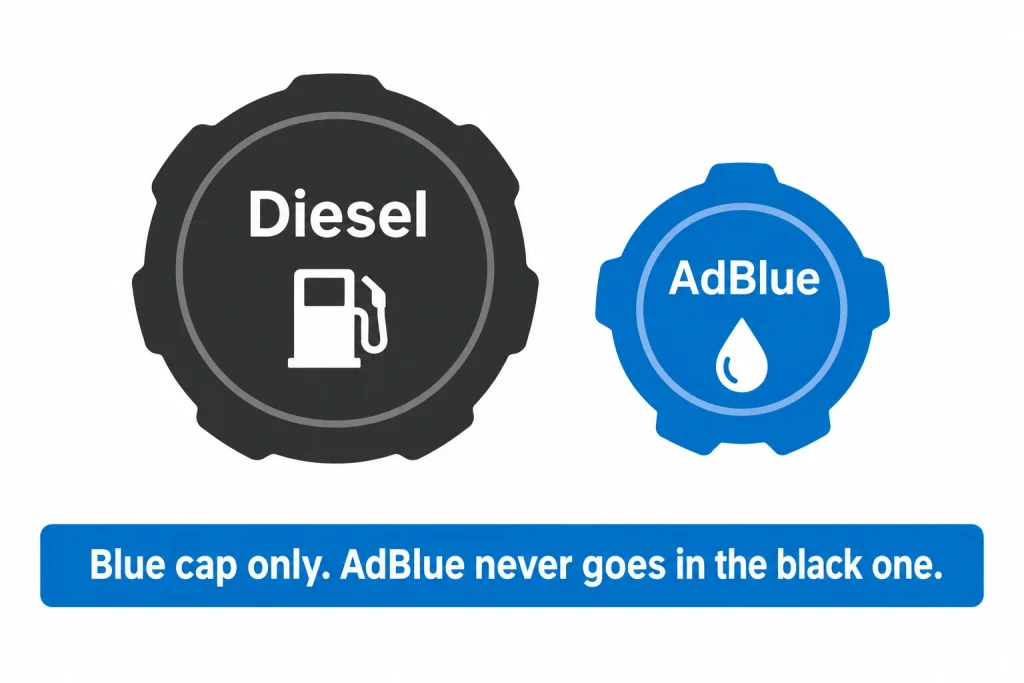
Check the cap colour before the nozzle goes in. AdBlue caps are blue. Diesel caps are black, and often bigger.
Read the label on the bottle or the pump twice. AdBlue pumps at HGV bays have a nozzle that fits a car’s diesel filler, which is how a lot of van drivers get caught.
Fill AdBlue at home or at a service, not on a busy forecourt, if your car has a filler that sits right beside the diesel one.
If a warning light asks for AdBlue, top up the AdBlue tank only. It is never a fuel tank additive.
FAQ
What happens if I put a little bit of AdBlue in my diesel tank?
Even a small amount matters, because it sinks to the bottom where the fuel pickup is. Half a litre in a full tank may burn through with nothing worse than a rough run, but the same half litre in a quarter-full tank can reach the pump within the first mile. We do not put a number on what is “safe” because you rarely know the true mix at the pump. A drain is quick and cheap next to a pump and injectors, so we drain.
How do you remove AdBlue from a fuel tank?
The whole tank is drained into a sealed container, bottom layer first so the AdBlue comes out rather than staying behind, then the tank and lines are flushed with clean diesel until the fuel runs clear. On a car that was started, the fuel filter is checked and usually replaced. Siphoning from the filler neck does not work, because it takes the diesel off the top and leaves the AdBlue underneath.
Does AdBlue dissolve in diesel?
No. AdBlue is water-based and diesel is an oil, so they separate straight away, with the AdBlue sinking to the bottom of the tank. This is why the mistake is dangerous even in small amounts: the AdBlue does not get diluted through the tank, it collects exactly where the pump draws from. When we drain these cars you can see the two layers in the container.
Will AdBlue damage a diesel engine?
The engine itself is rarely the casualty. The damage is to the fuel system: the high-pressure pump, which has no lubrication from water and can score or seize, then the injectors, which take any debris from the pump, plus corrosion of aluminium and brass parts if the AdBlue sits in the system. If the engine was never started, none of that has begun, and a drain and flush is usually the end of it.
What should I do if I accidentally put AdBlue in my petrol tank?
Do not start the engine, and treat it the same way as a diesel: leave the car where it is and call for a drain. Petrol cars do not use AdBlue, so this usually happens when a bottle meant for another vehicle goes in the wrong car. The corrosion and crystallisation risks are the same. We have covered that situation separately in our post on <a href=”https://fuel-doctor247.com/blog/what-happens-if-i-put-adblue-in-my-petrol-car/”>what happens if you put AdBlue in a petrol car</a>.
Speak to us now
If you are reading this next to the car with the engine off, you have already done the most important thing. Call Fuel Doctor 247 on 0333 577 5158 or 0755 456 6460. The line is answered 24 hours a day, we will ask how much went in and whether the engine ran, and a technician will be with you in roughly 30 to 45 minutes across our coverage area. The drain and flush typically takes 20 to 40 minutes and you drive away the same hour. No tow, no garage booking, and we tell you exactly what we found before we leave.
Plenty of drivers often make the mistake of filling their cars with the wrong fuel. However, a timely decision may help you save your vehicle from severe damage being your car gets back on the road. If you are one of those who has filled the car tank with the wrong fuel and looking for ways to resolve the problem quickly, this comprehensive guide will help you overcome your mistake with the help of a skilled wrong fuel doctor giving you useful insights preventing your vehicle from further damage.
Don’t Panic, If Wrong Fuel In Your Car – Here’s What to Do!
Of course, wrong fuelling in your car tank can be heart-stopping act especially when you fill the tank getting late from the essential meetings and the car breaks down ruining all your efforts and you feel helpless having no quick solution. After knowing your mistake you should take into account some consideration to get the car back on the road. These considerations, certainly, will help you hire the wrong fuel doctor who can play a significant role in saving your wallet from further damage.
Consider the Prompt Actions
After discovering your mistake of filling the wrong fuel, take below mentioned action if you want to save your investment:
1. Don’t Turn the Key:
Turing the key after wrong filling can change the entire situation giving you the chance of permanent regret so never commit this mistake. Immediately contact the professional wrong fuel doctor to handle the situation. The expert technician will drain the wrong fuel allowing you to hit the road again.
2. Identify the Situation:
Knowing of the situation regarding miss fuelling your car tank may help you overcome the situation. If you have filled your petrol car with diesel or vice versa, you can inform the wrong fuel doctor providing him an opportunity to be prepared regarding the solution before dealing with the task. The technician may take a quick and appropriate action reducing the chance of severe harm along with your wallet.
3. Avoid Self Drainage:
Only expert hands can save your investment so don’t try to remove the wrong fuel by yourself. Call for the expert wrong fuel doctor to cater to the task of having an impeccable experience. Remember, self-drainage causes horrible issues.
4. Stay Put and Call for Help:
Stay where you have filled the wrong fuel in your car and don’t move. Inform the well-known wrong fuel doctor minimizing the risk of damage.
Considerable Checks to Prevent Wrong Fuelling
Certainly wrong fuelling is not a deliberate act it happens mistakenly however with the help of a few checks you can save your bank from a big dent:
· Avoid using smart phones while refueling your vehicle as they divert your attention
· Consider fuel cap tag
· Use a filler neck stopper
· Take into account the pump trigger sticker
With the help of the above-mentioned thoughts and the quick availability of the wrong fuel doctor, you can reduce the risk of severe damage to your car. Wrong fuelling can be a manageable process only with quick action and prevent the vehicle from starting.
How long does drainage take?
It depends on your vehicle model and the expertise of the wrong fuel doctor. Sometimes wrong fuelling damages the capacity of vehicle components such as filters and so on.
Final Thoughts
Several drivers commit wrong fuel fill mistakes which cause damage the expensive vehicles. However, quick action can save your wallet. Contact to expert wrong fuel doctor, and discuss the issue. With careful action, the mechanic drains the wrong fuel easily providing you a chance to bring your car back on the road. Apart from that, the above guide will also help you minimize the wrong fuel-filling concern
FAQ’s
If I mistakenly fill my car with the wrong fuel what should I do first?
Never start your car’s engine in case of wrong fueling because starting the engine will provide the wrong fuel to all parts of the engine which causes severe damage.
How can I know if my petrol car is filled with diesel?
The receipt can help you know about the wrong fuelling or the staff may know the type of fuel application. Fuel nozzles also help recognize the wrong fueling mistake.
Should I drain the wrong fuel from my car by myself?
Never experiment with the wrong fuel damage by yourself as it can cause a serious misshape in terms of damage to the vehicle components, or improper removal of the wrong fuel.
What should I do after having the wrong fuel mistakenly?
Don’t start the vehicle and call for the best knowledgeable wrong fuel doctor to tackle the situation. Discuss the situation with the technician to get a safe solution.
Mistakenly adding diesel to a petrol vehicle is a more common scenario than many might think, especially in the hustle and bustle of daily life. It’s a mistake that can cause significant stress, particularly for those unaware of the potential consequences and the steps needed to resolve the issue. This article aims to shed light on what happens when a small amount of diesel ends up in a petrol car, the implications for the vehicle, and how to address the situation effectively.
Understanding the Impact of Diesel in a Petrol Engine:
Petrol and diesel engines operate on fundamentally different principles. Petrol engines use spark ignition to combust the fuel, whereas diesel engines use compression ignition. This critical difference means that even a small amount of diesel in a petrol engine can cause issues.
When Diesel Meets Petrol: The Immediate Effects
Adding diesel to a petrol car, even in small amounts, can lead to several immediate and longer-term problems. Initially, the engine may exhibit signs of distress, such as difficulty starting, a power reduction, and an uneven or rough idle. These symptoms occur because diesel is less volatile than petrol and does not vaporize as easily, leading to incomplete combustion in a petrol engine.
Long-Term Consequences for Your Engine
Over time, the presence of diesel can lead to more severe damage. Diesel’s oily consistency can foul spark plugs and clog the fuel system, including injectors and filters. Additionally, the improper combustion process can deposit soot and other contaminants within the engine and exhaust system, potentially leading to increased wear and tear.
Steps to Take After Adding Diesel to a Petrol Car
Do Not Start the Engine: If you realize the mistake before starting the car, do not turn on the ignition. Starting the engine circulates the contaminated fuel, increasing the risk of damage.
Seek Professional Assistance: The safest action is to tow the vehicle to a service station where professionals can drain and clean the fuel system. This process involves removing the diesel from the petrol tank, flushing the fuel lines, and replacing any components that may have been contaminated.
Fuel System Check: After the contaminated fuel has been removed, a thorough check of the fuel system components, including filters and injectors, is crucial to ensure no lasting damage has occurred.
Prevention Tips:
To prevent the stress and potential damage caused by adding diesel to a petrol car, consider the following tips:
Always double-check the fuel nozzle before refueling.
Use a fuel cap or filler neck device to avoid inserting the wrong fuel nozzle.
Stay focused and avoid distractions during the refueling process.
Conclusion:
Accidentally adding a small amount of diesel to a petrol car can lead to significant problems if not addressed promptly and properly. Understanding the potential impacts and taking the steps immediately after the mistake can save you from costly repairs and extended downtime. Always prioritize prevention and remain vigilant during refueling to avoid this common yet avoidable error.
🛠️Contact us now for immediate assistance. Let’s safeguard your vehicle’s performance and longevity together.
Mistakenly filling your vehicle with the wrong fuel type is a surprisingly common mishap that can lead to significant mechanical issues, stress, and unexpected expenses. This comprehensive guide aims to shed light on the problem of using the wrong fuel in Macclesfield, exploring the consequences, prevention strategies, and the vital services available to address this issue.
Key Points Overview:
Common Mistake: Filling a vehicle with the wrong fuel type is a common error that can lead to severe engine damage and unexpected expenses.
Consequences Explored: The article delves into the consequences of wrong fuel use, prevention strategies and available services in Macclesfield.
The Wrong Fuel Dilemma: An Overview
Fueling errors, specifically adding petrol to a diesel tank or vice versa, can cause severe damage to your vehicle’s engine. In Macclesfield, a town with a bustling population and a significant number of motorists, the incidence of such mistakes is noteworthy. The issue concerns not only the immediate inconvenience but also the potential long-term damage to your vehicle’s fuel system and engine.
Wrong Fuel Macclesfield: The Immediate Steps
Realization of Mistake: Recognize the error immediately to prevent further damage.
Avoid Engine Start: Do not start the vehicle to prevent the wrong fuel from circulating.
Experienced Technicians: These services employ skilled technicians for the fuel draining process.
Importance of Professional Help: Opting for expert service is crucial to avoid complications and ensure proper handling of the situation.
The Technicalities of Wrong Fuel Removal
Removing the wrong fuel from a vehicle involves several technical steps. Initially, the wrong fuel Macclesfield technicians will assess the situation to determine the amount of incorrect fuel and the potential damage. Following this, they will drain the tank, flush the fuel system with the correct fuel type, and ensure the vehicle is safe to drive. This process mitigates the immediate risks and helps prevent long-term damage to the engine and fuel system.
Prevention and Awareness: Key to Avoiding Wrong Fuel Mistakes
Awareness and preventive measures are crucial in avoiding the wrong fuel mishap. Simple practices such as double-checking the fuel type before refueling and using a fuel reminder tag can significantly reduce the risk of such errors. Moreover, raising awareness about the availability of wrong fuel services in Macclesfield encourages drivers to act promptly and appropriately in case of a fueling mistake.
The Importance of Wrong Fuel Services in Macclesfield
The availability of the wrong fuel services in Macclesfield is not just a convenience but a necessity. Given the potential for significant vehicle damage and the associated costs, having access to reliable and professional wrong fuel removal services is invaluable for drivers in the area. These services provide peace of mind, knowing that a solution is readily available in case of an unfortunate fueling error.
Conclusion:
In conclusion, the issue of using the wrong fuel in Macclesfield requires attention, awareness, and preparedness. By understanding the risks, knowing the immediate steps to take, and recognizing the value of professional wrong fuel removal services, drivers can better protect themselves and their vehicles from the adverse effects of such incidents. Remember, in the event of a wrong fuel mistake, prompt action and professional assistance are your best recourse.
Call us immediatelyhow we can assist you in this stressful situation. Don’t wait until it’s too late –prompt action can save your vehicle from serious damage. Trust Macclesfield’s leading wrong fuel specialists to take care of your car with the expertise and care it deserves.
In the bustling city of Bradford, with its myriad vehicles crisscrossing the streets, the occasional slip of putting the wrong fuel in one’s car is more common than many might think. Such an error, seemingly simple at the outset, can lead to complex problems, demanding swift and knowledgeable intervention. This comprehensive guide aims to illuminate the wrong fuel mishaps in Bradford, offering insights into their implications, immediate response strategies, professional recovery solutions, and preventive measures to help drivers steer clear of such predicaments.
Understanding the Gravity of Wrong Fuel Mistakes
Wrong fuel errors occur when diesel is mistakenly filled into a petrol vehicle or petrol into a diesel vehicle. Given the mechanical and operational differences between diesel and petrol engines, using the wrong fuel type can severely impair engine function and cause significant damage in worst-case scenarios.
Immediate Consequences:
For Diesel Engines: Petrol acts as a solvent, stripping away the lubrication inside diesel engines, which can lead to increased friction and damage to internal parts.
For Petrol Engines: Diesel, being thicker, can clog the fuel system of a petrol engine, leading to reduced efficiency, potential misfires, and smoke emissions.
Critical Steps Following a Wrong Fuel Error in Bradford
The moment you realize the mistake, taking immediate action can significantly mitigate potential damage:
Do Not Start the Engine: This prevents the wrong fuel from circulating through the system.
Move Your Vehicle Safely: If possible, push your car to a safe location without starting it.
Bradford boasts many professional services ready to address wrong fuel mishaps. When choosing a service, prioritize:
24/7 Availability: Wrong fuel incidents can happen at any hour, necessitating round-the-clock service.
Expertise and Experience: Opt for technicians who are well-versed in handling a variety of vehicles.
Reputation: Look for services with positive reviews and a track record of effective and efficient solutions.
Preventing Wrong Fuel Incidents in Bradford: Key Tips
Adopting certain practices can dramatically lower the chances of a wrong fuel error:
Always Double-Check: Before fueling, confirm your vehicle’s required fuel type.
Utilize Reminder Tools: Fuel reminder stickers on your cap or dashboard can be effective prompts.
Spread Awareness: Educate anyone else driving your vehicle about its fuel needs.
Get to Know Your Vehicle: Familiarization reduces the risk of mistakes, especially when switching between diesel and petrol vehicles.
Invest in Prevention: Some vehicles come equipped with misfuelling prevention devices. If yours does not, it might be worth the investment.
Conclusion
While wrong fuel mishaps in Bradford can be daunting, understanding how to handle such situations effectively can ease the stress and potential damage. Immediate action, coupled with the support of professional recovery services, is crucial. Moreover, preventive measures can significantly reduce the likelihood of these incidents, safeguarding your vehicle’s health and peace of mind. Armed with the knowledge and strategies outlined in this guide, drivers in Bradford can navigate the roads with an added layer of security against the pitfalls of wrong fuel errors.
Act Now:
Call us immediately if you’ve put the wrong fuel in your vehicle. The sooner you act, the lesser the damage.
Save our number, 07554566460, on your phone so you’re always prepared for any fuel-related mishaps on the road.
Your peace of mind is our top priority. Trust us to handle your wrong fuel emergency with expertise and care. Contact us today, and let us take the worry off your shoulders.
In the bustling region of West Yorkshire, vehicles form the backbone of daily commutes, business logistics, and leisure travels. Yet, amidst this constant flow of motion, a simple yet impactful error occurs with surprising frequency: the misfueling of vehicles. This article highlights the essential service provided to those who inadvertently introduce petrol into diesel engines or diesel into petrol tanks, focusing on the expertise of wrong fuel correction services in West Yorkshire.
Understanding the Wrong Fuel Problem in West Yorkshire
Misfueling, while a common oversight, brings immediate stress and potential harm to your vehicle. West Yorkshire, with its diverse array of vehicles, sees many of these incidents, prompting the need for specialized intervention.
The Immediate Response to Wrong Fueling
Realizing you’ve filled your tank with the wrong fuel can be a moment of panic. The steps you take next are crucial:
Do not start the engine. This prevents the wrong fuel from circulating through your car’s system, reducing potential damage.
Contact a professional immediately for the wrong fuel service in West Yorkshire. Expert help is essential for mitigating risks and resolving the issue efficiently.
Wrong Fuel West Yorkshire Services: What to Expect
Services aimed at correcting wrong fuel mishaps in West Yorkshire are designed to be comprehensive and efficient, ensuring minimal disruption to your day and safeguarding your vehicle’s integrity. Expectations include:
Rapid Response: Professionals understand the urgency and typically arrive promptly.
Fuel Draining and System Checks: They will drain the incorrect fuel, flush the system, and refill with the correct fuel, conducting necessary checks to ensure your vehicle is safe to drive.
The Importance of Professional Intervention
The complexity of fuel systems means that DIY fixes can often do more harm than good. Professional services offered:
Expertise and Equipment: Professionals have the necessary tools and know-how to handle various vehicle types.
Safety and Efficiency: Their methods ensure the problem is resolved correctly without compromising your vehicle’s performance or safety.
Preventing Wrong Fuel Mistakes
Prevention is always preferable to correction. Here are some tips to avoid misfueling:
Always double-check the fuel type before you start filling.
Use a fuel reminder sticker on your fuel cap or dashboard as a visual cue.
Stay focused at the pump, avoiding distractions during the fuel selection process.
Conclusion: The Safety Net for Drivers in West Yorkshire
The wrong fuel correction services in West Yorkshire stand as a critical support system for drivers, providing peace of mind and ensuring the region’s vehicular activities continue smoothly. Whether it’s diesel in a petrol engine or vice versa, the expertise available within West Yorkshire ensures that a simple mistake doesn’t turn into a major ordeal. As vehicles continue to traverse the roads of this vibrant region, the readiness and capability of wrong fuel correction services underscore a commitment to safety and excellence in automotive care.
Are you accidentally filled up with the wrong fuel in West Yorkshire? Don’t panic! Click here for immediate assistance from our expert team and ensure your vehicle is handled carefully and precisely. Get back on the road safely and swiftly with our trusted wrong fuel solutions. Act now!
In vehicular mishaps, few incidents cause as much panic and concern as putting the wrong fuel in a car. The scenario of mistakenly adding petrol to a diesel engine, or vice versa, is not uncommon and necessitates immediate attention. In this article, we will delve into the specifics of wrong fuel incidents in West Yorkshire, shedding light on the challenges faced by vehicle owners and professionals tasked with resolving this draining situation.
Wrong Fuel West Yorkshire: A Common Predicament
Wrong fuel incidents have become increasingly prevalent in West Yorkshire and many other parts of the UK. The bustling urban environment and hectic daily routines make drivers susceptible to such mistakes. Whether due to distraction, unfamiliarity with the vehicle, or sheer oversight, putting the wrong fuel in a car can lead to severe consequences for the engine and overall vehicle performance.
The substance of the Service: Wrong Fuel West Yorkshire
In the landscape of automotive services, the expertise to rectify wrong fuel incidents is crucial. The phrase wrong fuel West Yorkshire encapsulates the specialized services offered to individuals facing this predicament. As a provider in this industry, understanding the intricacies of fuel types, engine systems, and the draining process is paramount to ensuring effective and efficient assistance.
Navigating the Draining Job: A Delicate Undertaking
Resolving a wrong fuel incident involves draining the contaminated fuel from the vehicle’s system. This task is both delicate and demanding, requiring precision and expertise to prevent further damage to the engine. The professionals in West Yorkshire engaged in this draining job must comprehensively understand different vehicle models, fuel systems, and the potential repercussions of such mistakes.
Rising Incidence in West Yorkshire:
The urban environment and fast-paced lifestyle contribute to increasing wrong fuel incidents in West Yorkshire.
Distractions, lack of familiarity with the vehicle, and oversight are common factors leading to these fueling mistakes.
Professional Expertise: A Saving Grace in Wrong Fuel Incidents
Time becomes critical when a driver realizes they have added the wrong fuel. Immediate intervention is necessary to mitigate damage to the engine and other components. The services encapsulated by “Wrong Fuel West Yorkshire” are designed to provide swift and professional assistance. Trained technicians equipped with specialized tools can efficiently drain the contaminated fuel, minimizing the impact on the vehicle.
Preventing Long-Term Damage: A Top Priority
The consequences of driving with the wrong fuel can range from reduced engine efficiency to severe damage. By seeking professional assistance under the umbrella of “wrong fuel West Yorkshire,” vehicle owners can prevent long-term damage and ensure their vehicles are back on the road in optimal condition. Timely intervention saves money on potential repairs and offers the distressed driver peace of mind.
Prevention is often the best cure, and education plays a pivotal role in the context of wrong fuel incidents. Initiatives aimed at raising awareness about the differences between petrol and diesel, as well as providing guidelines for handling fueling procedures, can significantly reduce the occurrence of such mishaps. Collaborative efforts involving fuel stations, automotive associations, and educational institutions can contribute to a more informed and cautious driving community in West Yorkshire.
Public Awareness Campaigns: Shaping a Responsible Driving Culture
In addition to educational initiatives, public awareness campaigns focused on the risks and consequences of wrong fuel incidents can further contribute to a responsible driving culture. Highlighting real-life scenarios, potential damages, and the availability of professional services under the umbrella of wrong fuel in West Yorkshire can empower drivers to take precautions and avoid these stressful situations altogether.
Conclusion:
In the dynamic landscape of automotive services, the phrase “wrong fuel West Yorkshire” encapsulates a specialized field dedicated to rectifying a common yet challenging vehicular mishap. Resolving wrong fuel incidents requires technical expertise and a commitment to swift intervention to minimize potential damages. As the industry continues to evolve, collaborative efforts in education and awareness can play a pivotal role in reducing the frequency of wrong fuel incidents and fostering a more responsible and informed driving community in West Yorkshire.
Act now to resolve the wrong fuel issues in South Yorkshire! Contact us for swift and professional assistance. Don’t let a simple mistake disrupt your journey – trust our expert team to get you back on the road quickly. Call us today!
We use cookies to ensure that we give you the best experience on our website. If you continue to use this site we will assume that you are happy with it.