
You have just filled a petrol car with diesel, or you think you have, and you are standing at the pump wondering how bad this is. Here is the short version from people who drain this mistake for a living: if the engine has not been started, this is one of the easier misfuels to put right. If you have already driven off, it is still fixable, but the job gets bigger with every mile. What happens if you put diesel in a petrol car comes down almost entirely to that one question, so let us deal with the next two minutes first, then explain what is going on inside the engine.
Diesel in a petrol car: what to do in the next two minutes
Do not start the engine. That includes turning the key to the position where the dashboard lights come on, and on keyless cars it includes pressing the start button without your foot on the brake. On most modern cars that first click primes the fuel pump, and the pump does not care what is in the tank. It will push diesel up the fuel line towards the injectors before the engine has turned a single time.
If you are still at the pump, put the car in neutral, ask the forecourt staff to help you push it to a bay, and tell them what has happened. Staff see this every week and they will not be surprised. Leave the fuel cap open and the filler flap up so nobody else tries to be helpful and start it for you.
If you are on the road and the engine is already running, the advice changes slightly. Pull over as soon as it is safe, switch off, and do not attempt to restart it to “see if it clears”. It will not clear. Every restart pulls more diesel through the system and the drain and flush take longer as a result.
Then make one phone call. A mobile fuel drain means no tow, no garage booking and no waiting for a recovery truck to move the car twice. Our team covers the North West, Yorkshire and the wider North of England, and you can check your area on our areas we cover page.
Why a petrol engine cannot run on diesel
Petrol and diesel engines ignite fuel in completely different ways, and that difference is the whole story here.
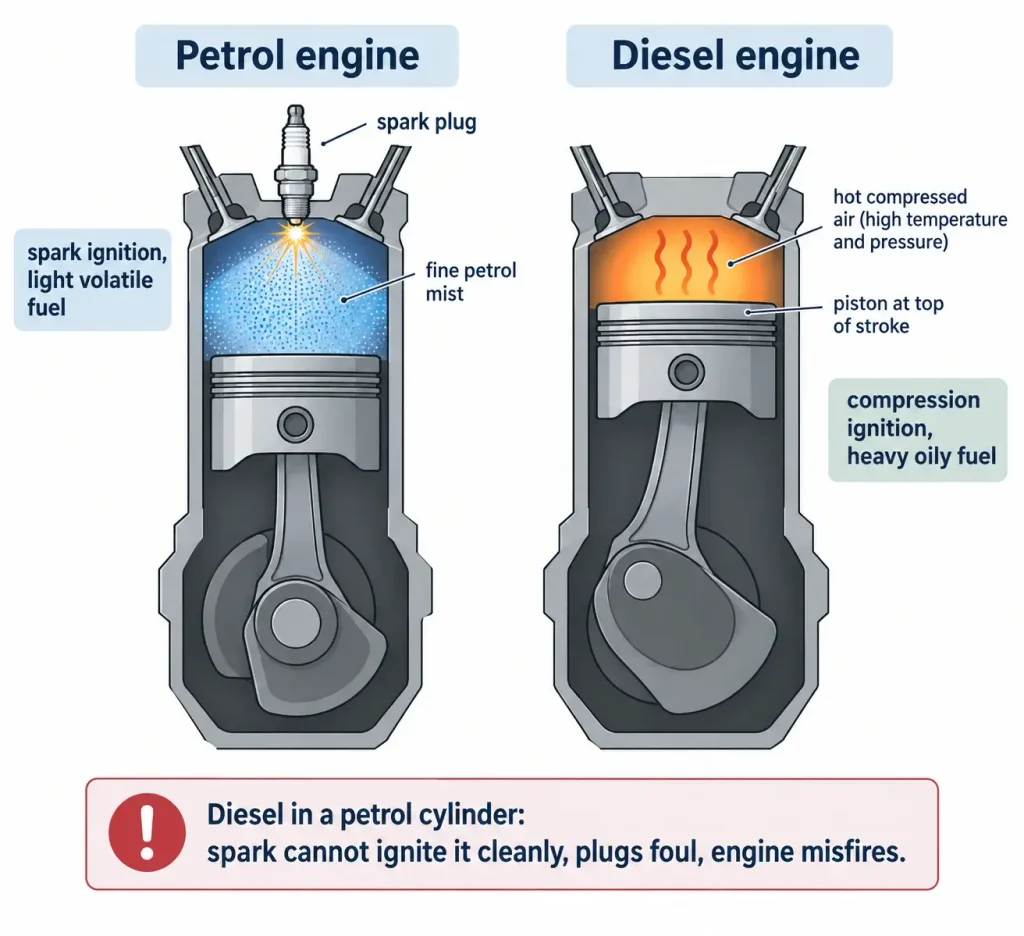
A petrol engine sprays a fine, easily vaporised mist of petrol into the cylinder and lights it with a spark plug. Diesel does not vaporise like that. It is heavier, oilier and far less volatile, which is exactly why a diesel engine ignites it with compression and heat instead of a spark. Put diesel in front of a spark plug and, for the most part, nothing happens. The plug fires into a wet, oily mist that will not catch cleanly.
What you get instead is a partial burn. Some of the diesel ignites late and badly, the rest coats the spark plugs and the inside of the cylinder in a black, sooty film. The plugs foul, the engine misfires, and the unburnt diesel ends up in the exhaust as thick white or grey smoke. Keep running it and that unburnt fuel reaches the catalytic converter, which is where the expensive damage can start.
The one piece of good news is that diesel is a lubricant. Unlike petrol in a diesel car, where the petrol strips the oil film from the high-pressure pump, diesel in a petrol system does not dry anything out. The fuel pump and lines are not being ground down while you decide what to do. The RAC’s wrong fuel advice says the same: diesel in a petrol car is the less serious of the two mistakes. That only holds if the wrong fuel comes out before it has been pushed through the whole system.
What happens if you started the engine or drove off
On most diesel-in-petrol call-outs we attend, the driver noticed at the pump. The black diesel nozzle is physically larger than the green petrol one and it does not sit cleanly in a petrol filler neck, so people often get a few litres in, feel that something is wrong, and stop. Those are the simple jobs. The diesel is still in the tank, nothing has been circulated, and it is a straightforward drain, flush and refuel.
The harder jobs are the ones where the driver did not notice until the car started to play up a mile or two down the road. If that is you, this is roughly what you will have felt, in order:
- The engine started on whatever petrol was still in the lines and ran normally for a short while.
- As diesel reached the injectors, the idle turned lumpy and the car began to hesitate or judder under acceleration.
- Smoke from the exhaust, usually white or grey, sometimes with a strong diesel smell.
- Loss of power, then the engine cutting out and refusing to restart, or starting and dying again.
If you got as far as the engine stalling, expect the spark plugs to need cleaning or replacing. When we pull plugs on a petrol car that has been run on diesel they come out wet and black, and no amount of flushing fixes a fouled plug from the outside. If the car was driven for a longer period, the catalytic converter may have taken damage from unburnt fuel, and that is something a garage needs to check once the fuel system is clean. Whether either of those applies to your car depends on how much diesel went in and how far you drove, and we will tell you plainly on site rather than guess over the phone.
How much diesel is too much in a petrol car
This is the question we get asked most on the phone, usually in the form of “it was only a couple of litres, will it be alright”. The honest answer has two parts.
A very small amount of diesel, mixed into a nearly full tank of petrol, will often burn through with nothing worse than a slightly rough idle and some smoke. There is no fixed safe percentage we would put our name to, because it depends on the engine, how full the tank was and how the car is driven. Some engines tolerate a litre in forty. Others will foul the plugs on much less.
The second part is the one that matters at the pump: you very rarely know the exact mix. Fuel gauges are not precise, people misremember how much was in the tank, and the diesel sits at the bottom where the pickup is. Because the drain is quick and the plugs are not, we drain rather than gamble, and we say so on every call. If you want the longer version of this, we have covered it in our post on a small amount of diesel in a petrol car.
“What a service thank you so much was with me within half an hour and fixed my bike, really nice to talk to and reassured me . Thank you so much again for your help ” – Nicola
What a mobile diesel-in-petrol drain involves
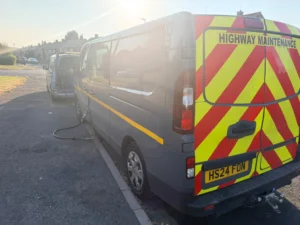
When you call, the first thing we ask is whether the engine has been started and roughly how much went in. That tells us what kit to bring and how long you will be waiting. Typical arrival is 30 to 45 minutes in our core areas, and we come to wherever the car is: forecourt, roadside, your driveway or a work car park.
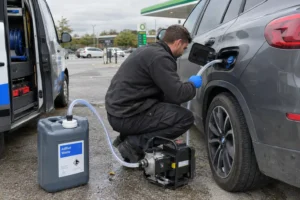
The drain itself is not complicated, which is why it does not need a garage. We connect to the tank, pump the contaminated fuel out into a sealed container for licensed disposal, then flush the lines with clean petrol so that what reaches the injectors afterwards is fuel, not a diesel-petrol mix. If the engine was run, we will look at the plugs and tell you whether they need attention. Then we put enough clean petrol in to get you to a pump and run the engine to check it starts and idles as it should. On a car that was never started, the whole thing usually takes 20 to 40 minutes.
You can read more about what is included on our diesel in petrol fuel drain service page, and if you are not sure which fuel went where, our guide to wrong fuel in car symptoms will help you work it out before you ring.
FAQ
There is no safe number we would stand behind. A litre or two in a near-full tank of petrol will often burn through with some smoke and a rough idle, but the same amount in a quarter-full tank can foul the spark plugs. Because you rarely know the true mix at the pump, and because a drain is quicker and cheaper than a set of plugs and a catalytic converter check, we recommend draining rather than driving on.
Very little, and that is the point. The diesel is sitting in the tank and has not reached the pump, lines or injectors. A mobile drain removes it, flushes the lines and refuels the car, and in most cases the engine is none the wiser. This is by far the most common version of the job we attend, and it is the easiest to put right.
Not far, and you should not try. The car will run on the petrol left in the lines, then begin to misfire and smoke as the diesel reaches the injectors, and eventually stall. Every restart pushes more diesel through the system, adds to the clean-up and raises the chance of fouled plugs. If it has started to judder, pull over, switch off and leave it.
The spark plugs are the first casualty and they can foul within minutes of running on a heavy diesel mix. Damage to the catalytic converter from unburnt fuel is a slower process and depends on how far the car was driven. The internal parts of the engine itself are usually unaffected by a short run, because diesel lubricates rather than strips. How much of this applies to your car depends on the mix and the distance, which is why we look at the plugs on any car that was driven.
A lumpy idle, hesitation or juddering when you accelerate, white or grey exhaust smoke with a diesel smell, a noticeable loss of power, and finally the engine cutting out and refusing to restart. If the car has not been started yet you will see none of these, and that is the situation to aim for.
Speak to us now
If you are reading this at the pump or on the hard shoulder, you have already done the hard part by not driving on. Call Fuel Doctor 247 on 0333 577 5158 or 0755 456 6460. The line is answered 24 hours a day, we will ask two quick questions about what went in and whether the engine ran, and a technician will be with you in roughly 30 to 45 minutes across our coverage area. The drain and flush typically take 20 to 40 minutes and you drive away the same hour. No tow, no garage booking, and we tell you exactly what we found before we leave.