
You fill up, you drive normally, and somehow the gauge is dropping faster than it should. With pump prices what they are across Greater Manchester, that stings. The good news is that most wasted fuel comes down to a short list of habits and small faults, and nearly all of them are fixable this week without spending anything.
We drain and recover fuel from cars for a living, so we spend our days around tanks, pumps and fuel systems. Here is what actually wastes fuel, how can you avoid wasting fuel day to day, and the one pump mistake that can cost you a full tank in thirty seconds.
What’s Most Likely to Waste Fuel?
If you sat the UK theory test, you may remember this one. The DVSA’s answer to “how can you avoid wasting fuel” is regular servicing, and they are right. A tired engine with a clogged air filter, old spark plugs or degraded oil has to work harder for the same speed, and every extra bit of work is paid for at the pump.
Behind servicing, the biggest offenders we see are:
- Harsh acceleration and late braking, which can add 15 to 20 percent to consumption in town driving
- Idling at school gates, level crossings and drive-thrus
- Underinflated tyres, which increase rolling resistance
- Roof racks and boxes left on when empty, ruining the car’s aerodynamics
- Carrying dead weight in the boot for weeks on end
None of these feels dramatic on its own. Stacked together across a month of driving around Manchester traffic, they are the difference between filling up weekly and filling up every ten days.
Driving Tips to Save Fuel That Cost Nothing
The cheapest fuel is the fuel you never burn. These driving tips to save fuel need no tools and no garage visit.
Read the road further ahead. If the lights are red two hundred metres away, lift off early and let the car slow in gear. Modern engines cut fuel delivery completely on the overrun, so coasting toward a red light in gear uses no fuel at all, while braking hard at the last second throws away the energy you already paid for.
Keep the revs down. Shift up early, stay in the highest gear that pulls comfortably, and hold a steady speed rather than surging and lifting. Cruise control on the motorway helps with this.
Switch off rather than idle. The Highway Code tells drivers not to leave the engine running unnecessarily while stationary, and an idling engine does zero miles per gallon. If you will be stopped for more than a minute or so, turn the key.
Use air conditioning with a bit of thought. Around town, open windows are cheaper. At motorway speed, open windows create enough drag that the air con becomes the better option.
Simple Maintenance That Protects Your MPG
Check your tyre pressures once a month, cold, against the sticker in the door shut. A tyre that is 10 psi down drags noticeably, and most drivers cannot feel it from the seat.
Stick to the service schedule. A fresh air filter, the correct grade of oil and healthy plugs or glow plugs let the engine breathe and burn properly. We regularly work on cars where a long-overdue service would have paid for itself in fuel alone.
Empty the boot and take the roof box off between trips. An extra 50 kg of clutter and an empty roof bar setup both cost you money on every single journey, whether you notice or not.
How to Avoid Fuel Spillage at the Pump
Wasted fuel is not only burned fuel. We see plenty of it lost on the forecourt floor.
To avoid fuel spillage, stop at the first click of the nozzle. Forcing extra fuel in after the automatic cutoff fills the filler neck and the vapour space the tank needs for expansion. On a warm day, that overfilled fuel expands, finds the breather, and ends up down your paintwork and on the ground. It also risks flooding the evaporative emissions system, which can mean a garage bill far bigger than the splash of petrol you squeezed in.
Set the car on level ground where you can, keep the nozzle fully seated in the filler neck until you have finished, and give it a second in the neck before withdrawing it. Rushing this last step is where most small spills happen.
Great service and reasonable price,told me technician will come between 45 – 60 minutes,technician came before 45 minutes.Will definitely recommend. ” Judith Munthali “
Misfuelling: The Quickest Way to Waste a Full Tank
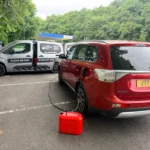
Rushing at the pump causes something worse than spillage. Grab the wrong nozzle and you can waste 60 litres and risk the engine in one go. We attend these call-outs every week across Greater Manchester, and one pattern comes up again and again: on most petrol-in-diesel jobs, the driver noticed at the pump and never turned the key. That single decision keeps the wrong fuel sitting in the tank, and the fix stays simple.
The reason is what petrol does inside a diesel system. Diesel lubricates the high-pressure fuel pump as it passes through. Petrol acts as a solvent, stripping that lubricating film so the pump’s finely machined parts run metal on metal. Start the engine and you also pull the contaminated mix through the filter, the pump and the injectors, spreading the problem through every expensive component in the fuel system. The same logic applies to diesel in a petrol car, and AdBlue poured into a diesel tank is worse still, because it crystallises in the lines and corrodes metal components if it is not removed quickly. See our guide to AdBlue in a fuel tank for that one.
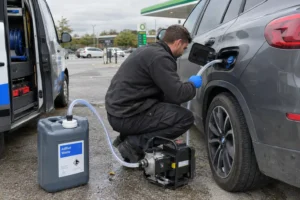
If it happens to you, do not start the engine, even to move off the pump. Tell the forecourt staff, push the car aside with their help, and call a mobile petrol in diesel fuel drain. Whether any damage has been done depends on your car, the mix in the tank and how far it was driven, so we will always be straight with you about that on the phone.
So pleased we could help quickly! Misfuelling can feel like a nightmare, but that’s why our mobile fuel drain team in Greater Manchester is on call around the clock. Getting it sorted within an hour of your enquiry is exactly the standard we hold ourselves to. Thanks for trusting Fuel Doctor 247 — we really appreciate it! ” John Fitton “
Quick Answers on Wasting Fuel
What’s most likely to waste fuel?
Day to day, aggressive driving wastes the most: hard acceleration, high revs and late braking. Over the longer term, a poorly maintained engine quietly costs you more, which is why the theory test answer is regular servicing. Fix the driving style first, since it is free, then keep the car serviced to hold onto the gains.
How can u avoid wasting fuel on short journeys?
Combine errands into one trip where you can. A cold engine runs a richer fuel mixture and the catalytic converter is not yet at working temperature, so the first mile or two is always the thirstiest. Three separate cold starts in a day use far more fuel than one longer loop covering the same jobs.
Does leaving the engine idling really waste much fuel?
Yes. A typical car burns roughly half a litre to a litre per hour at idle while covering no distance at all. Ten minutes of idling a day adds up to litres of fuel a month for nothing. If you expect to be stationary for more than a minute, switching off and restarting uses less.
What should I do if I put the wrong fuel in my car?
Do not turn the key. Leave the car where it is, let the forecourt staff know, and call a mobile fuel drain service. If the engine has not run, the wrong fuel is still sitting in the tank and can usually be drained and flushed at the pump in 20 to 40 minutes, with no tow and no garage booking.
Wrong Fuel In? Call Us Before You Start the Engine
If you are reading this at a pump with the wrong fuel in your tank, the next step is one phone call. Misfuel Doctor answers 24/7, a technician typically reaches you in 30 to 45 minutes anywhere in our Greater Manchester coverage area, and a standard drain and flush takes 20 to 40 minutes at the roadside. Most drivers are back behind the wheel within the hour. Call Misfuel Doctor now on 07826 035386.
About the author
Raees Ahmad is a mobile EV charging and wrong fuel recovery technician at Fuel-doctor247, helping drivers across Greater Manchester, Lancashire and Yorkshire] with 10+ years of roadside experience. He and the team attend EV charging, roadside and forecourt call-outs 24/7 and have got 1,000+ UK drivers moving again.